Homophones worksheet for Year 3: Sound-alike words
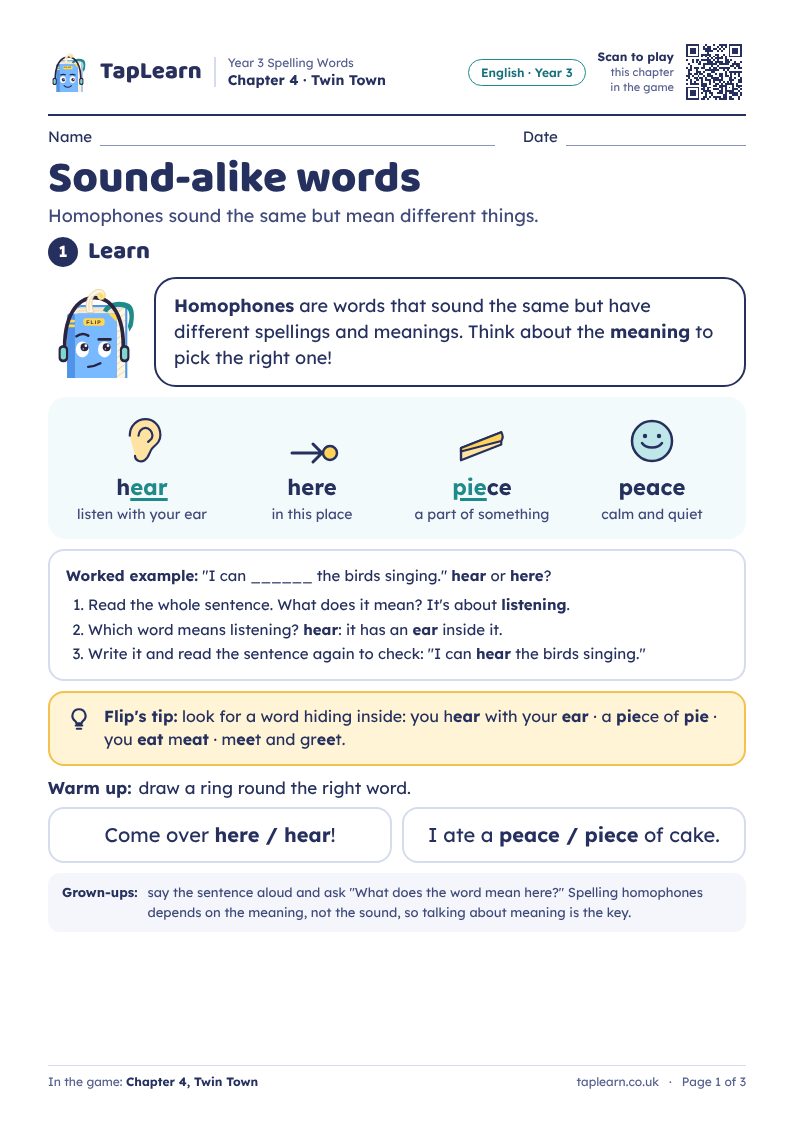
Sound-alike Words is a printable homophones worksheet for Year 3 (ages 7 to 8) that teaches children to choose between words that sound the same, like hear and here, by thinking about meaning and spotting a word hiding inside. On the sheet, children match homophones to meanings, pick the right word in sentences and write the missing partner.
This worksheet is for members
Membership opens every chapter of every game and every worksheet, for all your children.
See the plansAlready a member? Log in to print it.
Start with the free one: Sneaky sound spellings (chapter 1).
Print it on A4, in colour or black and white. Do it after the chapter, or before it to see what your child already knows.
What's on the worksheet
Your child chooses the right homophone by thinking about its meaning: hear or here, piece or peace, meet or meat, and more. Includes picture trick cards to make together and an answers sheet.
- Page 1 · Learn
- What homophones are, hear and here, piece and peace with meanings, a worked example choosing hear, Flip's hidden-word tip, and a warm-up.
- Page 2 · Try it together
- Picture trick cards: choose a pair like hear/here or plane/plain, write each word big on a card, draw a picture in or around it to show its meaning, then make up sentences.
- Page 3 · Practise
- Match words like meet, meat, plane and knot to meanings, ring the right word in sentences, write the missing homophone, write a sentence with hear and here, and a challenge.
- Answers sheet
- Every answer, mix-ups like here for hear, and which-one and homophone-spotting ideas.
3 A4 pages and an answers sheet · about 20 minutes
In the classroom
- Make a class display of picture trick cards for common homophones.
- Use Practise B as a mini-whiteboard check.
Questions from the worksheet
- Draw a line to match each word to its meaning: meet, meat, plane, plain, knot.
- Draw a ring round the right word in each sentence: Dad pressed the brake / break to stop the car. Leo missed / mist the bus this morning.
- Write the missing homophone: main, berry, male, fair, scene.
- Ava wrote: "I can here the music." Is she right? Which word should she use, and how can she remember it?
The answers are on the answers sheet, for grown-ups.
Using it at home
- Say the sentence aloud and ask, "What does the word mean here?" Homophones depend on meaning, not sound.
- Keep the picture trick cards on the fridge and test each other at mealtimes for a few days.
- Say a sentence like "Pass me a ___ of toast" and your child spells the right homophone aloud.
Watch out for
- Swapping homophones, like here for hear or peace for piece.
- Read the whole sentence first and ask, "What does the word need to mean?"
- Missing the silent letter in knot or knew.
- The k is silent, and not and knot are a homophone pair.
Questions and answers
What is a homophone?
A homophone is a word that sounds the same as another word but has a different spelling and meaning, like hear and here.
How can children remember hear and here?
You hear with your ear, and hear has ear inside it. Here means in this place, like there and where.
How can children remember piece and peace?
Think of a piece of pie: piece starts with pie. Peace means calm and quiet.
 TapLearn