Singular and plural worksheet for Year 1: One or more
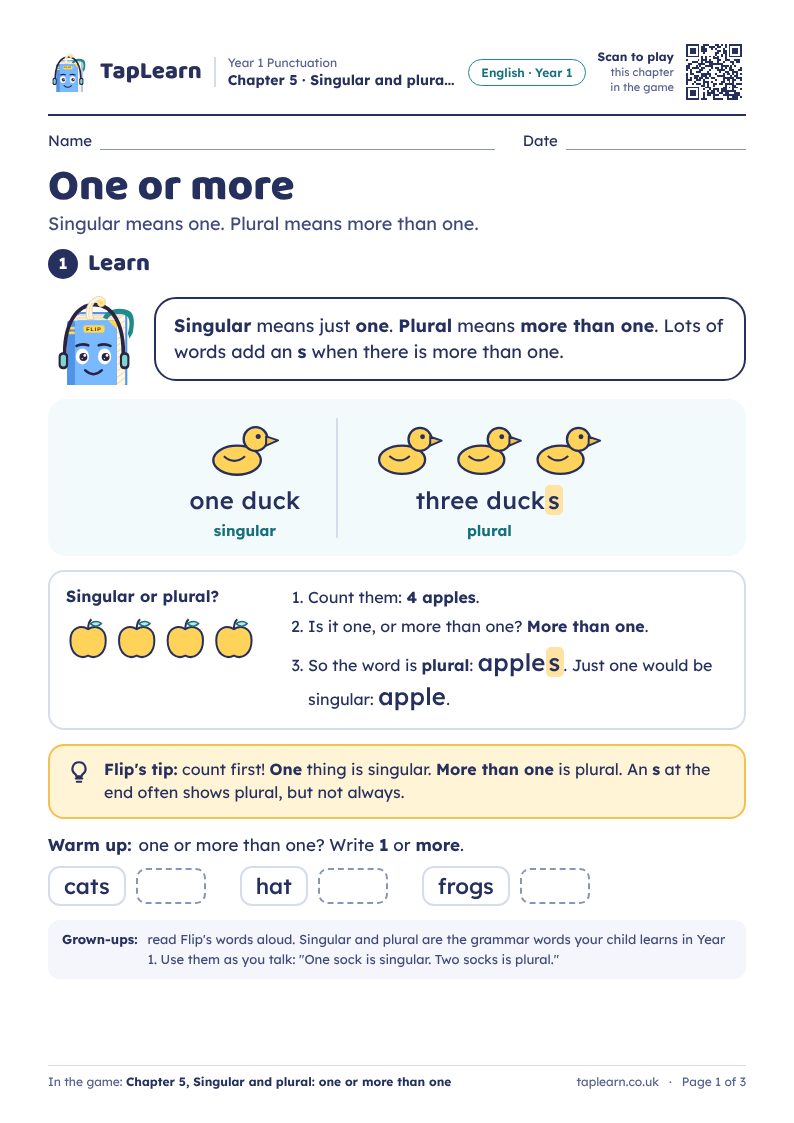
One or More is a printable singular and plural worksheet for Year 1 (ages 5 to 6) that teaches children to count first: one thing is singular, more than one is plural, and many plurals add an s. It covers the Year 1 grammar terminology singular and plural.
This worksheet is for members
Membership opens every chapter of every game and every worksheet, for all your children.
See the plansAlready a member? Log in to print it.
Start with the free one: Letters, words and spaces (chapter 1).
Print it on A4, in colour or black and white. Do it after the chapter, or before it to see what your child already knows.
What's on the worksheet
Your child learns that singular means one and plural means more than one, and tells which is which from pictures and words. Includes a sort-it-out activity with things from home and an answers sheet.
- Page 1 · Learn
- One duck and three ducks labelled singular and plural, a worked example counting apples, Flip's tip to count first, and a one-or-more warm-up.
- Page 2 · Try it together
- Sort it out: label two papers singular and plural, the grown-up makes little groups of spoons, socks or toys, and the child puts each on the right paper and says it.
- Page 3 · Practise
- Ring the right word for counted pictures, write S or P, draw one apple and three balls, ring the right word to finish sentences, and a challenge about bus.
- Answers sheet
- Every answer, mix-ups like only looking for an s, and singular-or-plural and make-it-more ideas.
3 A4 pages and an answers sheet · about 20 minutes
Using it at home
- Use the grammar words as you talk: "One sock is singular. Two socks is plural."
- In sort it out, if your child puts a single thing on the plural paper, count it together: "Is it one, or more than one?"
- Say "one cat" and your child says "two cats".
Watch out for
- Mixing up singular and plural.
- Link them to meaning every time: "Singular, just one. Plural, more than one."
- Only looking for an s.
- Words like bus and dress end in s but are singular. Always ask, "How many are there?"
- Leaving the s off after a number, like "two frog".
- Say both aloud and ask which sounds right.
Questions from the worksheet
- Write S for singular or P for plural: cats, dog, hats, cup, bees, sun.
- Draw it! 1 apple (singular). 3 balls (plural).
- Draw a ring round the right word: I have one hat / hats. I can see two frog / frogs. Mia has four pen / pens.
- Leo says, "bus is plural, because it ends with an s." Is he right? Draw one bus to help you think.
The answers are on the answers sheet, for grown-ups.
National curriculum in England
This worksheet practises these statements from the Year 1 english programme of study:
- Terminology: letter, capital letter, word, singular, plural, sentence, punctuation, full stop, question mark, exclamation mark
- Use the grammatical terminology in English appendix 2 in discussing their writing
In the classroom
- Play singular or plural?: say "one car" or "lots of cars" and pupils show one finger or wiggle all ten.
- Run sort it out as a group activity with classroom objects.
Questions and answers
What do singular and plural mean?
Singular means one. Plural means more than one: one duck is singular, three ducks is plural.
How do you make a word plural?
Lots of words add an s when there is more than one, like hat and hats.
Is every word ending in s plural?
No. Bus and dress end in s but are singular. Count how many there are to check.
More worksheets from Year 1 Punctuation: A Park Adventure with Dot the Full Stop
- Chapter 1: Finger spaces worksheet: Letters, words and spaces Free
- Chapter 2: Capital letters and full stops worksheet: Start and stop Members
- Chapter 3: Question marks and exclamation marks worksheet: Which end mark? Members
- Chapter 4: Capital letters for names worksheet: Capitals for names Members
- Chapter 6: Grammar words worksheet: Check my writing Members
 TapLearn