Capital letters for names worksheet for Year 1: Capitals for names
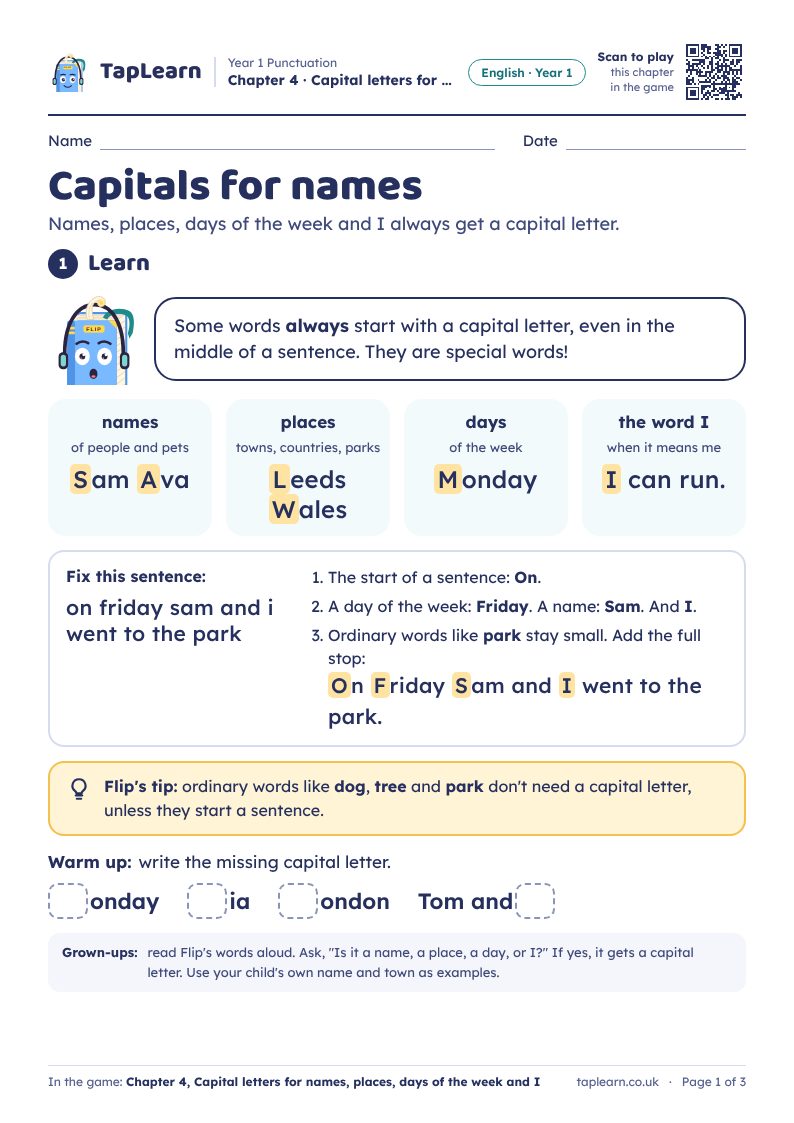
Capitals for Names is a printable capital letters for names worksheet for Year 1 (ages 5 to 6) that teaches children that names, places, days of the week and I always start with a capital letter, but ordinary words like dog and park don't. It covers the Year 1 statement on using a capital letter for names of people, places, the days of the week and the pronoun I.
This worksheet is for members
Membership opens every chapter of every game and every worksheet, for all your children.
See the plansAlready a member? Log in to print it.
Start with the free one: Letters, words and spaces (chapter 1).
Print it on A4, in colour or black and white. Do it after the chapter, or before it to see what your child already knows.
What's on the worksheet
Your child uses capital letters for names of people and places, the days of the week and the word I, but not for ordinary words. Includes a capital letter hunt and an answers sheet.
- Page 1 · Learn
- Names, places, days and the word I with their capital letters, a worked example fixing "on friday sam and i went to the park", Flip's tip on ordinary words, and a warm-up.
- Page 2 · Try it together
- Capital letter hunt: look in a book or on a calendar for capital letters in the middle of sentences, and sort each into name, place, day or I.
- Page 3 · Practise
- Ring the words that need a capital letter, sort names, places and days, fix the capital letters in three sentences, and a challenge about "My Dog likes the Park".
- Answers sheet
- Every answer, mix-ups like a small i, and name-or-not and days-chant ideas.
3 A4 pages and an answers sheet · about 20 minutes
Using it at home
- Ask, "Is it a name, a place, a day, or I?" If yes, it gets a capital letter. Use your child's own name and town as examples.
- In the hunt, capital letters at the start of a sentence don't count. On a walk, street and town signs work too.
- Say the days of the week together and draw a big capital letter in the air for each one.
Watch out for
- Writing a small i for "I".
- Say, "When I means me, it's always a capital, wherever it is in the sentence."
- Using small letters for names and days, like sam or monday.
- Ask, "Is this the name of someone, somewhere or a day?"
- Putting capitals on ordinary words, like Dog or Park.
- Ask, "Is it the name of one special person or place?" A dog is any dog; Max is one dog's name.
Questions from the worksheet
- Draw a ring round the words that need a capital letter: sam, dog, monday, park, london, i, cat, friday.
- Sort the words into names, places and days: Leo, Tuesday, York, Zoe, Wales, Sunday.
- Fix the capital letters. Write the sentence again: on tuesday i saw tom.
- Leo wrote: My Dog likes the Park. Is he right? Which capital letters should be small?
The answers are on the answers sheet, for grown-ups.
National curriculum in England
This worksheet practises these statements from the Year 1 english programme of study:
- Punctuation: separation of words with spaces; introduction to capital letters, full stops, question marks and exclamation marks to demarcate sentences; capital letters for names and for the personal pronoun I
- Develop their understanding of the concepts set out in English appendix 2 by: using a capital letter for names of people, places, the days of the week, and the personal pronoun 'I'
In the classroom
- Play name or not?: pupils stand tall for a name, place or day and crouch for an ordinary word.
- Use the class register and a calendar to collect names and days that need capitals.
Questions and answers
Which words need a capital letter in Year 1?
Names of people and pets, places, the days of the week and the word I always need a capital letter, as well as the start of a sentence.
Why is I always a capital letter?
When I means me, it is always written as a capital letter, wherever it comes in the sentence.
Do words like dog and park need a capital?
No. Ordinary words like dog, tree and park stay small unless they start a sentence or are part of a name, like Oak Park.
More worksheets from Year 1 Punctuation: A Park Adventure with Dot the Full Stop
- Chapter 1: Finger spaces worksheet: Letters, words and spaces Free
- Chapter 2: Capital letters and full stops worksheet: Start and stop Members
- Chapter 3: Question marks and exclamation marks worksheet: Which end mark? Members
- Chapter 5: Singular and plural worksheet: One or more Members
- Chapter 6: Grammar words worksheet: Check my writing Members
 TapLearn