Question marks and exclamation marks worksheet for Year 1: Which end mark?
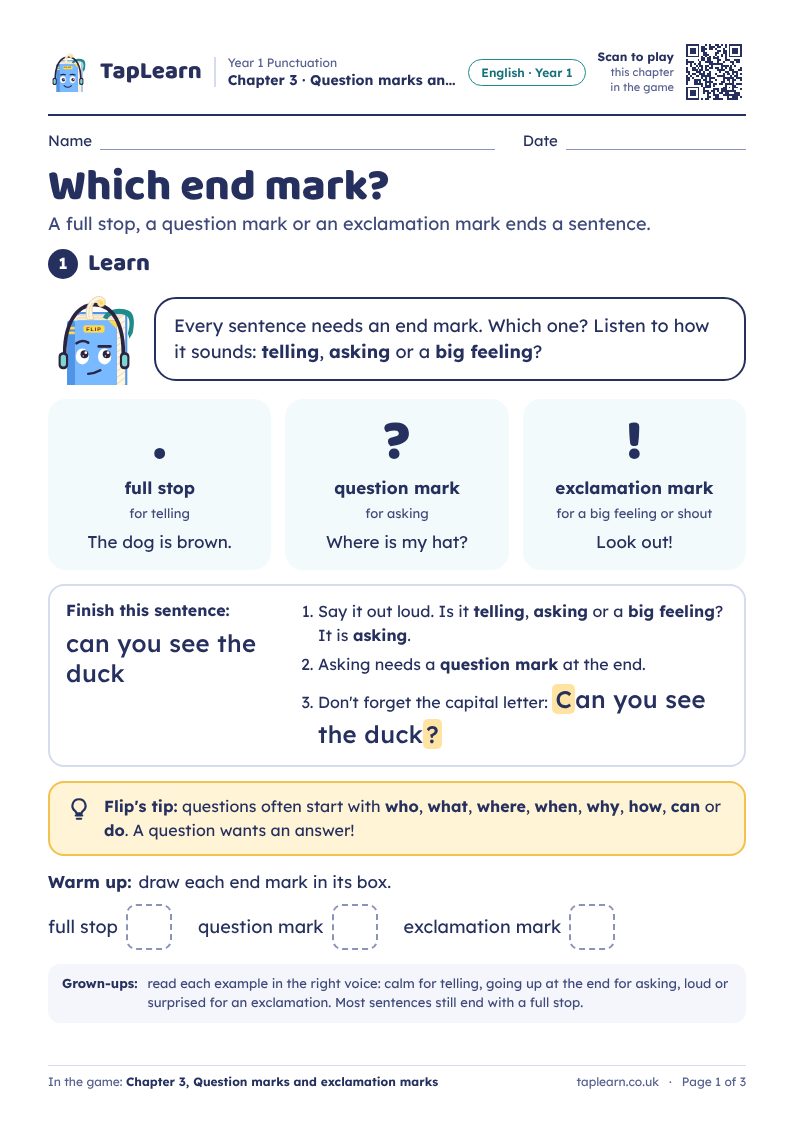
Which End Mark? is a printable question marks and exclamation marks worksheet for Year 1 (ages 5 to 6) that teaches children to listen to a sentence: telling takes a full stop, asking a question mark and a big feeling an exclamation mark. It covers the Year 1 statement on punctuating sentences with a capital letter and a full stop, question mark or exclamation mark.
This worksheet is for members
Membership opens every chapter of every game and every worksheet, for all your children.
See the plansAlready a member? Log in to print it.
Start with the free one: Letters, words and spaces (chapter 1).
Print it on A4, in colour or black and white. Do it after the chapter, or before it to see what your child already knows.
What's on the worksheet
Your child chooses a full stop for telling, a question mark for asking and an exclamation mark for a big feeling or shout. Includes a three voices game and an answers sheet.
- Page 1 · Learn
- The three end marks with examples, a worked example finishing "can you see the duck", Flip's tip on question words, and a draw-each-mark warm-up.
- Page 2 · Try it together
- Three voices: draw a full stop, question mark and exclamation mark on paper, then take turns saying a sentence in a telling, asking or excited voice while the other points to its mark.
- Page 3 · Practise
- Ring the right end mark, finish six sentences with the right mark, write a question for Flip and an exciting sentence, and a challenge about exclamation marks everywhere.
- Answers sheet
- Every answer, mix-ups like a question mark on a telling sentence, and mark-detective and twenty-questions ideas.
3 A4 pages and an answers sheet · about 20 minutes
Using it at home
- Read each example in the right voice: calm for telling, going up at the end for asking, loud or surprised for an exclamation.
- A question can be said in a quiet voice and it still needs a question mark.
- When reading a story, stop at each end mark and ask, "Is that telling, asking or a big feeling?"
Watch out for
- Putting a full stop at the end of a question.
- Ask, "Does it want an answer?" If yes, it needs a question mark.
- Putting a question mark on a telling sentence.
- Read it aloud: is it asking anything?
- Using exclamation marks everywhere.
- If everything is shouted, nothing stands out. Most sentences are telling sentences.
Questions from the worksheet
- Draw a ring round the right end mark: Where is the cat. I have a red hat. Help, I'm stuck. What is your name.
- Finish each sentence. Write . or ? or ! in the box: Do you like apples. Watch out, a wasp. My bag is blue.
- Write your own sentences. Ask Flip a question. Then write about something exciting that happened at the park.
- Mia wrote: I am eating my lunch! She says every sentence should have an exclamation mark. Is she right? Which mark would you use?
The answers are on the answers sheet, for grown-ups.
National curriculum in England
This worksheet practises these statements from the Year 1 english programme of study:
- Punctuation: separation of words with spaces; introduction to capital letters, full stops, question marks and exclamation marks to demarcate sentences; capital letters for names and for the personal pronoun I
- Terminology: letter, capital letter, word, singular, plural, sentence, punctuation, full stop, question mark, exclamation mark
- Develop their understanding of the concepts set out in English appendix 2 by: beginning to punctuate sentences using a capital letter and a full stop, question mark or exclamation mark
In the classroom
- Play three voices as a class: say sentences and pupils hold up the matching end mark card.
- Play twenty questions, writing each question on the board with its question mark.
Questions and answers
When do you use a question mark?
Use a question mark at the end of a sentence that asks something. Questions often start with who, what, where, when, why, how, can or do.
When do you use an exclamation mark?
Use an exclamation mark for a big feeling, a shout or a surprise, like "Look out!" Most sentences still end with a full stop.
Can a sentence end with a full stop or an exclamation mark?
Sometimes both work. "It's raining." and "It's raining!" are both fine: it depends how you feel.
More worksheets from Year 1 Punctuation: A Park Adventure with Dot the Full Stop
- Chapter 1: Finger spaces worksheet: Letters, words and spaces Free
- Chapter 2: Capital letters and full stops worksheet: Start and stop Members
- Chapter 4: Capital letters for names worksheet: Capitals for names Members
- Chapter 5: Singular and plural worksheet: One or more Members
- Chapter 6: Grammar words worksheet: Check my writing Members
 TapLearn