Capital letters and full stops worksheet for Year 1: Start and stop
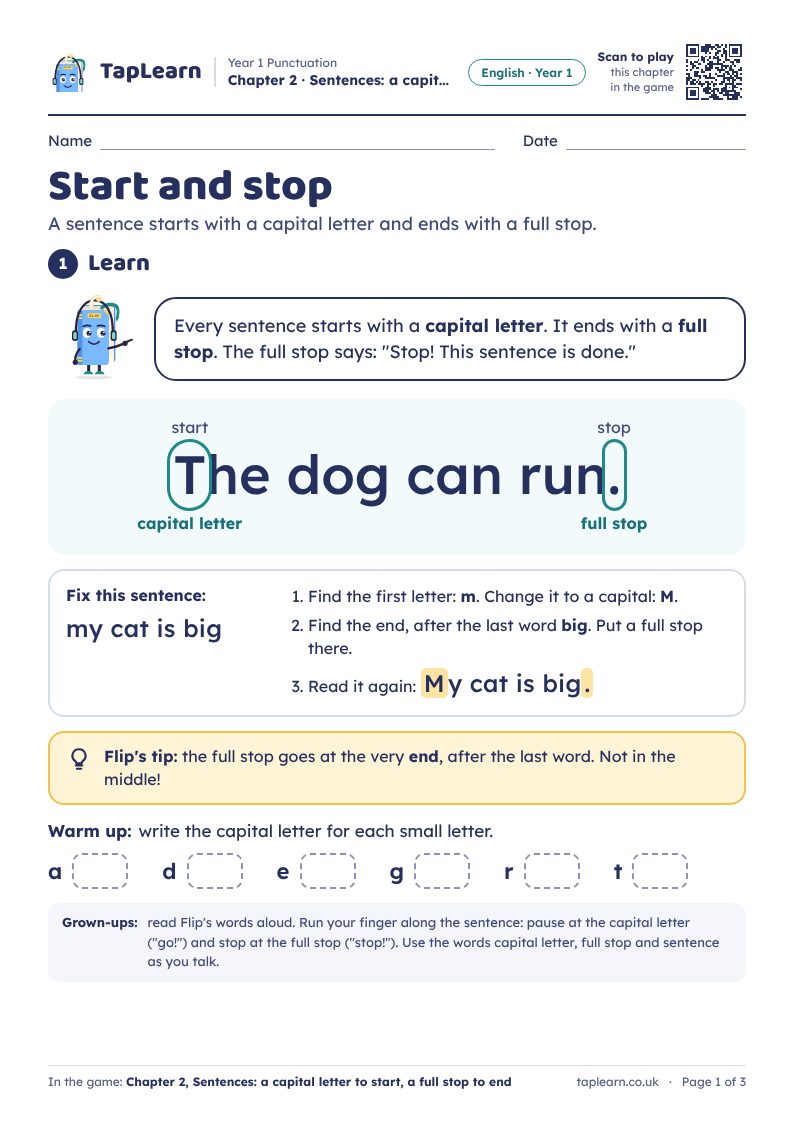
Start and Stop is a printable capital letters and full stops worksheet for Year 1 (ages 5 to 6) that teaches children that every sentence starts with a capital letter and ends with a full stop after the last word. It covers the Year 1 statement on beginning to punctuate sentences using a capital letter and a full stop.
This worksheet is for members
Membership opens every chapter of every game and every worksheet, for all your children.
See the plansAlready a member? Log in to print it.
Start with the free one: Letters, words and spaces (chapter 1).
Print it on A4, in colour or black and white. Do it after the chapter, or before it to see what your child already knows.
What's on the worksheet
Your child starts each sentence with a capital letter, ends it with a full stop, and uses the words capital letter, full stop and sentence. Includes a be-the-teacher activity and an answers sheet.
- Page 1 · Learn
- A sentence with its capital letter and full stop labelled, a worked example fixing "my cat is big", Flip's tip on where the full stop goes, and a write-the-capital warm-up.
- Page 2 · Try it together
- Be the teacher: the grown-up writes three sentences about your day with no capitals or full stops, and the child adds them in colour, then writes their own sentence.
- Page 3 · Practise
- Tick or cross six sentences, add a capital letter and full stop, put the full stop in the right box, label a capital letter, full stop and word, and a challenge.
- Answers sheet
- Every answer, mix-ups like a full stop in the middle, and robot-reading and name-it ideas.
3 A4 pages and an answers sheet · about 20 minutes
Using it at home
- Run your finger along a sentence: pause at the capital letter ("go!") and stop at the full stop ("stop!").
- If your child isn't sure where a sentence ends, read it aloud and ask, "Does that make sense on its own? Is it finished?"
- Read a page in a robot voice and freeze at every full stop while your child says "Stop!"
Watch out for
- Forgetting the capital letter.
- Ask, "How does a sentence start?" before they write.
- Forgetting the full stop.
- Read the sentence back together. When your voice stops, the full stop goes there.
- Putting a full stop in the middle, like "I like. the slide".
- Read it aloud: "I like" doesn't make sense on its own, so it isn't finished yet.
Questions from the worksheet
- Is the sentence right? Tick the right ones. Cross the wrong ones: The sun is hot. the duck can swim. A bird sat on a tree. Mum has. a cup
- Add a capital letter and a full stop. Write the sentence again: we went to the park. the ball is red.
- Where does the full stop go? The bee is on the flower
- Leo wrote: the duck is wet. He says, "I put a full stop, so it's right!" Is he right? What does he need to fix?
The answers are on the answers sheet, for grown-ups.
National curriculum in England
This worksheet practises these statements from the Year 1 english programme of study:
- Punctuation: separation of words with spaces; introduction to capital letters, full stops, question marks and exclamation marks to demarcate sentences; capital letters for names and for the personal pronoun I
- Terminology: letter, capital letter, word, singular, plural, sentence, punctuation, full stop, question mark, exclamation mark
- Develop their understanding of the concepts set out in English appendix 2 by: beginning to punctuate sentences using a capital letter and a full stop, question mark or exclamation mark
In the classroom
- Play be the teacher as a class: display unpunctuated sentences for pupils to fix on mini whiteboards.
- Point to marks in a big book and ask, "Is that a capital letter or a full stop?"
Questions and answers
How should a sentence start and end in Year 1?
A sentence starts with a capital letter and ends with a full stop, question mark or exclamation mark.
Where does the full stop go?
The full stop goes at the very end of the sentence, after the last word, not in the middle.
How do children know where a sentence ends?
Read it aloud. When it makes sense on its own and your voice stops, that is where the sentence ends.
More worksheets from Year 1 Punctuation: A Park Adventure with Dot the Full Stop
- Chapter 1: Finger spaces worksheet: Letters, words and spaces Free
- Chapter 3: Question marks and exclamation marks worksheet: Which end mark? Members
- Chapter 4: Capital letters for names worksheet: Capitals for names Members
- Chapter 5: Singular and plural worksheet: One or more Members
- Chapter 6: Grammar words worksheet: Check my writing Members
 TapLearn