Capital letters worksheet for Year 1
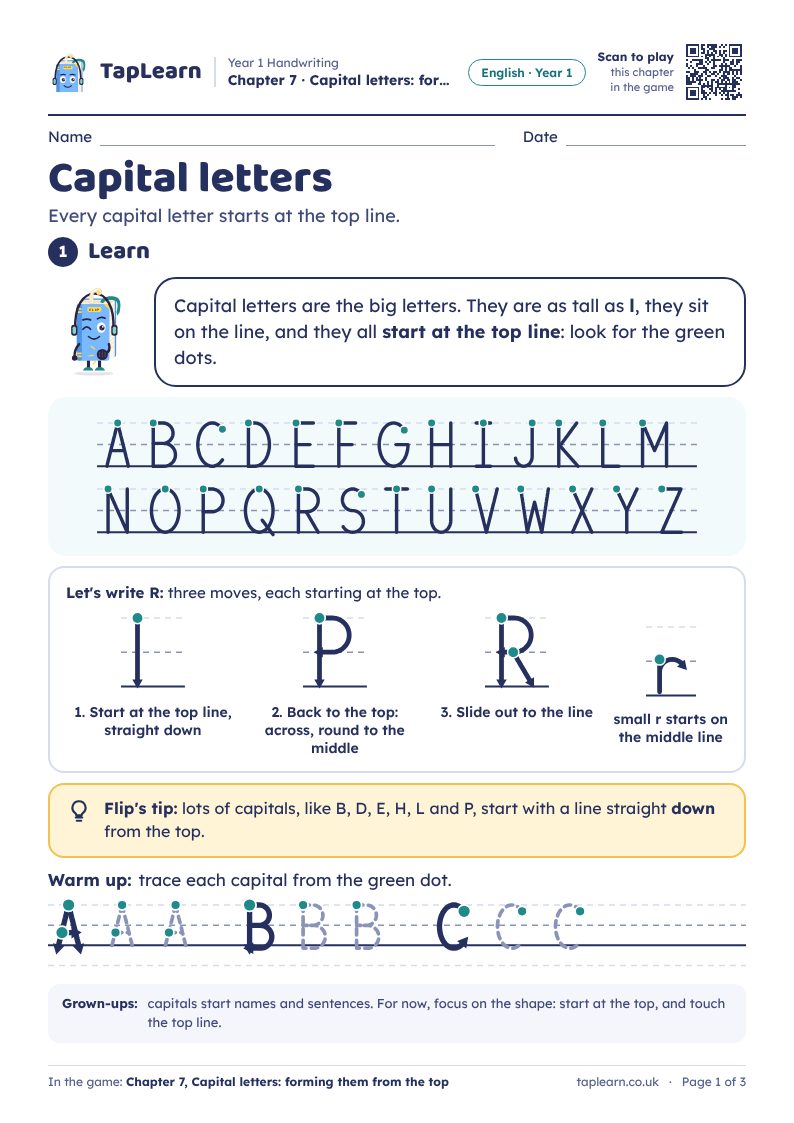
Capital Letters is a printable capital letters worksheet for Year 1 (ages 5 to 6) that teaches children that every capital is as tall as l, sits on the line and starts at the top line, like R in three moves. It covers the Year 1 handwriting statement on forming capital letters.
This worksheet is for members
Membership opens every chapter of every game and every worksheet, for all your children.
See the plansAlready a member? Log in to print it.
Start with the free one: Ready to write (chapter 1).
Print it on A4, in colour or black and white. Do it after the chapter, or before it to see what your child already knows.
What's on the worksheet
Your child practises forming capital letters from the top line, matching capitals to small letters and writing their name with a capital. Includes a capital hunt activity and an answers sheet.
- Page 1 · Learn
- What capital letters look like, a worked example writing R in three moves, Flip's tip on capitals that start with a line down, and a capital tracing warm-up.
- Page 2 · Try it together
- Capital hunt: look for capitals on food packets, a book cover, a calendar or post, trace each in the air from the top, then write it and its small letter partner.
- Page 3 · Practise
- Match capitals to small letters, ring every capital letter, trace each capital from the top line, write your name with a capital, and a challenge about writing L from the bottom.
- Answers sheet
- Every answer, mix-ups like capitals in the middle of a word, and name-spotting and big-and-small ideas.
3 A4 pages and an answers sheet · about 20 minutes
In the classroom
- Use names on the register for a name-spotting starter: which capital starts each one?
- Play big and small: say a letter, and pupils draw the capital in the air and the small letter on the table.
Questions from the worksheet
- Match each capital to its small letter. Draw a line from dot to dot.
- Draw a ring round every capital letter.
- Write your name. Start with a capital letter.
- Leo writes his capital L by starting at the bottom right, going along the line, then up. "It looks the same!" he says. Is that the right way? Where should L start?
The answers are on the answers sheet, for grown-ups.
National curriculum in England
This worksheet practises this statement from the Year 1 english programme of study:
- Form capital letters
Using it at home
- Capitals start names and sentences, but for now focus on the shape: start at the top and touch the top line.
- In the capital hunt, talk about which capitals look like their small letter (C c, O o, S s) and which look different (A a, G g, R r).
- If your child writes a capital in the middle of their name, point out that capitals go at the start.
Watch out for
- Starting at the bottom and pushing up, especially on L, E, H and M.
- Put a finger on the top line: "start here".
- Mixing capitals and small letters in a word, like mIa or sAm.
- Capitals go at the start of a name, not in the middle.
- Mixing up R and r, or G and g.
- Capitals are tall and touch the top line; r starts on the middle line.
Questions and answers
Where should capital letters start?
Every capital letter starts at the top line. Capitals are as tall as l and sit on the line.
Which capitals look like their small letters?
Some capitals look just like their small letter, such as C c, O o, S s and W w. Others look quite different, such as A a, G g and R r.
When do Year 1 children use capital letters?
Capital letters start names and sentences. On this sheet, children write their own name starting with a capital.
More worksheets from Year 1 Handwriting: Trace Letters and Digits with Poppy
- Chapter 1: Pencil grip worksheet: Ready to write Free
- Chapter 2: Letter formation worksheet: Start, go, stop Members
- Chapter 3: Curly caterpillar letters worksheet Members
- Chapter 4: Long ladder letters worksheet Members
- Chapter 5: One-armed robot letters worksheet Members
- Chapter 6: Zig-zag letters worksheet Members
- Chapter 8: Number formation worksheet: Digits 0 to 9 Members
 TapLearn