Pencil grip worksheet for Year 1: Ready to write
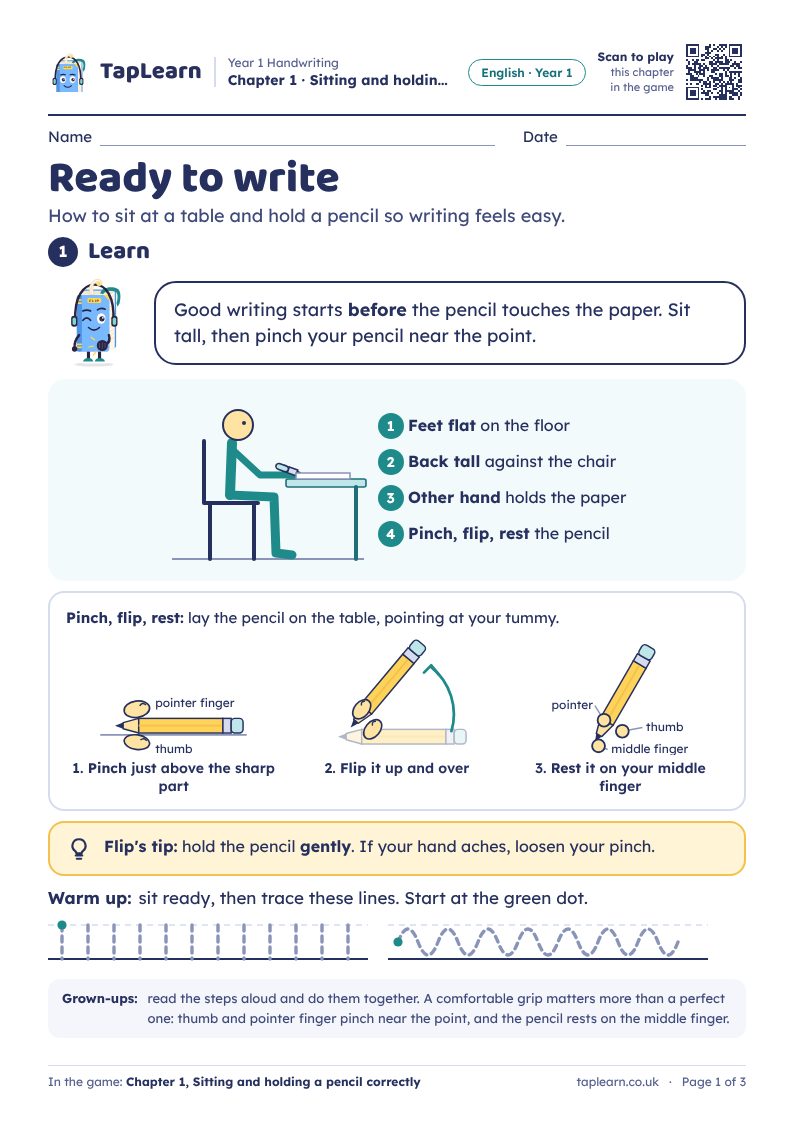
Ready to Write is a printable pencil grip worksheet for Year 1 (ages 5 to 6) that teaches children to sit with feet flat and back tall, and to pinch, flip and rest the pencil just above the sharp part. It covers the Year 1 handwriting statement on sitting correctly at a table, holding a pencil comfortably and correctly.
Free to print, no account needed.
Print it on A4, in colour or black and white. Do it after the chapter, or before it to see what your child already knows.
What's on the worksheet
Your child practises sitting tall with feet flat and holding a pencil with a comfortable pinch, flip and rest grip, then traces zig-zags, hills and loops. Includes a Ready, steady, write! game and an answers sheet.
- Page 1 · Learn
- The four steps to sitting ready, pictures of pinch, flip and rest, Flip's tip to hold the pencil gently, and a sit-ready line-tracing warm-up.
- Page 2 · Try it together
- Ready, steady, write!: pick up dry pasta with a pinch, then the grown-up calls Ready, Steady, Write while the child sits tall, pinches the pencil and draws a big wavy line. Swap and play daily.
- Page 3 · Practise
- Spot who is ready to write, tick the fingers pinching in the right place, put the four steps in order, trace zig-zags, hills and loops, and a challenge about a fist grip.
- Answers sheet
- Every answer, mix-ups like holding too far up, and peg-pinch and dough-ball ideas.
3 A4 pages and an answers sheet · about 20 minutes
Using it at home
- A comfortable grip matters more than a perfect one. If your child's feet don't reach the floor, put a box or a pile of books under them.
- Left-handed children tilt the paper the other way and hold the pencil a little further up: that's fine.
- If you see white fingertips or your child says their hand aches, the pinch is too tight: shake out and try gently.
Watch out for
- Slouching or feet dangling.
- Say "Ready, steady, write!" first. A box under the feet helps.
- Holding the pencil in a fist.
- Go back to pinch, flip, rest, and praise any try at a pinch.
- Holding the pencil too far up.
- Draw a small ring just above the sharp part as a "pinch spot".
Questions from the worksheet
- Put the steps in order. Write 1, 2, 3, 4: Pinch, flip and rest the pencil. Feet flat on the floor. Other hand holds the paper. Back tall against the chair.
- Which fingers are pinching in the right place? Tick the box.
- Sit ready. Trace each pattern from the green dot: zig-zags, hills, loops.
- Sam holds his pencil in his fist, like a spoon for stirring. He says it holds tight. Is he right? What could he try?
The answers are on the answers sheet, for grown-ups.
National curriculum in England
This worksheet practises this statement from the Year 1 english programme of study:
- Sit correctly at a table, holding a pencil comfortably and correctly
In the classroom
- Play Ready, steady, write! as a whole class before every writing task for a week.
- Set up a pinch station with pegs, pasta and play dough for fine motor practice.
Questions and answers
How should a Year 1 child hold a pencil?
Pinch the pencil just above the sharp part with the thumb and pointer finger, and rest it on the middle finger. This is often called the tripod grip.
What is pinch, flip, rest?
It is a way to pick up a pencil: lay it pointing at your tummy, pinch it near the point, flip it up and over, and rest it on your middle finger.
Why does sitting position matter for handwriting?
Feet flat, back tall and the other hand holding the paper give a steady base, so the writing hand can control small letters.
More worksheets from Year 1 Handwriting: Trace Letters and Digits with Poppy
- Chapter 2: Letter formation worksheet: Start, go, stop Members
- Chapter 3: Curly caterpillar letters worksheet Members
- Chapter 4: Long ladder letters worksheet Members
- Chapter 5: One-armed robot letters worksheet Members
- Chapter 6: Zig-zag letters worksheet Members
- Chapter 7: Capital letters worksheet Members
- Chapter 8: Number formation worksheet: Digits 0 to 9 Members
 TapLearn