One-armed robot letters worksheet for Year 1
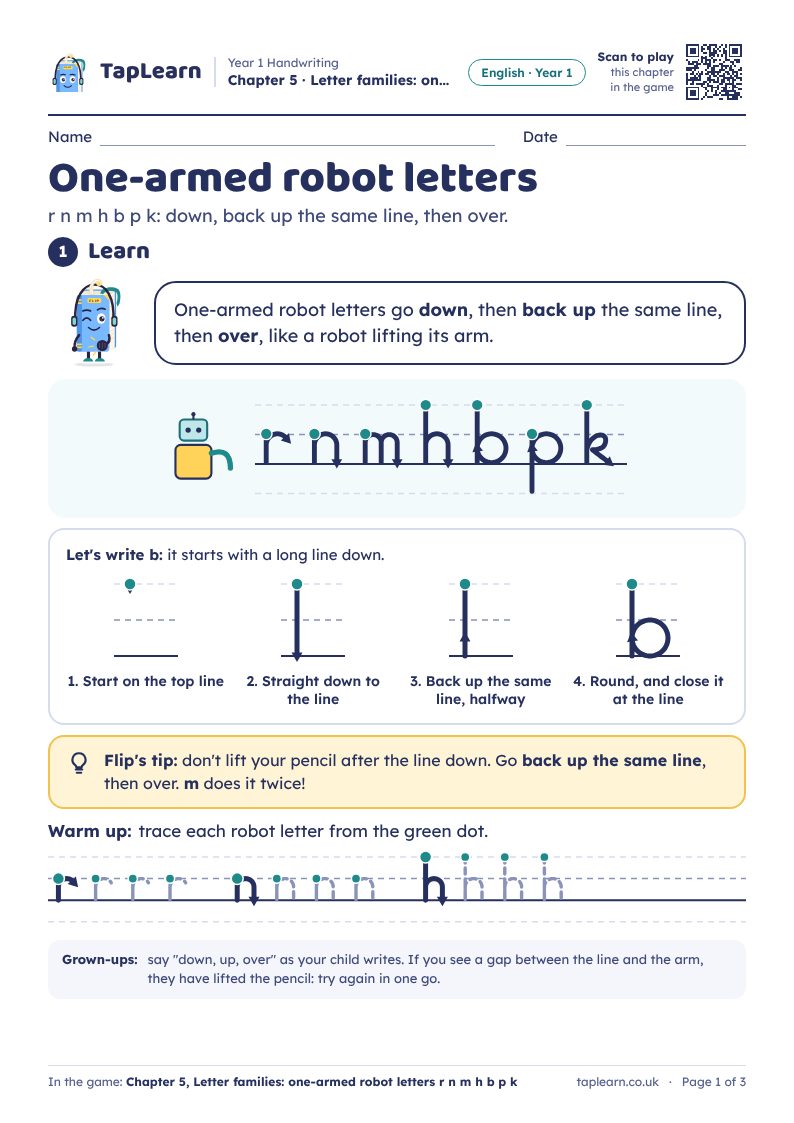
One-Armed Robot Letters is a printable one-armed robot letters worksheet for Year 1 (ages 5 to 6) that teaches children to go down, back up the same line and over for r, n, m, h, b, p and k without lifting the pencil. It covers the Year 1 handwriting statements on forming lower-case letters in the correct direction and knowing which letters belong to which handwriting families.
This worksheet is for members
Membership opens every chapter of every game and every worksheet, for all your children.
See the plansAlready a member? Log in to print it.
Start with the free one: Ready to write (chapter 1).
Print it on A4, in colour or black and white. Do it after the chapter, or before it to see what your child already knows.
What's on the worksheet
Your child practises the one-armed robot letters r n m h b p k (down, back up the same line, then over) and tells b from d. Includes a robot-moves activity and an answers sheet.
- Page 1 · Learn
- Meet the one-armed robot family, a worked example writing b, Flip's tip not to lift the pencil after the line down, and a robot letter tracing warm-up.
- Page 2 · Try it together
- Robot moves: move one arm down, back up and over while saying "down, up, over", write r, n, h and m big, then make "bed" fists to check b and d.
- Page 3 · Practise
- Ring every one-armed robot letter, write b or d to finish words, trace each letter, find robot letters in words, and a challenge about writing bog for dog.
- Answers sheet
- Every answer, mix-ups like h and n, and robot-dance and b-or-d spotting ideas.
3 A4 pages and an answers sheet · about 20 minutes
Using it at home
- Say "down, up, over" as your child writes. A gap between the line and the arm means they lifted the pencil: try again in one go.
- The "bed" fists are a handy check whenever your child is unsure about b and d: the left hand makes b and the right hand makes d.
- On a page of a book, find every b and d and ask how each one starts.
Watch out for
- Lifting the pencil after the line down, which leaves a gap.
- Say "down, up the same line, over".
- Mixing up b and d.
- d belongs to the curly family; b is a robot letter. Use the "bed" fists.
- Mixing up h and n.
- h starts on the top line (tall); n starts on the middle line.
Questions from the worksheet
- Draw a ring round every one-armed robot letter.
- b or d? Say the word for each picture. Write the missing letter: _ed, _oor, _all, _rum.
- Find the robot letters in these words. Trace them, then write one on your own.
- Leo wrote bog when he meant dog. How could he remember which way to write d?
The answers are on the answers sheet, for grown-ups.
National curriculum in England
This worksheet practises these statements from the Year 1 english programme of study:
- Begin to form lower-case letters in the correct direction, starting and finishing in the right place
- Understand which letters belong to which handwriting 'families' (ie letters that are formed in similar ways) and to practise these
In the classroom
- Do robot moves as a class warm-up, calling out a letter for pupils to act with their arm.
- Use Practise B as a quick b-or-d check with mini whiteboards.
Questions and answers
What are one-armed robot letters?
One-armed robot letters are r, n, m, h, b, p and k. They go down, back up the same line, then over, like a robot lifting its arm.
How can my child stop mixing up b and d?
Think about how each starts: b starts with a long line down, and d starts with a c shape. Making "bed" with two fists shows which way each faces.
Is b in the same letter family as d?
No. b is a one-armed robot letter and d is a curly caterpillar letter, because they start in different ways.
More worksheets from Year 1 Handwriting: Trace Letters and Digits with Poppy
- Chapter 1: Pencil grip worksheet: Ready to write Free
- Chapter 2: Letter formation worksheet: Start, go, stop Members
- Chapter 3: Curly caterpillar letters worksheet Members
- Chapter 4: Long ladder letters worksheet Members
- Chapter 6: Zig-zag letters worksheet Members
- Chapter 7: Capital letters worksheet Members
- Chapter 8: Number formation worksheet: Digits 0 to 9 Members
 TapLearn