Letter formation worksheet for Year 1: Start, go, stop
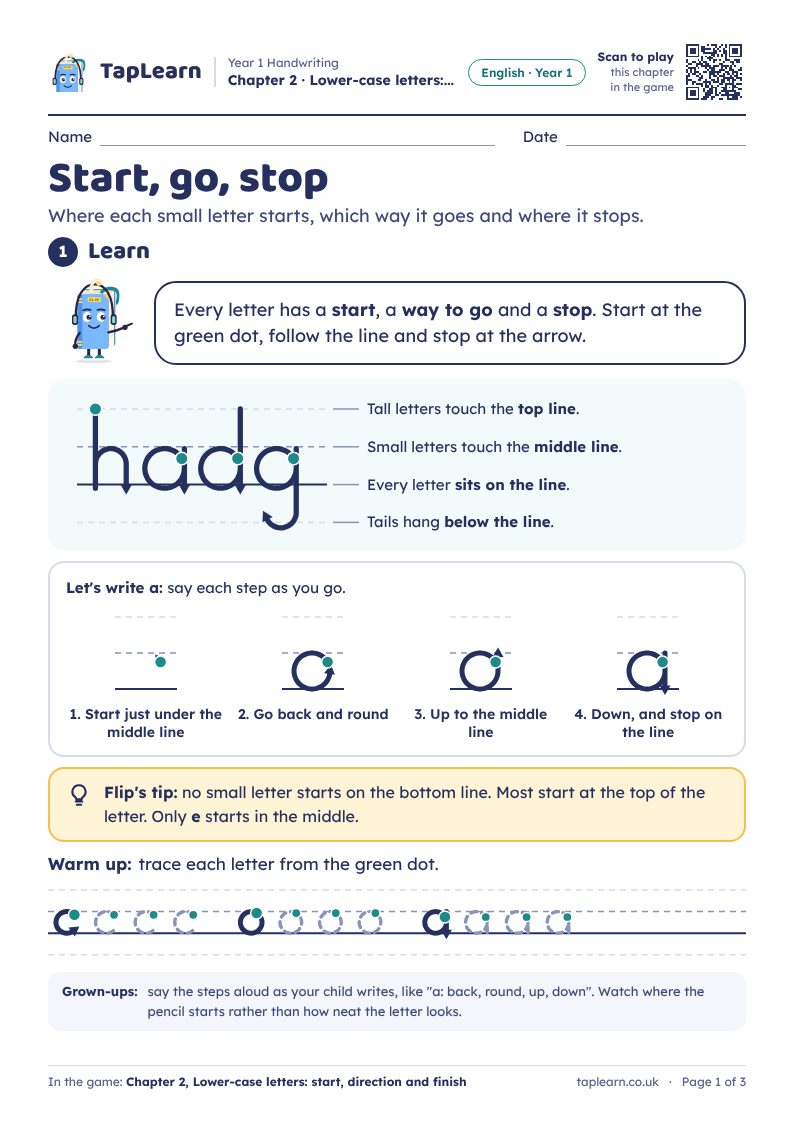
Start, Go, Stop is a printable letter formation worksheet for Year 1 (ages 5 to 6) that teaches children where each small letter starts, which way it goes and where it stops, with tall letters, small letters and tails. It covers the Year 1 handwriting statement on forming lower-case letters in the correct direction, starting and finishing in the right place.
This worksheet is for members
Membership opens every chapter of every game and every worksheet, for all your children.
See the plansAlready a member? Log in to print it.
Start with the free one: Ready to write (chapter 1).
Print it on A4, in colour or black and white. Do it after the chapter, or before it to see what your child already knows.
What's on the worksheet
Your child practises where each lower-case letter starts, which way it goes and where it stops, including b and d. Includes a tray-writing activity and an answers sheet.
- Page 1 · Learn
- Lines showing where tall letters, small letters and tails go, a worked example writing a step by step, Flip's tip that only e starts in the middle, and a tracing warm-up.
- Page 2 · Try it together
- Tray writing: write a letter big in the air, then in a tray of flour, salt or sugar with one finger, saying "start, go, stop". Try c, a, d, h, n and e.
- Page 3 · Practise
- Ring the right starting dot, tick the letter that goes the right way, trace letters from the green dot, trace the word bed, and a challenge about writing o from the bottom.
- Answers sheet
- Every answer, mix-ups like going round c, o and a the wrong way, and back-writing and teacher-for-a-day ideas.
3 A4 pages and an answers sheet · about 20 minutes
Using it at home
- Say the steps aloud as your child writes, like "a: back, round, up, down". Watch where the pencil starts rather than how neat the letter looks.
- In tray writing, if your child starts at the bottom, wipe it together and try again from the top: "Where does it start?"
- Use the word bed as a picture for b and d: b at the start, d at the end.
Watch out for
- Starting letters at the bottom.
- Ask "Where does it start?" before each letter and point to the top.
- Going round the wrong way on c, o and a.
- Trace big in the air together, saying "back and round".
- Mixing up b and d.
- b starts with a long line down; d starts with c. The word bed is a handy picture.
Questions from the worksheet
- Where does each letter start? Draw a ring round the right dot.
- Which one goes the right way? Follow the arrows, then tick the box.
- b starts with a long line down. d starts like c. Trace bed, then write it.
- Mia writes o by starting at the bottom and going round the other way. "It still looks like an o!" she says. Does it matter? Why?
The answers are on the answers sheet, for grown-ups.
National curriculum in England
This worksheet practises this statement from the Year 1 english programme of study:
- Begin to form lower-case letters in the correct direction, starting and finishing in the right place
In the classroom
- Model letters on the board and have the class sky-write them, saying start, go, stop together.
- Use Practise A as a quick check, watching starting points rather than neatness.
Questions and answers
What is letter formation?
Letter formation is how each letter is written: where it starts, which way the pencil goes and where it stops.
Where should lower-case letters start?
Most small letters start at the top of the letter, and no small letter starts on the bottom line. Only e starts in the middle.
Does it matter how a letter is formed if it looks right?
Yes. Letters started in the right place are quicker and smoother, and they are easier to join up later on.
More worksheets from Year 1 Handwriting: Trace Letters and Digits with Poppy
- Chapter 1: Pencil grip worksheet: Ready to write Free
- Chapter 3: Curly caterpillar letters worksheet Members
- Chapter 4: Long ladder letters worksheet Members
- Chapter 5: One-armed robot letters worksheet Members
- Chapter 6: Zig-zag letters worksheet Members
- Chapter 7: Capital letters worksheet Members
- Chapter 8: Number formation worksheet: Digits 0 to 9 Members
 TapLearn