Bank notes worksheet for Year 1
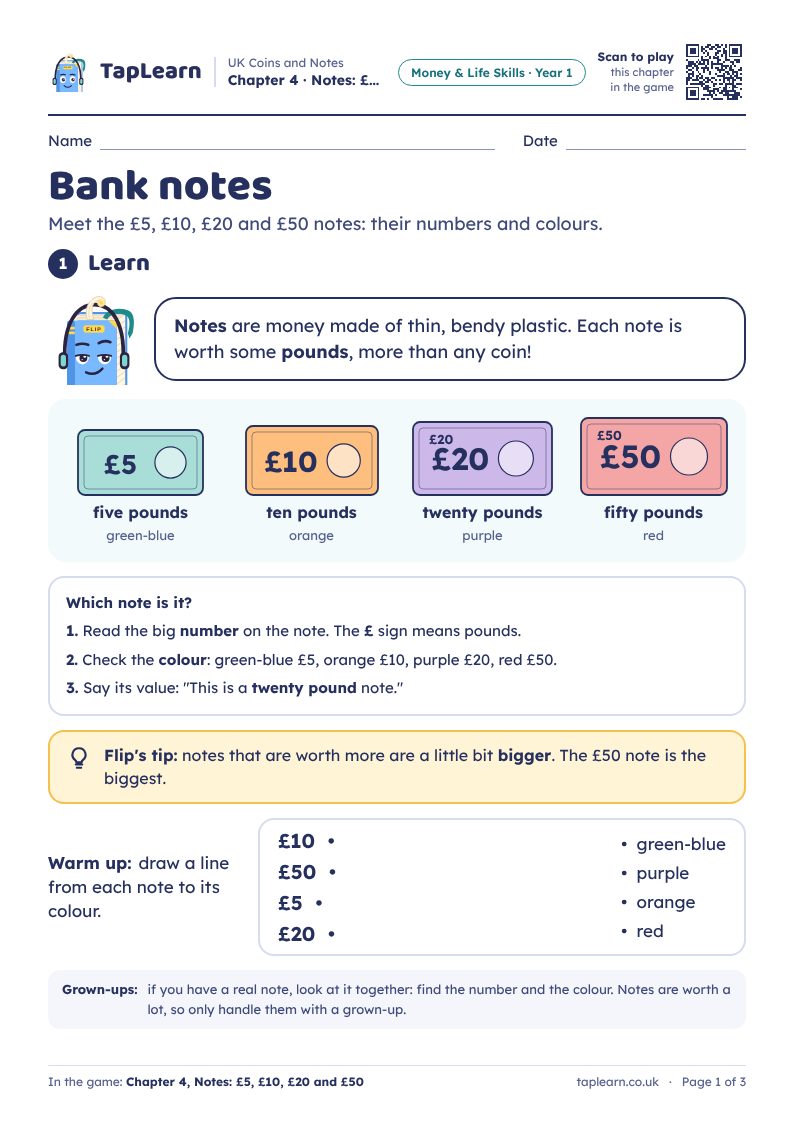
Bank Notes is a printable bank notes worksheet for Year 1 (ages 5 to 6) that teaches children to read the big number on a note and check its colour: green-blue 5 pounds, orange 10 pounds, purple 20 pounds and red 50 pounds. It covers the Year 1 maths statement on recognising and knowing the value of different denominations of coins and notes.
This worksheet is for members
Membership opens every chapter of every game and every worksheet, for all your children.
See the plansAlready a member? Log in to print it.
Start with the free one: Pence coins (chapter 1).
Print it on A4, in colour or black and white. Do it after the chapter, or before it to see what your child already knows.
What's on the worksheet
Your child recognises the 5, 10, 20 and 50 pound notes by number and colour, says what each is worth and tells coins from notes. Includes a make-your-own-notes activity and an answers sheet.
- Page 1 · Learn
- The four notes with their names and colours, a worked example on which note it is, Flip's tip that notes worth more are a little bigger, and a match-the-colour warm-up.
- Page 2 · Try it together
- Make your own notes: draw and colour four play notes, the grown-up puts a cost on some toys, and the child buys each toy with the matching note, saying its name.
- Page 3 · Practise
- Match notes to names, colour each note, ring the note worth the most and tick the least, sort coins and notes, and a challenge about weight and value.
- Answers sheet
- Every answer, mix-ups like thinking heavier coins are worth more, and note-spotting and colour-call ideas.
3 A4 pages and an answers sheet · about 20 minutes
In the classroom
- Play colour call as a starter: say a colour and pupils hold up the matching play note.
- Use Practise D to sort real or plastic coins and play notes into two hoops.
Questions from the worksheet
- Draw a line from each note to its name: five pounds, ten pounds, twenty pounds, fifty pounds.
- Colour each note the right colour: green-blue, orange, purple or red.
- Coin or note? Write each one in the right box: 1 pound, 10 pounds, 2 pounds, 50 pounds, 5 pounds, 20 pounds.
- Leo says a 2 pound coin is worth more than a 5 pound note, because coins are heavier. Is he right? How do you know?
The answers are on the answers sheet, for grown-ups.
National curriculum in England
This worksheet practises this statement from the Year 1 maths programme of study:
- Recognise and know the value of different denominations of coins and notes
Source: National curriculum in England: mathematics programmes of study (DfE)
Using it at home
- If you have a real note, look at it together and find the number and colour. Notes are worth a lot, so only handle them with a grown-up.
- Keep your play notes to use again in Chapter 5.
- Say a colour, like "purple!", and your child says the note it matches.
Watch out for
- Mixing up which note is which.
- Read the number first, then check the colour: green-blue 5, orange 10, purple 20, red 50.
- Thinking coins are worth more because they are heavier.
- Every note is worth more than every coin.
- Saying "five" instead of "five pounds".
- Always say the word pounds with the number.
Questions and answers
What colour are UK bank notes?
The 5 pound note is green-blue, the 10 pound note is orange, the 20 pound note is purple and the 50 pound note is red.
Are notes worth more than coins?
Yes. Every UK note is worth more than every UK coin, even though coins are heavier.
What are UK notes made of?
UK notes are made of thin, bendy plastic.
 TapLearn