Pence coins worksheet for Year 1
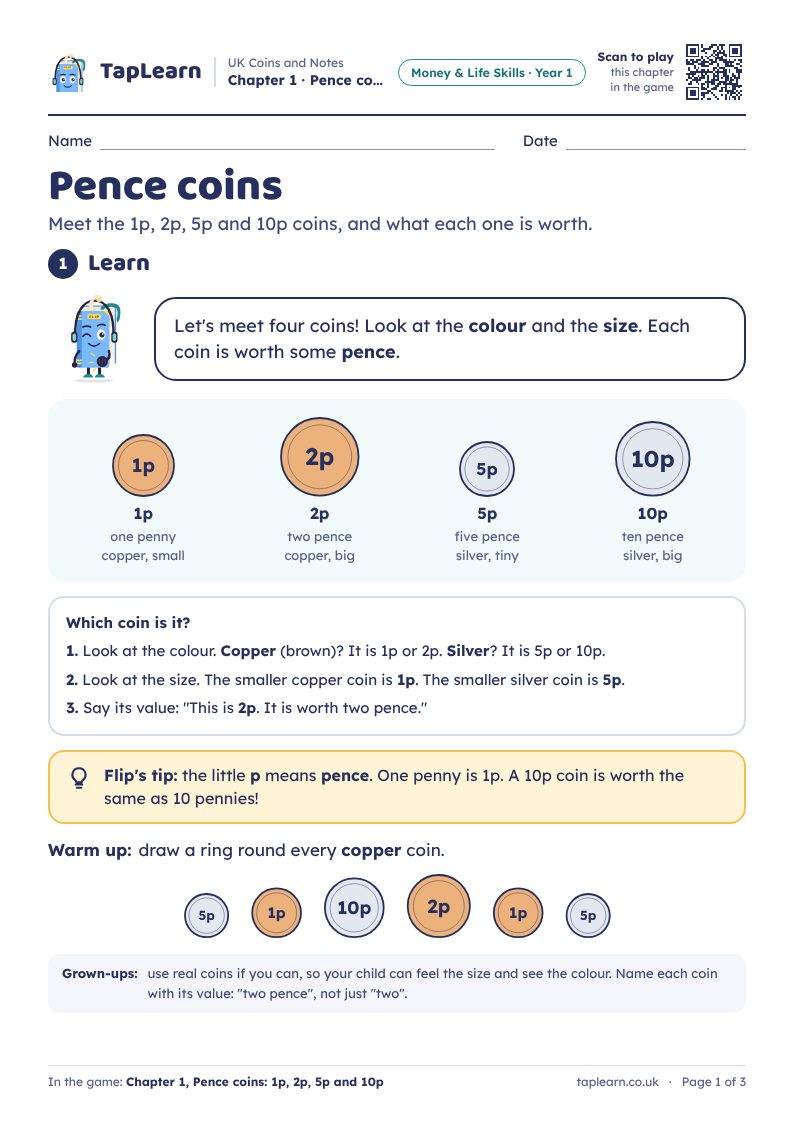
Pence Coins is a printable pence coins worksheet for Year 1 (ages 5 to 6) that teaches children to tell the 1p, 2p, 5p and 10p coins apart by colour (copper or silver) and size, and to say each value. It covers the Year 1 maths statement on recognising and knowing the value of different denominations of coins and notes.
Free to print, no account needed.
Print it on A4, in colour or black and white. Do it after the chapter, or before it to see what your child already knows.
What's on the worksheet
Your child recognises the 1p, 2p, 5p and 10p coins by colour and size, and says what each one is worth. Includes a coin sort activity and an answers sheet.
- Page 1 · Learn
- The 1p, 2p, 5p and 10p coins with their names, colours and sizes, a worked example on telling which coin it is, Flip's tip on the little p, and a ring-the-copper-coins warm-up.
- Page 2 · Try it together
- Coin sort: tip out coins from a purse or jar, sort them into copper and silver, then put each kind in its own cup, naming it as it drops in, and count how many of each.
- Page 3 · Practise
- Match coins to names, write which coin it is from its colour and size, ring every 2p, find the coin worth the same as some pennies, and a challenge about two copper coins.
- Answers sheet
- Every answer, mix-ups like 5p and 10p, and feely-bag and toy-shop ideas.
3 A4 pages and an answers sheet · about 20 minutes
In the classroom
- Run coin sort as a group activity with real or plastic coins in sorting trays.
- Set up a class toy shop with toys costing 1p, 2p, 5p or 10p, paid for with one matching coin.
Questions from the worksheet
- Draw a line from each coin to its name: 10p, 1p, 5p, 2p.
- Draw a ring round every 2p coin: 2p, 1p, 10p, 2p, 5p, 1p, 2p.
- Which coin is worth the same as 10 pennies? Ring it: 2p, 10p or 5p.
- Mia says, "These are both 1p, because they are both copper." Is she right? How can you tell?
The answers are on the answers sheet, for grown-ups.
National curriculum in England
This worksheet practises this statement from the Year 1 maths programme of study:
- Recognise and know the value of different denominations of coins and notes
Source: National curriculum in England: mathematics programmes of study (DfE)
Using it at home
- Use real coins if you can, so your child can feel the size and see the colour. Name each coin with its value: "two pence", not just "two".
- Keep coins away from babies and little children, and wash hands after playing with money.
- Put a 1p and a 2p in a sock. Can your child pull out the 2p just by feeling its size?
Watch out for
- Mixing up 1p and 2p.
- Both are copper. Put them side by side: the 2p is the bigger one.
- Mixing up 5p and 10p.
- Both are round and silver. The 5p is the smallest of all our coins; the 10p is much bigger.
- Saying "two" instead of "two pence".
- Always say the value with "pence" or "p", so it doesn't get mixed up with pounds later.
Questions and answers
What does the p mean on coins?
The little p means pence. One penny is 1p, and a 10p coin is worth the same as 10 pennies.
How can children tell the 1p and 2p coins apart?
Both are copper, but the 2p is bigger. Put them side by side to compare.
Which is the smallest UK coin?
The 5p is the smallest of all UK coins. It is silver and round.
 TapLearn