Pound coins worksheet for Year 1
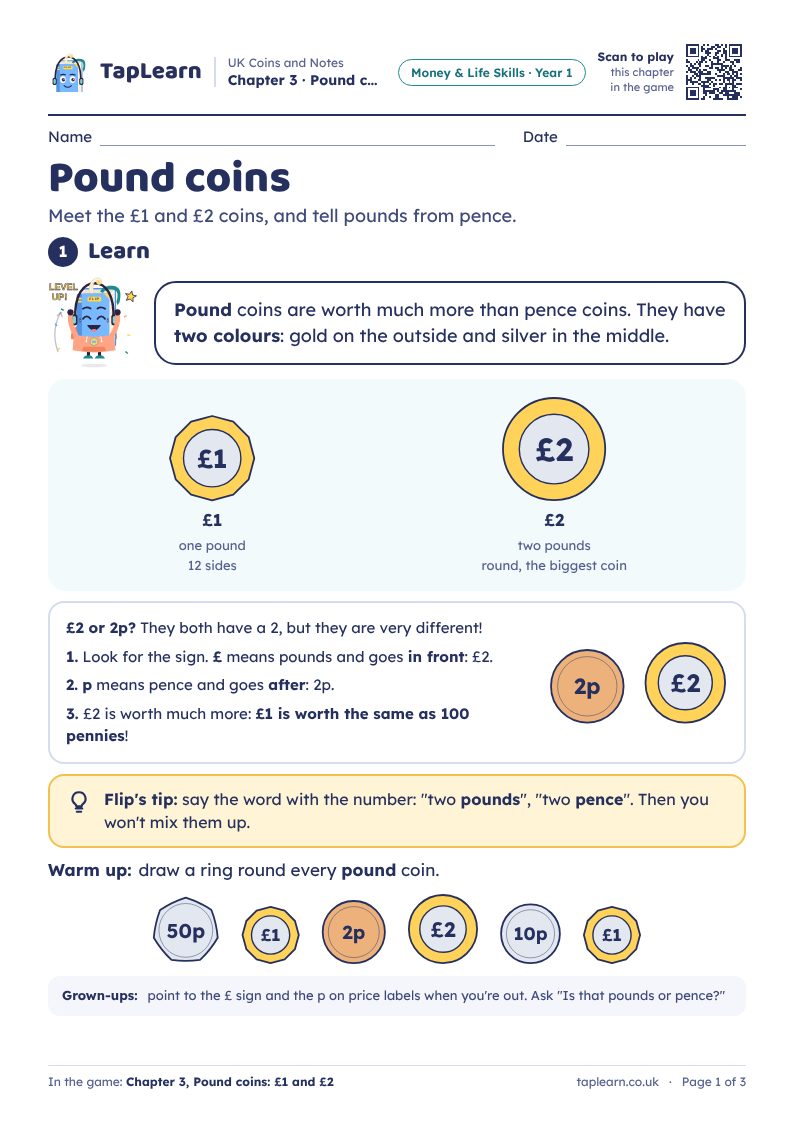
Pound Coins is a printable pound coins worksheet for Year 1 (ages 5 to 6) that teaches children to spot the gold and silver 1 pound and 2 pound coins, read the pound sign and the p, and tell pounds from pence. It covers the Year 1 maths statement on recognising and knowing the value of different denominations of coins and notes.
This worksheet is for members
Membership opens every chapter of every game and every worksheet, for all your children.
See the plansAlready a member? Log in to print it.
Start with the free one: Pence coins (chapter 1).
Print it on A4, in colour or black and white. Do it after the chapter, or before it to see what your child already knows.
What's on the worksheet
Your child recognises the 1 pound and 2 pound coins and tells pounds from pence, such as 2p and 2 pounds. Includes a toy shop activity and an answers sheet.
- Page 1 · Learn
- The 1 pound coin with 12 sides and the round 2 pound coin, a worked example comparing 2p with 2 pounds, Flip's tip to say the word with the number, and a ring-the-pound-coins warm-up.
- Page 2 · Try it together
- Toy shop: the grown-up writes costs from 1p to 2 pounds on toy labels, the child reads each label aloud and pays with the one coin that matches.
- Page 3 · Practise
- Match coins to names, write each coin's value, ring the one worth more, match descriptions to coins, write values with the right sign, and a challenge about 2p and 2 pounds.
- Answers sheet
- Every answer, mix-ups like the sign in the wrong place, and pounds-or-pence and label-spotting ideas.
3 A4 pages and an answers sheet · about 20 minutes
In the classroom
- Display shop labels in pounds and pence and ask pupils to sort them into two groups.
- Use Practise C as a show-me check: which is worth more?
Questions from the worksheet
- Draw a line from each coin to its name: one pound, two pounds, one penny, two pence.
- Which coin is it? 12 sides, gold and silver. Round, gold and silver, the biggest. Round, copper, small.
- Write it with the pound sign or p: two pounds, two pence, one pound.
- Ava says the 2 pound coin and 2p are worth the same, because they both have a 2. Is she right? Why not?
The answers are on the answers sheet, for grown-ups.
National curriculum in England
This worksheet practises this statement from the Year 1 maths programme of study:
- Recognise and know the value of different denominations of coins and notes
Source: National curriculum in England: mathematics programmes of study (DfE)
Using it at home
- Point to the pound sign and the p on shop labels when you're out. Ask "Is that pounds or pence?"
- In the toy shop, include toys costing 2p and 2 pounds, and 1p and 1 pound, so your child has to read the sign.
- Say an amount, like "two pounds!" or "ten pence!", and your child points to the right coin.
Watch out for
- Mixing up pence and pounds, such as 2p and 2 pounds.
- Say the word every time: "two pence", "two pounds".
- Writing the sign in the wrong place.
- The pound sign goes before the number; p goes after it (2p).
- Mixing up the 1 pound and 2 pound coins.
- The 1 pound coin has 12 sides; the 2 pound coin is round and bigger.
Questions and answers
What is the difference between pounds and pence?
Pounds are worth much more than pence. One pound is worth the same as 100 pennies.
Where does the pound sign go?
The pound sign goes in front of the number. The p for pence goes after the number, as in 2p.
How can children recognise a 1 pound coin?
The 1 pound coin has 12 sides and two colours: gold on the outside and silver in the middle.
 TapLearn