20p and 50p coins worksheet for Year 1: Seven-sided coins
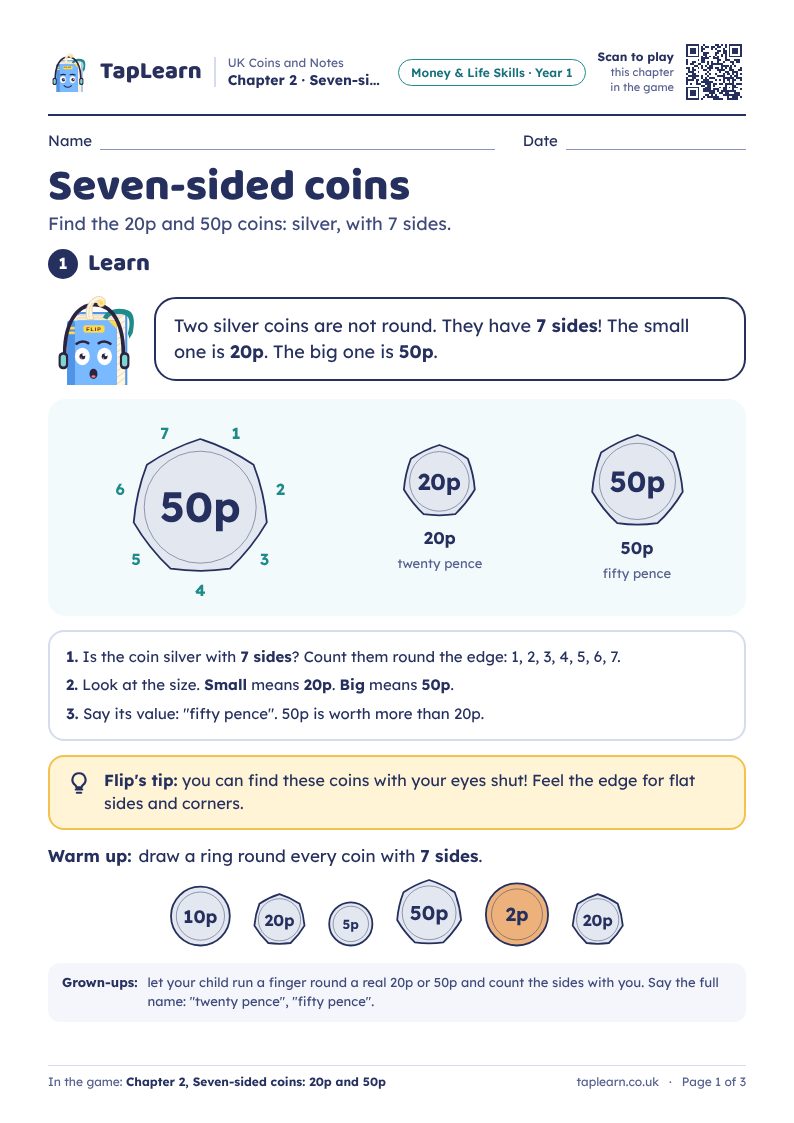
Seven-Sided Coins is a printable 20p and 50p coins worksheet for Year 1 (ages 5 to 6) that teaches children to count the 7 sides of the silver 20p and 50p coins and tell them apart by size: small is 20p, big is 50p. It covers the Year 1 maths statement on recognising and knowing the value of different denominations of coins and notes.
This worksheet is for members
Membership opens every chapter of every game and every worksheet, for all your children.
See the plansAlready a member? Log in to print it.
Start with the free one: Pence coins (chapter 1).
Print it on A4, in colour or black and white. Do it after the chapter, or before it to see what your child already knows.
What's on the worksheet
Your child finds the seven-sided 20p and 50p coins, tells them apart by size and says what they are worth. Includes a feely sock activity and an answers sheet.
- Page 1 · Learn
- The 20p and 50p coins with their 7 sides counted, a worked example on telling them apart, Flip's tip to feel for flat sides, and a ring-the-seven-sided-coins warm-up.
- Page 2 · Try it together
- Feely sock: put a few coins in a clean sock, feel for one with flat sides and corners, say "20p" or "50p" from its size, then pull it out and check.
- Page 3 · Practise
- Match coins to names, write 20p or 50p, sort coins into seven-sided and round, ring the coin worth more, and a challenge about a seven-sided coin.
- Answers sheet
- Every answer, mix-ups like miscounting sides, and coin-hunt and shape-spot ideas.
3 A4 pages and an answers sheet · about 20 minutes
Using it at home
- Let your child run a finger round a real 20p or 50p and count the sides with you. Say the full name: "twenty pence", "fifty pence".
- No 20p or 50p at home? Draw them on card and cut them out together.
- Tip out a purse: who can find a 20p and a 50p first by feeling for the sides?
Watch out for
- Mixing up 20p and 50p.
- Both are silver with 7 sides. Put them side by side: the 50p is clearly bigger.
- Mixing up pence and pounds, like 50p and fifty pounds.
- Read the sign together: "p" means pence.
- Miscounting sides.
- Put a finger on one side and count round until you come back to it.
Questions from the worksheet
- Draw a line from each coin to its name: 50p, 5p, 20p, 10p.
- Sort the coins. Write each value in the right box, 7 sides or round: 20p, 1p, 50p, 10p, 5p, 2p.
- Draw a ring round the coin that is worth more: 20p or 50p? 10p or 20p? 50p or 5p?
- Sam points to a big seven-sided coin and says, "It has 7 sides, so it's 20p." Is he right? How can you tell?
The answers are on the answers sheet, for grown-ups.
National curriculum in England
This worksheet practises this statement from the Year 1 maths programme of study:
- Recognise and know the value of different denominations of coins and notes
Source: National curriculum in England: mathematics programmes of study (DfE)
In the classroom
- Pass a feely bag round a group, with pupils naming 20p or 50p before pulling the coin out.
- Link to shape work: count the sides of other straight-sided shapes in the classroom.
Questions and answers
Which UK coins have 7 sides?
The 20p and 50p coins both have 7 sides. They are silver, and the 50p is bigger.
How do you tell a 20p from a 50p?
Both have 7 sides, so look at the size: the small one is 20p and the big one is 50p.
Is a 50p worth more than a 20p?
Yes. A 50p is worth fifty pence and a 20p is worth twenty pence.
 TapLearn