Statements worksheet for Year 2: Telling sentences
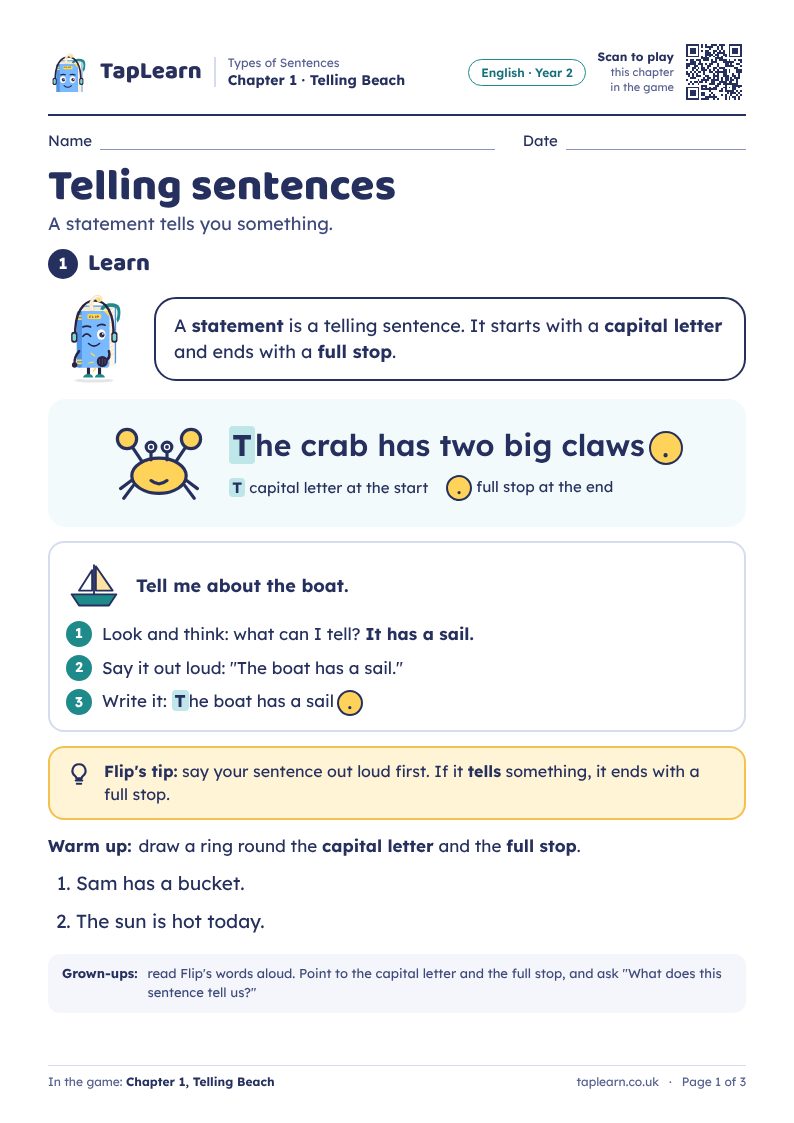
Telling Sentences is a printable statements worksheet for Year 2 (ages 6 to 7) that teaches children that a statement tells you something, starts with a capital letter and ends with a full stop. It covers the Year 2 statements on using sentences with different forms (statement, question, exclamation, command) and using capital letters and full stops to demarcate sentences.
Free to print, no account needed.
▶ Play chapter 1 in the game · How the types of sentences works
Print it on A4, in colour or black and white. Do it after the chapter, or before it to see what your child already knows.
What's on the worksheet
Your child writes statements that tell you something, starting with a capital letter and ending with a full stop. Includes an I-spy statements game to play at home and an answers sheet.
- Page 1 · Learn
- What a statement is, with the capital letter and full stop labelled, a worked example writing about a boat, Flip's tip to say the sentence aloud first, and a warm-up.
- Page 2 · Try it together
- I spy statements: take turns to pick something you can see and say a telling sentence about it, then the child draws two things and writes a statement for each.
- Page 3 · Practise
- Ring the telling sentences, add full stops, tick whether the end mark is right, write a statement about a picture, and a challenge about Leo's sentence.
- Answers sheet
- Every answer, mix-ups like a ? on every sentence, and tell-me-three-things and finger-full-stops ideas.
3 A4 pages and an answers sheet · about 20 minutes
Using it at home
- Point to the capital letter and the full stop, and ask, "What does this sentence tell us?"
- If your child forgets the full stop, ask, "Have you finished telling? Then show it with a full stop."
- At teatime, your child tells you three statements about their day.
Watch out for
- Using the wrong end mark, like ? or ! on every sentence.
- Ask, "Is it telling, asking, or shouting with a big feeling?" A telling sentence gets a full stop.
- Leaving out the full stop.
- Read the sentence aloud together and stop where it ends: "That's where the full stop goes."
- Putting capital letters in the middle.
- Only the first word, and names like Mia, need one.
Questions from the worksheet
- Draw a ring round each telling sentence: The fish can swim. Can the fish swim? Where is my spade? The shell is on the sand.
- Put a full stop at the end of each statement: Mia found a shell. The waves are big. Leo has a kite.
- Is the end mark right? Tick yes or no: The sea is very cold? I like ice cream.
- Leo wrote: the dog ran on the sand. What two things has he forgotten?
The answers are on the answers sheet, for grown-ups.
National curriculum in England
This worksheet practises these statements from the Year 2 english programme of study:
- Develop their understanding of the concepts set out in English appendix 2 by: learning how to use sentences with different forms: statement, question, exclamation, command
- Develop their understanding of the concepts set out in English appendix 2 by: learning how to use subordination (using when, if, that, or because) and co-ordination (using or, and, or but)
- Develop their understanding of the concepts set out in English appendix 2 by: learning how to use the grammar for year 2 in English appendix 2
- Sentence: subordination (using when, if, that, or because) and co-ordination (using or, and, or but)
- Sentence: how the grammatical patterns in a sentence indicate its function as a statement, question, exclamation or command
- Punctuation: use of capital letters, full stops, question marks and exclamation marks to demarcate sentences
In the classroom
- Play I spy statements as a class starter, writing one on the board.
- Use Practise C as a quick mini-whiteboard check: yes or no?
Questions and answers
What is a statement sentence?
A statement is a sentence that tells you something. It starts with a capital letter and ends with a full stop, like "The crab has two big claws."
How do you know where a full stop goes?
Read the sentence aloud and stop where the idea ends. That's where the full stop goes.
What do children learn about statements in Year 2?
In Year 2, children learn that a statement tells something and is one of four sentence types, with questions, exclamations and commands.
More worksheets from Types of Sentences: Build and Join Them on Sentence Island
- Chapter 2: Question sentences worksheet: Asking questions Free
- Chapter 3: Exclamation sentences worksheet: Wow! Exclamations Free
- Chapter 4: Bossy verbs worksheet: Bossy commands Free
- Chapter 5: Types of sentences worksheet: Four sentence types Free
- Chapter 6: Conjunctions worksheet: Joining words Free
 TapLearn