Question sentences worksheet for Year 2: Asking questions
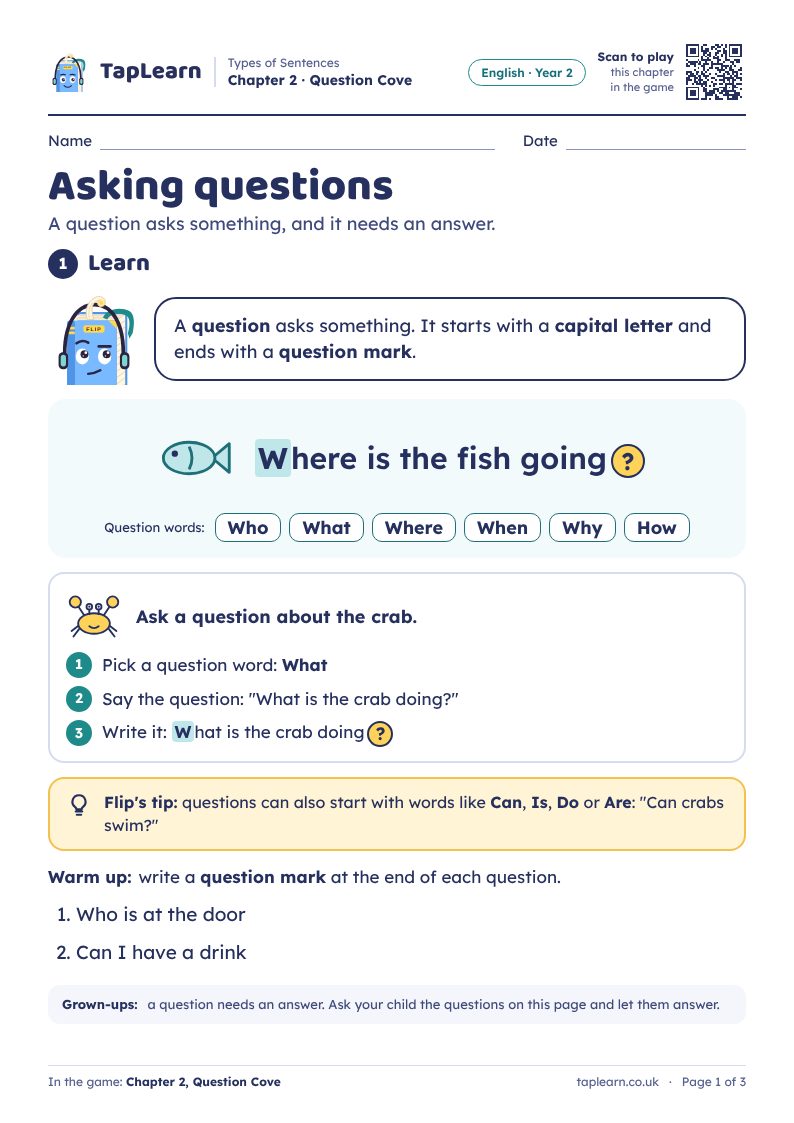
Asking Questions is a printable question sentences worksheet for Year 2 (ages 6 to 7) that teaches children that a question asks something, needs an answer and ends with a question mark. It covers the Year 2 statements on using sentences with different forms (statement, question, exclamation, command) and using question marks to demarcate sentences.
Free to print, no account needed.
Print it on A4, in colour or black and white. Do it after the chapter, or before it to see what your child already knows.
What's on the worksheet
Your child writes questions that ask something and end with a question mark, using question words like who, what and where, and words like can and is. Includes a what's-in-the-bag guessing game and an answers sheet.
- Page 1 · Learn
- What a question is, the question words who, what, where, when, why and how, a worked example asking about a crab, Flip's tip on Can, Is, Do and Are, and a warm-up.
- Page 2 · Try it together
- What's in the bag?: the grown-up hides a safe object in a bag and the child asks yes-or-no questions to guess it, then writes two favourite questions.
- Page 3 · Practise
- Ring the right end mark, match questions to answers, write a question for an answer, write a question for a talking fish, and a challenge about Ava's sentence.
- Answers sheet
- Every answer, mix-ups like missing questions that start with Can, and question-of-the-day and turn-it-round ideas.
3 A4 pages and an answers sheet · about 20 minutes
Using it at home
- A question needs an answer, so ask your child the questions on the Learn page and let them answer.
- In what's in the bag, check each question ends with a question mark. Ask, "Were you asking or telling?"
- Say "The cat is asleep." Your child turns it into a question: "Is the cat asleep?"
Watch out for
- Using the wrong end mark, especially on questions starting with Can, Is or Do.
- Ask, "Does it need an answer?" If yes, it needs a question mark.
- Writing a back-to-front question mark.
- Practise the shape together: a curl, then a dot underneath.
In the classroom
- Play what's in the bag as a whole-class question game.
- Use question of the day as a morning routine, with a different question word each day.
Questions from the worksheet
- Draw a ring round the right end mark, . or ?: Where is my spade. The sun is shining. Do you like crabs. Is it time to go home.
- Match each question to its answer: Who made the sandcastle? Where is the shell? Can the boat float? When is lunch?
- Write a question for this answer. The answer is: The dog is in the garden.
- You meet a talking fish. Write a question you would ask it.
- Ava wrote: Can I have a turn. Is this right? What should go at the end?
The answers are on the answers sheet, for grown-ups.
National curriculum in England
This worksheet practises these statements from the Year 2 english programme of study:
- Develop their understanding of the concepts set out in English appendix 2 by: learning how to use sentences with different forms: statement, question, exclamation, command
- Develop their understanding of the concepts set out in English appendix 2 by: learning how to use subordination (using when, if, that, or because) and co-ordination (using or, and, or but)
- Develop their understanding of the concepts set out in English appendix 2 by: learning how to use the grammar for year 2 in English appendix 2
- Sentence: subordination (using when, if, that, or because) and co-ordination (using or, and, or but)
- Sentence: how the grammatical patterns in a sentence indicate its function as a statement, question, exclamation or command
- Punctuation: use of capital letters, full stops, question marks and exclamation marks to demarcate sentences
Questions and answers
What is a question sentence?
A question is a sentence that asks something and needs an answer. It starts with a capital letter and ends with a question mark.
What are question words?
Question words start many questions: who, what, where, when, why and how.
Do all questions start with a question word?
No. Questions can also start with words like can, is, do or are, as in "Can crabs swim?"
 TapLearn