Conjunctions worksheet for Year 2: Joining words
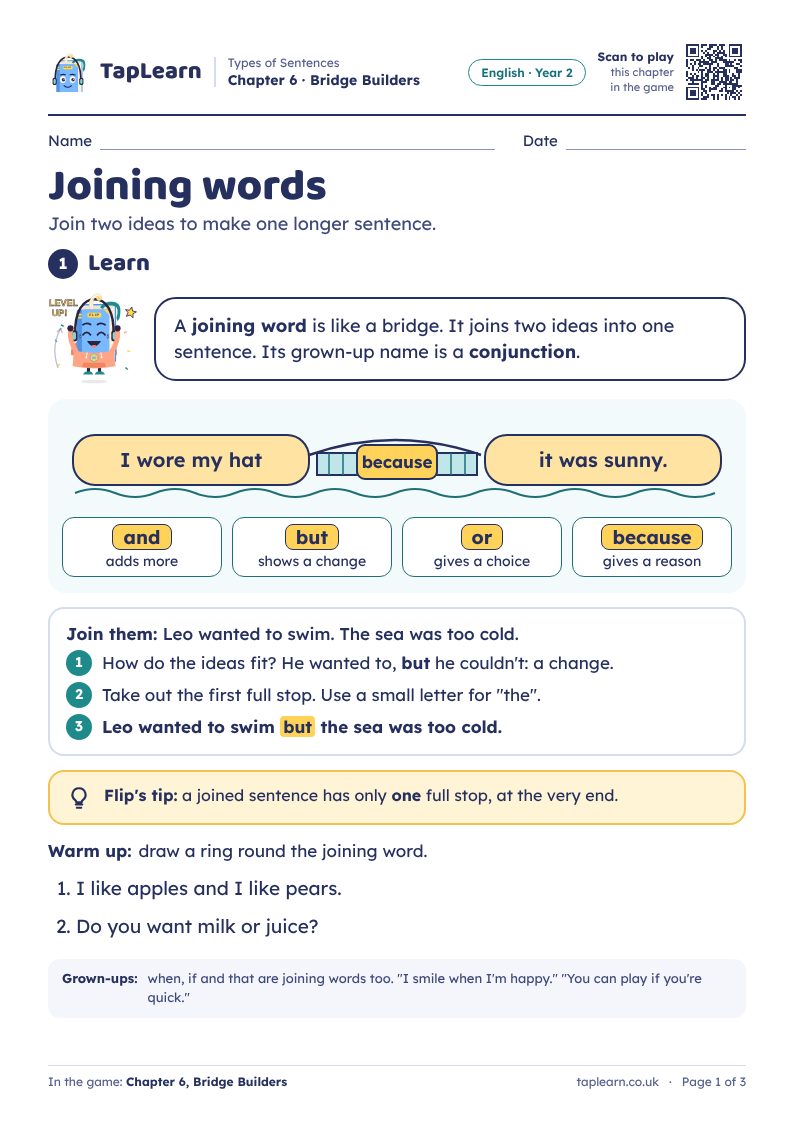
Joining Words is a printable conjunctions worksheet for Year 2 (ages 6 to 7) that teaches children to join two ideas with and, but, or and because, using one full stop at the end. It covers the Year 2 statement on subordination (using when, if, that or because) and co-ordination (using or, and or but).
Free to print, no account needed.
Print it on A4, in colour or black and white. Do it after the chapter, or before it to see what your child already knows.
What's on the worksheet
Your child joins two ideas into one sentence with and, but, or and because, and finishes sentences with when and if. Includes a finish-my-idea game about a toy and an answers sheet.
- Page 1 · Learn
- What a joining word (conjunction) is, what and, but, or and because each do, a worked example joining two sentences with but, Flip's one-full-stop tip, and a warm-up.
- Page 2 · Try it together
- Finish my idea: the grown-up starts a sentence about a toy and stops at the joining word, the child finishes it, and you try all four words before swapping.
- Page 3 · Practise
- Ring the right joining word, match the two halves, join two sentences with a given word, finish sentences with when and if, and a challenge about two full stops.
- Answers sheet
- Every answer, mix-ups like and, and, and, and because-chain and or-game ideas.
3 A4 pages and an answers sheet · about 20 minutes
Using it at home
- When, if and that are joining words too: "I smile when I'm happy." "You can play if you're quick."
- In finish my idea, good starters are "Teddy wanted cake but…", "Teddy can have a nap or…" and "Teddy went outside and…".
- Ask choices at mealtimes with or: "Do you want peas or carrots?"
Watch out for
- Using two full stops in a joined sentence.
- A joined sentence has one full stop, at the end. Read it aloud without stopping.
- Long chains of and, and, and.
- They are hard to read. Try but or because instead.
- Using but for a reason, like "I wore my coat but it was cold".
- Ask, "Is it a change, or a reason?" A reason needs because.
Questions from the worksheet
- Draw a ring round the joining word that fits: I put on my coat ( because / or ) it was raining. Sam ran fast ( and / but ) he did not win.
- Join the two sentences with the word given: Mia went to bed. She was tired. (because)
- Finish each sentence: I smile when… I will help you if…
- Ava wrote: I ate my lunch. because I was hungry. Is this right? How would you fix it?
The answers are on the answers sheet, for grown-ups.
National curriculum in England
This worksheet practises these statements from the Year 2 english programme of study:
- Develop their understanding of the concepts set out in English appendix 2 by: learning how to use sentences with different forms: statement, question, exclamation, command
- Develop their understanding of the concepts set out in English appendix 2 by: learning how to use subordination (using when, if, that, or because) and co-ordination (using or, and, or but)
- Develop their understanding of the concepts set out in English appendix 2 by: learning how to use the grammar for year 2 in English appendix 2
- Sentence: subordination (using when, if, that, or because) and co-ordination (using or, and, or but)
- Sentence: how the grammatical patterns in a sentence indicate its function as a statement, question, exclamation or command
- Punctuation: use of capital letters, full stops, question marks and exclamation marks to demarcate sentences
In the classroom
- Play a because chain round the class: each pupil finishes the last sentence and starts a new one.
- Use Practise B as a matching task in pairs.
Questions and answers
What is a conjunction in Year 2?
A conjunction is a joining word that joins two ideas into one sentence. Year 2 children use and, but, or and because, and also when, if and that.
What does each joining word do?
And adds more, but shows a change, or gives a choice and because gives a reason.
How many full stops does a joined sentence have?
Just one, at the very end: "I ate my lunch because I was hungry."
More worksheets from Types of Sentences: Build and Join Them on Sentence Island
- Chapter 1: Statements worksheet: Telling sentences Free
- Chapter 2: Question sentences worksheet: Asking questions Free
- Chapter 3: Exclamation sentences worksheet: Wow! Exclamations Free
- Chapter 4: Bossy verbs worksheet: Bossy commands Free
- Chapter 5: Types of sentences worksheet: Four sentence types Free
 TapLearn