Bossy verbs worksheet for Year 2: Bossy commands
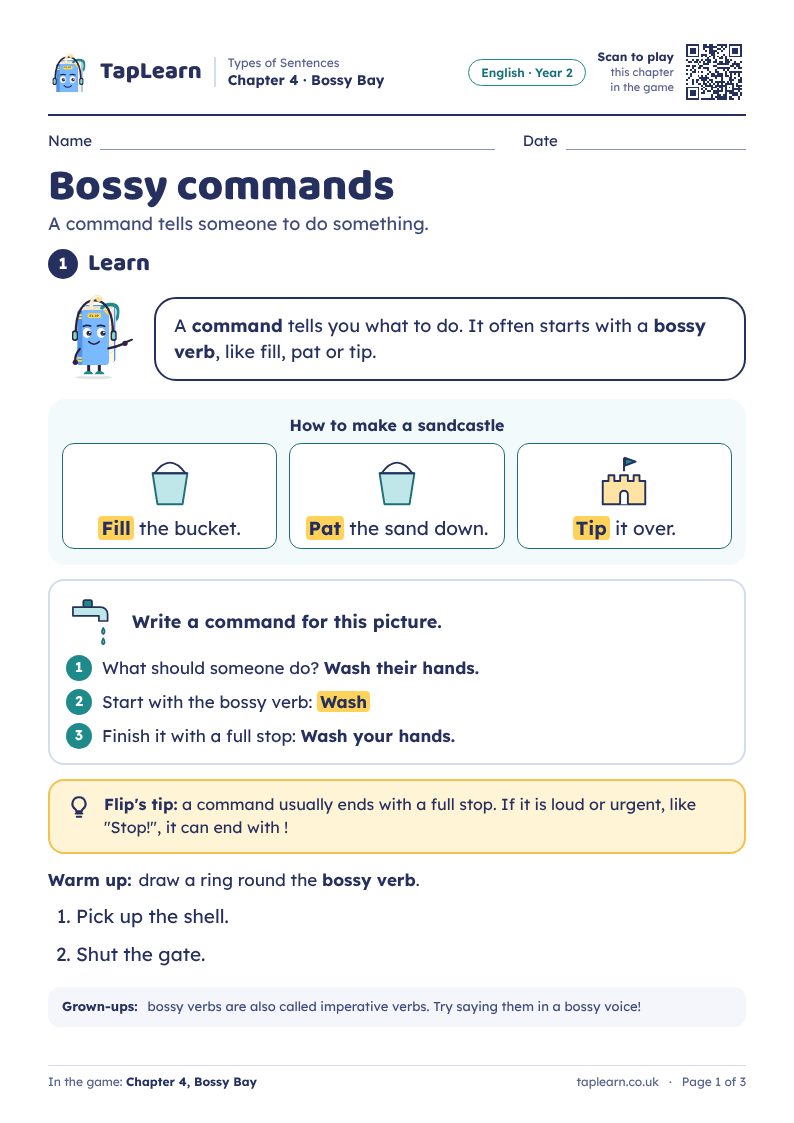
Bossy Commands is a printable bossy verbs worksheet for Year 2 (ages 6 to 7) that teaches children that a command tells someone what to do and often starts with a bossy verb, like "Fill the bucket." It covers the Year 2 statements on using sentences with different forms (statement, question, exclamation, command) and how a sentence's pattern shows its job.
Free to print, no account needed.
▶ Play chapter 4 in the game · How the imperative verbs (bossy verbs) works
Print it on A4, in colour or black and white. Do it after the chapter, or before it to see what your child already knows.
What's on the worksheet
Your child writes commands that tell someone what to do, starting with a bossy (imperative) verb like fill, pat or tip. Includes a robot helper tower-building game and an answers sheet.
- Page 1 · Learn
- What a command is, sandcastle instructions with bossy verbs, a worked example writing "Wash your hands.", Flip's tip on when a command ends with !, and a warm-up.
- Page 2 · Try it together
- Robot helper: the grown-up is a robot that only does exactly what a command says, and the child gives commands to build a tower of cups, then they swap.
- Page 3 · Practise
- Ring the commands, choose a bossy verb for each command, write commands for pictures, write two commands for looking after a pet fish, and a challenge about please.
- Answers sheet
- Every answer, mix-ups like starting with "You", and bossy-boots and kitchen-commands ideas.
3 A4 pages and an answers sheet · about 20 minutes
Using it at home
- Bossy verbs are also called imperative verbs. Try saying them in a bossy voice!
- As the robot, if your child says "The cup goes on top", wait for a bossy verb: "Put the cup on top."
- While you get ready to go out, let your child give you three commands.
Watch out for
- Starting with "You", like "You put the cup on top".
- Show that a command can start straight away with the bossy verb.
- Putting ! on every command.
- Most commands end with a full stop. Use ! only for loud or urgent ones, like "Stop!"
- Telling instead of commanding, like "The toys go in the box".
- Ask, "What should I do?" Then start with that word.
In the classroom
- Play robot helper in pairs with classroom blocks.
- Write a class set of commands for a daily job, like feeding the class fish.
Questions from the worksheet
- Draw a ring round each command: Feed the fish. The fish is hungry. Is the fish hungry? Close the door. Wipe your feet.
- Choose a bossy verb from the box (Put, Brush, Hold) for each command: ___ your teeth. ___ my hand. ___ the toys in the box.
- Write two commands to tell a friend how to look after a pet fish.
- Sam says: "Please sit down." is not a command, because it starts with please. Is he right? Find the bossy verb.
The answers are on the answers sheet, for grown-ups.
National curriculum in England
This worksheet practises these statements from the Year 2 english programme of study:
- Develop their understanding of the concepts set out in English appendix 2 by: learning how to use sentences with different forms: statement, question, exclamation, command
- Develop their understanding of the concepts set out in English appendix 2 by: learning how to use subordination (using when, if, that, or because) and co-ordination (using or, and, or but)
- Develop their understanding of the concepts set out in English appendix 2 by: learning how to use the grammar for year 2 in English appendix 2
- Sentence: subordination (using when, if, that, or because) and co-ordination (using or, and, or but)
- Sentence: how the grammatical patterns in a sentence indicate its function as a statement, question, exclamation or command
- Punctuation: use of capital letters, full stops, question marks and exclamation marks to demarcate sentences
Questions and answers
What is a bossy verb?
A bossy verb tells someone what to do, like fill, pat, put or wash. Its grown-up name is an imperative verb.
What is a command sentence?
A command tells someone to do something. It often starts with a bossy verb and usually ends with a full stop, like "Wash your hands."
Is a sentence with please still a command?
Yes. "Please sit down." is a polite command, and the bossy verb is sit.
More worksheets from Types of Sentences: Build and Join Them on Sentence Island
- Chapter 1: Statements worksheet: Telling sentences Free
- Chapter 2: Question sentences worksheet: Asking questions Free
- Chapter 3: Exclamation sentences worksheet: Wow! Exclamations Free
- Chapter 5: Types of sentences worksheet: Four sentence types Free
- Chapter 6: Conjunctions worksheet: Joining words Free
 TapLearn