Subject and object worksheet for Year 6
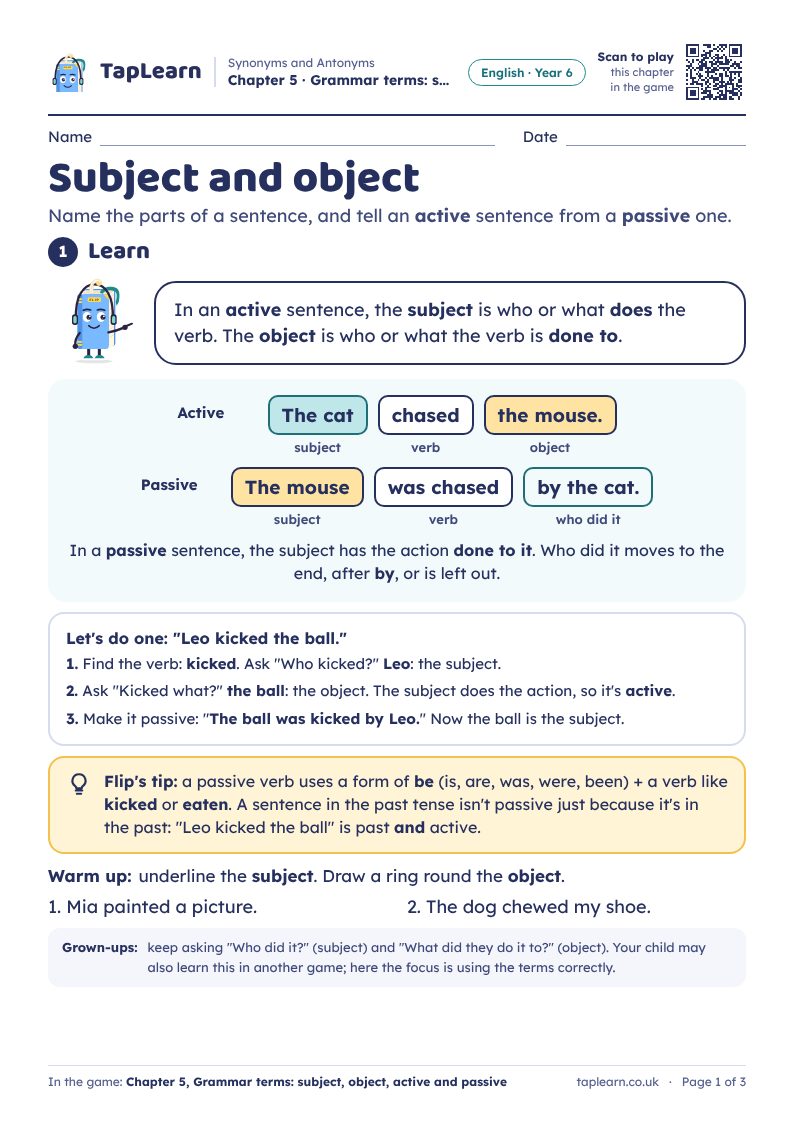
Subject and Object is a printable subject and object worksheet for Year 6 (ages 10 to 11) that teaches children that in an active sentence the subject does the verb to the object, while in a passive sentence the subject has the action done to it. It covers the Year 6 statement on using the terms subject, object, active and passive.
Free to print, no account needed.
Print it on A4, in colour or black and white. Do it after the chapter, or before it to see what your child already knows.
What's on the worksheet
Your child spots the subject and object of a sentence and says whether it is active or passive, and learns that past tense doesn't mean passive. Includes an action replay game with soft toys and an answers sheet.
- Page 1 · Learn
- "The cat chased the mouse" in active and passive with each part labelled, a worked example with "Leo kicked the ball", Flip's tip on was and were, and a warm-up.
- Page 2 · Try it together
- Action replay: make a toy do something, like push a ball, say it as an active sentence and name the subject and object, then replay it in the passive.
- Page 3 · Practise
- Underline subjects and ring objects, write A or P, rewrite active sentences as passive and a passive one as active, and a challenge about past tense.
- Answers sheet
- Every answer, mix-ups like thinking past tense means passive, and a flip-it idea.
3 A4 pages and an answers sheet · about 25 minutes
Using it at home
- Keep asking "Who did it?" (subject) and "What did they do it to?" (object).
- In action replay, try one where who did it is left out: "The sock was hidden." It's still passive.
- Say an active sentence and your child says it in the passive, then back again.
Watch out for
- Swapping subject and object.
- Ask, "Who or what is doing the verb?" In an active sentence, that's the subject.
- Thinking past tense means passive.
- Look for a form of be (was, were, is, are) plus a verb like eaten or kicked.
- Missing a passive without by.
- "The biscuits were eaten" is still passive, even though it doesn't say who ate them.
Questions from the worksheet
- Underline the subject. Draw a ring round the object: Sam opened the window. The hungry fox caught a rabbit.
- Is each sentence active or passive? Write A or P: The window was broken by a football. Yesterday, Ava baked a cake. All the biscuits were eaten.
- Rewrite each active sentence as a passive one: The chef cooked the meal. Mia won the race.
- Rewrite this passive sentence as an active one: The song was sung by the choir.
- Leo says, "'Yesterday, Ava baked a cake' is passive, because it happened in the past." Is he right? Explain.
The answers are on the answers sheet, for grown-ups.
National curriculum in England
This worksheet practises this statement from the Year 6 english programme of study:
- Terminology: subject, object, active, passive, synonym, antonym, ellipsis, hyphen, colon, semi-colon, bullet points
In the classroom
- Play flip it as a starter: pupils turn active sentences into passive ones on mini whiteboards.
- Act out action replays with two pupils and a ball.
Questions and answers
What is the subject and object of a sentence?
In an active sentence, the subject is who or what does the verb, and the object is who or what it's done to: the cat (subject) chased the mouse (object).
What is the difference between active and passive?
In an active sentence the subject does the action. In a passive one the subject has the action done to it: "The mouse was chased by the cat."
Is a past tense sentence always passive?
No. "Leo kicked the ball" is past tense and active. A passive verb uses a form of be plus a verb, like was kicked.
More worksheets from Synonyms and Antonyms: A Word Islands Adventure
- Chapter 1: Synonyms worksheet: Similar meanings Free
- Chapter 2: Antonyms worksheet: Opposite meanings Free
- Chapter 3: Synonyms and antonyms worksheet: Synonym or antonym? Free
- Chapter 4: Shades of meaning worksheet: Choosing the best word Free
- Chapter 6: Punctuation terms worksheet: Punctuation names Free
 TapLearn