Punctuation terms worksheet for Year 6: Punctuation names
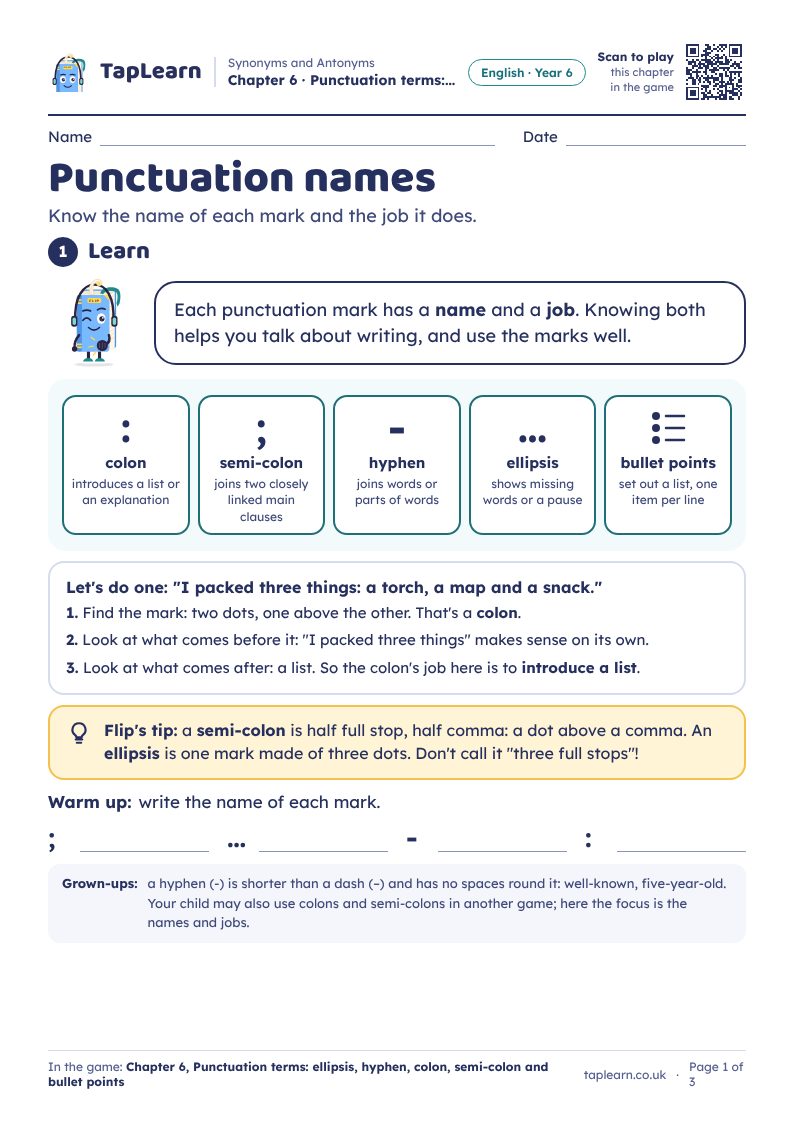
Punctuation Names is a printable punctuation terms worksheet for Year 6 (ages 10 to 11) that teaches the name and job of the colon, semi-colon, hyphen, ellipsis and bullet points, such as a colon introducing a list. It covers the Year 6 statement on using the terms ellipsis, hyphen, colon, semi-colon and bullet points.
Free to print, no account needed.
Print it on A4, in colour or black and white. Do it after the chapter, or before it to see what your child already knows.
What's on the worksheet
Your child names the colon, semi-colon, hyphen, ellipsis and bullet points, and says what job each one does. Includes a punctuation spotters hunt in recipes, leaflets or packets and an answers sheet.
- Page 1 · Learn
- The five marks with their names and jobs, a worked example finding the colon before a list, Flip's tip on semi-colons and ellipses, and a name-the-mark warm-up.
- Page 2 · Try it together
- Punctuation spotters: look through a recipe, leaflet, packet or book for a colon, semi-colon, hyphen, ellipsis and bullet points, copy a few words around each and say its job.
- Page 3 · Practise
- Join marks to names, write the missing mark in sentences, name the mark and its job in two sentences, rewrite a list with bullet points, and a challenge about a semi-colon.
- Answers sheet
- Every answer, mix-ups like calling an ellipsis three full stops, and cereal-box and say-the-mark ideas.
3 A4 pages and an answers sheet · about 25 minutes
Using it at home
- A hyphen (-) is shorter than a dash and has no spaces round it: well-known, five-year-old.
- In punctuation spotters, recipes often have colons and bullet points; semi-colons can be rare, so a novel may help. It's fine not to find every mark.
- At breakfast, spot any colons, hyphens or bullet points on the cereal packet.
Watch out for
- Mixing up colon and semi-colon.
- A colon introduces a list or explanation; a semi-colon joins two linked main clauses.
- Calling an ellipsis "three full stops".
- An ellipsis is a single punctuation mark with its own name.
- Mixing up a hyphen and a dash.
- A hyphen is short and joins words; a dash is longer.
Questions from the worksheet
- Write the missing mark in each box: colon, semi-colon, hyphen or ellipsis. You will need three things ☐ flour, eggs and milk. Leo's sister is a five ☐ year ☐ old.
- Name the mark in each sentence and say what job it does: Sam loves maths; his sister loves art.
- Rewrite this list using bullet points: To build a den, you need: blankets, cushions, pegs and a torch.
- Ava wrote: "I play two sports; football and swimming." Is the semi-colon right? Which mark should she use, and why?
The answers are on the answers sheet, for grown-ups.
National curriculum in England
This worksheet practises this statement from the Year 6 english programme of study:
- Terminology: subject, object, active, passive, synonym, antonym, ellipsis, hyphen, colon, semi-colon, bullet points
In the classroom
- Display the five marks with their jobs and refer to them during writing.
- Use Practise B as a mini-whiteboard check.
Questions and answers
What is the difference between a colon and a semi-colon?
A colon introduces a list or an explanation. A semi-colon joins two closely linked main clauses: "Sam loves maths; his sister loves art."
What is an ellipsis?
An ellipsis is one punctuation mark made of three dots. It shows missing words or a pause.
What does a hyphen do?
A hyphen joins words or parts of words, like five-year-old or well-known.
 TapLearn