Shades of meaning worksheet for Year 6: Choosing the best word
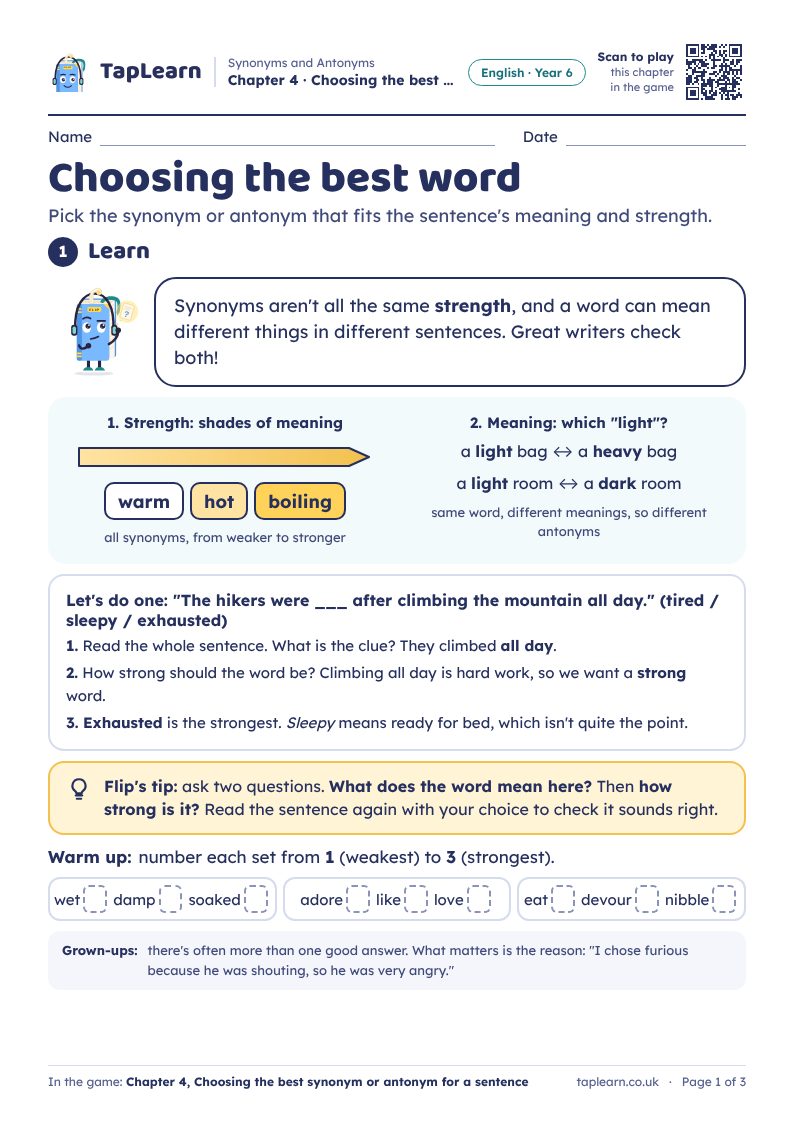
Shades of Meaning is a printable shades of meaning worksheet for Year 6 (ages 10 to 11) that teaches children to ask what a word means in a sentence and how strong it should be, like warm, hot or boiling, and that light can mean not heavy or not dark. It covers the Year 6 statement on how words are related by meaning as synonyms and antonyms.
Free to print, no account needed.
Print it on A4, in colour or black and white. Do it after the chapter, or before it to see what your child already knows.
What's on the worksheet
Your child chooses the synonym or antonym that fits a sentence's meaning and strength: warm, hot or boiling; a light bag is heavy, but a light room is dark. Includes a shades-of-meaning line-up and an answers sheet.
- Page 1 · Learn
- Warm, hot and boiling as a strength scale, light bag and light room compared, a worked example choosing exhausted for tired hikers, Flip's two-questions tip, and an order-by-strength warm-up.
- Page 2 · Try it together
- Shades of meaning line-up: write three sets of words like whisper, say, shout, scream on scraps, lay each set from weakest to strongest and talk about any you disagree on.
- Page 3 · Practise
- Order words by strength, ring the antonym that fits a word's meaning in a sentence, choose a word for each sentence and explain why, make a sentence stronger, and a challenge about light.
- Answers sheet
- Every answer, mix-ups like ignoring the sentence, and strength-ladder and turn-it-up ideas.
3 A4 pages and an answers sheet · about 25 minutes
Using it at home
- There's often more than one good answer. What matters is the reason: "I chose furious because he was shouting."
- In the line-up, disagreement is good because some words are very close. Ask your child to explain their order.
- Say a plain sentence ("The dog was big") and take turns making it stronger or weaker.
Watch out for
- Ignoring the sentence, like choosing dark as the opposite of a light bag.
- Ask, "What does light mean here?"
- Choosing the wrong strength, like "The boiling bath was nice and relaxing".
- Ask, "Is that too strong, or not strong enough?"
Questions from the worksheet
- Write each set in order from weakest to strongest: overjoyed, pleased, happy; stare, glance, look; downpour, drizzle, rain.
- The word in bold has more than one meaning. Ring the antonym that fits: Leo carried a light bag (heavy / dark). Sam has fair hair (unfair / dark).
- Choose the word that fits and explain your choice: Ava (whispered / said / screamed) so she wouldn't wake the baby.
- Make it stronger! Rewrite with a stronger synonym for each underlined word: The big storm made the scared children run inside.
- Leo says, "The antonym of light is always dark." Is he right? Give an example to explain.
The answers are on the answers sheet, for grown-ups.
National curriculum in England
This worksheet practises this statement from the Year 6 english programme of study:
- Word: how words are related by meaning as synonyms and antonyms
In the classroom
- Build a class strength ladder for a word like said on the board.
- Use Practise C as a talk task: pairs choose a word and justify it.
Questions and answers
What are shades of meaning?
Shades of meaning are how strong similar words are, like warm, hot and boiling, from weaker to stronger.
Does a word always have the same antonym?
No. It depends on the meaning in the sentence: a light bag is the opposite of a heavy bag, but a light room is the opposite of a dark room.
How do children choose the right synonym?
Ask what the word means in the sentence, then how strong it should be, and read the sentence again to check.
 TapLearn