Bus stop method worksheet for Year 5
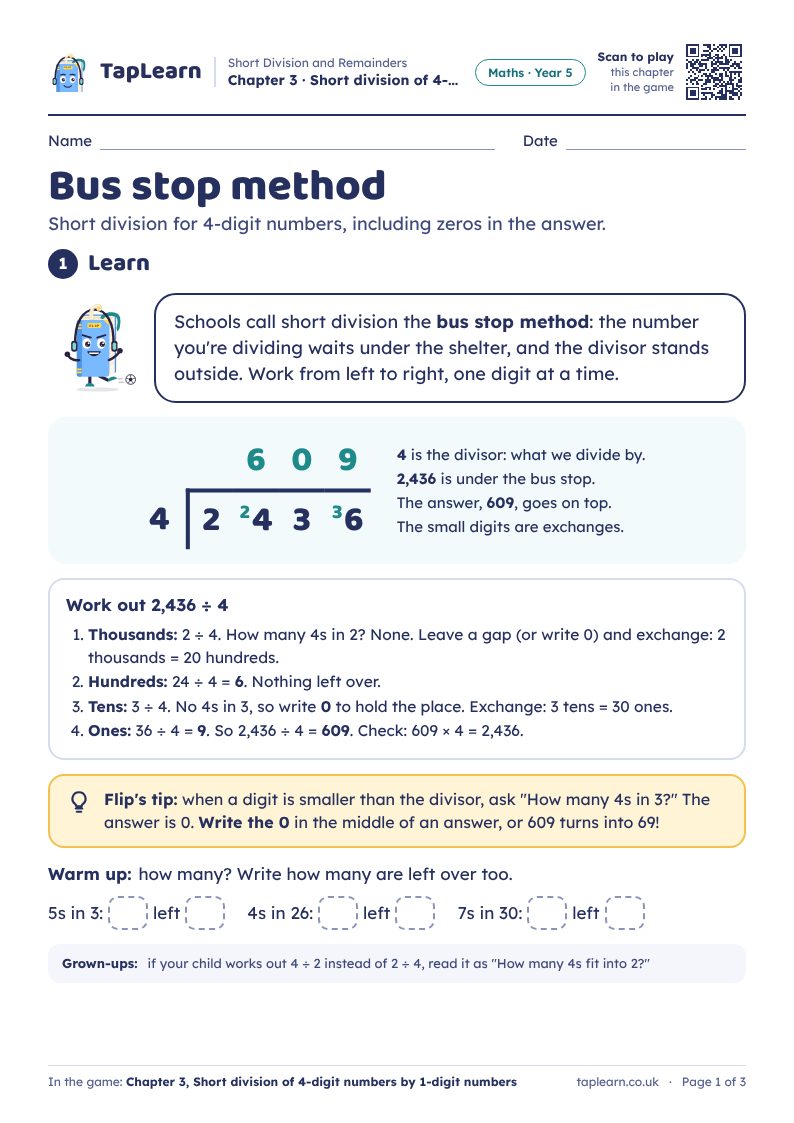
Bus Stop Method is a printable bus stop method worksheet for Year 5 (ages 9 to 10) that teaches children to divide one digit at a time and write a 0 when a digit is too small to share, so 609 doesn't become 69. It covers the Year 5 maths statement to divide numbers up to 4 digits by a one-digit number using short division and interpret remainders appropriately for the context.
This worksheet is for members
Membership opens every chapter of every game and every worksheet, for all your children.
See the plansAlready a member? Log in to print it.
Start with the free one: Sharing big numbers (chapter 1).
▶ Play chapter 3 in the game · How the bus stop method (short division) works
Print it on A4, in colour or black and white. Do it after the chapter, or before it to see what your child already knows.
What's on the worksheet
Your child divides 4-digit numbers by 1-digit numbers with the bus stop method, including zeros in the answer and digits smaller than the divisor. Includes a divide-the-year activity and an answers sheet.
- Page 1 · Learn
- The parts of the bus stop labelled, a worked example for 2,436 ÷ 4 with a 0 in the answer, Flip's tip to ask "How many 4s in 3?", and a how-many-and-left-over warm-up.
- Page 2 · Try it together
- Divide the year: write 2,026 under a bus stop with 2 outside, divide it saying each step aloud, check by multiplying, then try 4,812 ÷ 4 and 3,045 ÷ 5.
- Page 3 · Practise
- Use the bus stop method, divide numbers with a 0 in the answer, ring the right answer and check by multiplying, solve a bakery rolls problem, and a challenge about 69.
- Answers sheet
- Every answer, mix-ups like dividing the wrong way round, and house-number and estimate-first ideas.
3 A4 pages and an answers sheet · about 25 minutes
Using it at home
- If your child works out 4 ÷ 2 instead of 2 ÷ 4, read it as "How many 4s fit into 2?"
- In divide the year, if a check doesn't match, look for a missing 0 or a lost exchange. Finding the slip is good practice too.
- Estimate first: 2,436 ÷ 4 is about 2,400 ÷ 4 = 600. Is the answer close?
Watch out for
- Leaving out a zero, so 1,004 becomes 14.
- Every digit under the bus stop needs a digit above it, except a gap at the very start.
- Dividing the wrong way round, doing 4 ÷ 2 instead of 2 ÷ 4.
- Ask "How many 4s fit into 2?"
- Losing an exchange after writing 0.
- The whole digit moves on: 3 tens become 30 ones.
Questions from the worksheet
- Use the bus stop method: 4,824 ÷ 4; 3,654 ÷ 3; 1,736 ÷ 8.
- Ring the right answer. Check by multiplying: 4,016 ÷ 4 = 14, 104, 1,004 or 1,040.
- The bakery makes 1,632 rolls in a week. It bakes the same number on each of 6 days. How many rolls a day?
- Mia worked out 2,436 ÷ 4 and wrote 69. Is she right? Check by multiplying, and explain what happened.
The answers are on the answers sheet, for grown-ups.
National curriculum in England
This worksheet practises this statement from the Year 5 maths programme of study:
- Divide numbers up to 4 digits by a one-digit number using the formal written method of short division and interpret remainders appropriately for the context
Source: National curriculum in England: mathematics programmes of study (DfE)
In the classroom
- Use Practise C as a multiple-choice hinge question, checking choices by multiplying.
- Have pairs write divisions with a 0 in the answer for each other to solve.
Questions and answers
What is the bus stop method?
It's what schools call short division. The number being divided sits under the shelter, the divisor stands outside, and the answer goes on top.
Why do you write a 0 in the answer?
When a digit is too small to share, there are no groups, so write 0 to hold the place. Without it, 609 becomes 69.
How do you divide a 4-digit number by a 1-digit number?
Work from left to right one digit at a time, exchanging any leftover into the next place, then check by multiplying.
 TapLearn