Division with remainders worksheet for Year 5: Remainders
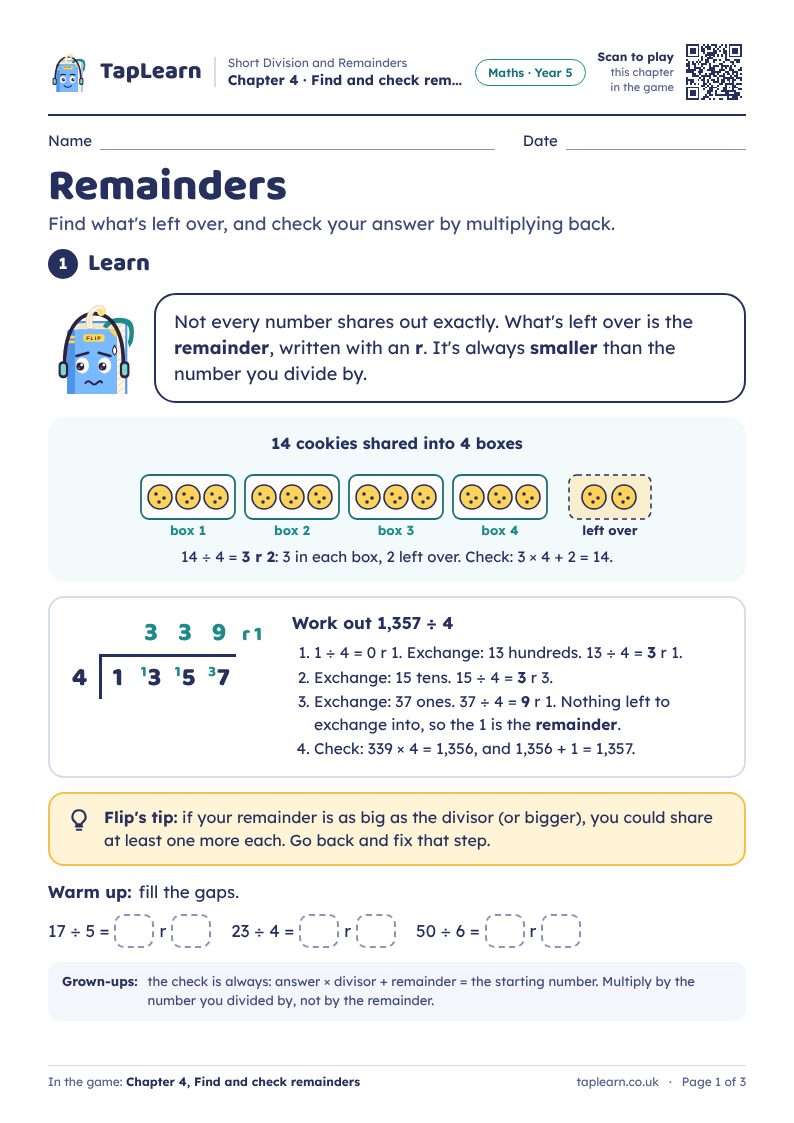
Remainders is a printable division with remainders worksheet for Year 5 (ages 9 to 10) that teaches children that a remainder is always smaller than the divisor and to check with answer × divisor + remainder. It covers the Year 5 maths statement to divide numbers up to 4 digits by a one-digit number using short division and interpret remainders appropriately for the context.
This worksheet is for members
Membership opens every chapter of every game and every worksheet, for all your children.
See the plansAlready a member? Log in to print it.
Start with the free one: Sharing big numbers (chapter 1).
Print it on A4, in colour or black and white. Do it after the chapter, or before it to see what your child already knows.
What's on the worksheet
Your child finds remainders with short division, makes sure they are smaller than the divisor, and checks by multiplying back and adding the remainder. Includes a family shares activity and an answers sheet.
- Page 1 · Learn
- 14 cookies in 4 boxes with 2 left over, a worked example for 1,357 ÷ 4 with a remainder of 1, Flip's tip on remainders that are too big, and a warm-up.
- Page 2 · Try it together
- Family shares: count a handful of pasta, share it equally between everyone until there aren't enough to go round, write the leftover, and check by multiplying and adding.
- Page 3 · Practise
- Use short division and write remainders, decide if remainders are possible, divide and check by multiplying back, check Sam's answer, and a challenge about checking the wrong way.
- Answers sheet
- Every answer, mix-ups like forgetting the remainder, and leftover-game and days-and-weeks ideas.
3 A4 pages and an answers sheet · about 25 minutes
Using it at home
- The check is always: answer × divisor + remainder = the starting number.
- In family shares, ask "Could we give everyone one more?" before writing the leftover.
- Ask how many weeks and days 45 days is: 45 ÷ 7 = 6 r 3.
Watch out for
- Giving a remainder that's too big, like 29 ÷ 4 = 6 r 5.
- Ask "Could each group have one more?"
- Forgetting the remainder, so 47 ÷ 5 = 9.
- Check: 9 × 5 = 45, not 47, so 2 is missing.
- Checking the wrong way, like 9 × 2 + 5.
- Multiply by the divisor, then add the remainder.
Questions from the worksheet
- Use short division. Write the remainder: 547 ÷ 5; 862 ÷ 8; 499 ÷ 4.
- Is the remainder possible? Ring yes or no: 29 ÷ 4 = 6 r 5; 44 ÷ 7 = 5 r 9.
- Sam says 725 ÷ 4 = 181 r 1. Write a check to show whether he's right.
- Leo checks 47 ÷ 5 = 9 r 2 like this: 9 × 2 + 5 = 23. "It doesn't make 47, so my answer is wrong," he says. Is Leo's check right? How should he check?
The answers are on the answers sheet, for grown-ups.
National curriculum in England
This worksheet practises this statement from the Year 5 maths programme of study:
- Divide numbers up to 4 digits by a one-digit number using the formal written method of short division and interpret remainders appropriately for the context
Source: National curriculum in England: mathematics programmes of study (DfE)
In the classroom
- Use Practise B as a quick true-or-false check on possible remainders.
- Run family shares with counters in groups of different sizes.
Questions and answers
What is a remainder?
A remainder is what's left over when a number doesn't share out exactly. 14 ÷ 4 = 3 r 2.
Can a remainder be bigger than the divisor?
No. A remainder is always smaller than the number you divide by. If it isn't, you could share at least one more each.
How do you check a division with a remainder?
Multiply the answer by the divisor, then add the remainder: 9 × 5 + 2 = 47.
 TapLearn