Remainder word problems worksheet for Year 5: Remainders in real life
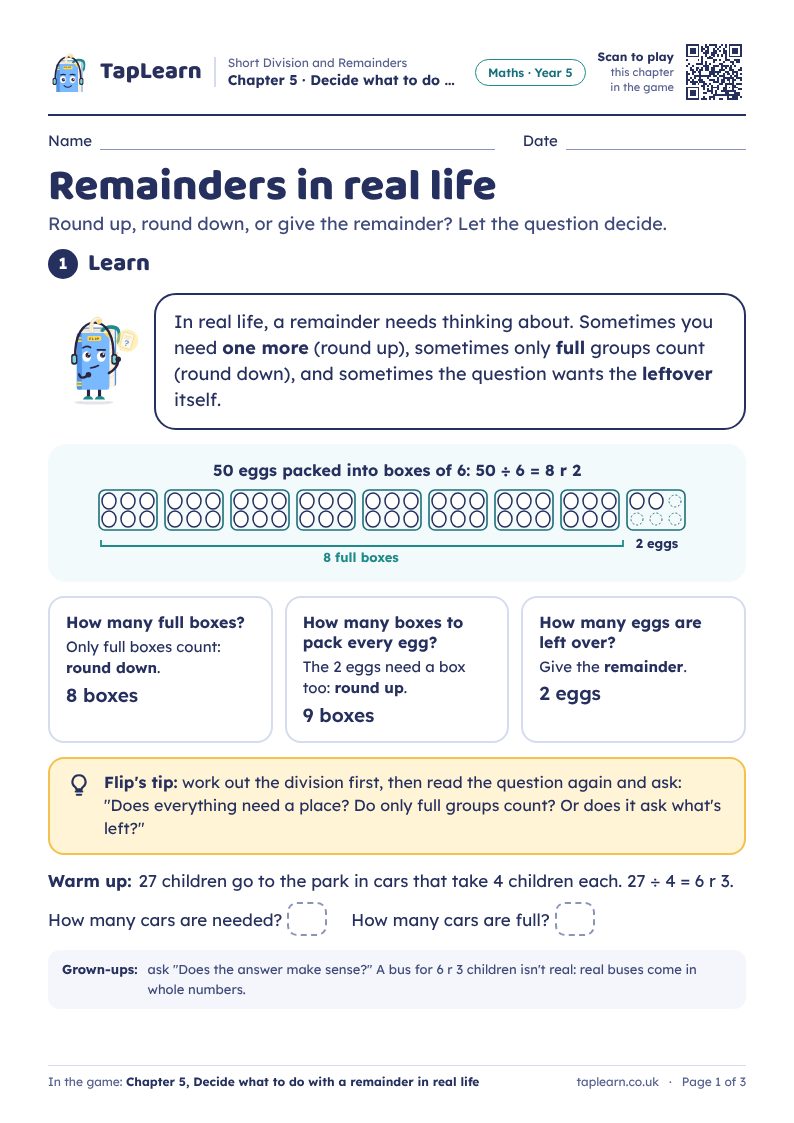
Remainders in Real Life is a printable remainder word problems worksheet for Year 5 (ages 9 to 10) that teaches children to divide first, then read the question again to decide whether to round up, round down or give the leftover. It covers the Year 5 maths statement to divide numbers up to 4 digits by a one-digit number using short division and interpret remainders appropriately for the context.
This worksheet is for members
Membership opens every chapter of every game and every worksheet, for all your children.
See the plansAlready a member? Log in to print it.
Start with the free one: Sharing big numbers (chapter 1).
Print it on A4, in colour or black and white. Do it after the chapter, or before it to see what your child already knows.
What's on the worksheet
Your child decides whether to round up, round down or give the remainder in real-life division problems, like minibuses, bags and ribbons. Includes an egg box packing activity and an answers sheet.
- Page 1 · Learn
- 50 eggs in boxes of 6 answering three different questions, Flip's tip on what to ask after dividing, and a warm-up about cars for 27 children.
- Page 2 · Try it together
- Egg box packing: pack 50 pasta eggs into boxes of 6, answer how many boxes are full, how many are needed and how many eggs are left, then try 38 eggs in boxes of 4.
- Page 3 · Practise
- Decide what to do with remainders for minibuses and stickers, divide for sports day, cookie bags and ribbon, match café table questions to answers, and a challenge about minibuses.
- Answers sheet
- Every answer, mix-ups like always rounding down, and party-planning ideas.
3 A4 pages and an answers sheet · about 25 minutes
Using it at home
- Ask "Does the answer make sense?" A bus for 6 r 3 children isn't real: real buses come in whole numbers.
- In egg box packing, talk about why the three answers are different even though they come from the same division.
- Plan a party: 23 guests and cupcakes in packs of 6. How many packs do you need?
Watch out for
- Always rounding down, so 58 children get 6 minibuses.
- Ask "Who's left behind?"
- Always rounding up, so 2,000 cookies make 334 bags.
- The last bag isn't full, and the question asks for full bags.
- Answering with the remainder when the question asks how many groups.
- Read the question again after dividing.
Questions from the worksheet
- 30 children go on a trip. Each minibus seats 8. How many minibuses are needed?
- A baker has 2,000 cookies and packs them in bags of 6. How many full bags?
- 75 people come to the bakery café. Each table seats 4. 75 ÷ 4 = 18 r 3. How many tables are needed so everyone sits?
- Mia says, "58 children need minibuses that seat 9. 58 ÷ 9 = 6 r 4, so we need 6 minibuses." Is Mia right? Explain.
The answers are on the answers sheet, for grown-ups.
National curriculum in England
This worksheet practises this statement from the Year 5 maths programme of study:
- Divide numbers up to 4 digits by a one-digit number using the formal written method of short division and interpret remainders appropriately for the context
Source: National curriculum in England: mathematics programmes of study (DfE)
In the classroom
- Use Practise C as a matching task, then have pairs write three questions for one division.
- Run egg box packing with counters and egg boxes in small groups.
Questions and answers
When do you round up a remainder?
Round up when everything needs a place, like children needing seats on a minibus. 58 ÷ 9 = 6 r 4, so you need 7 minibuses.
When do you round down a remainder?
Round down when only full groups count, like full bags of cookies or full boxes of eggs.
When do you give the remainder as the answer?
Give the remainder when the question asks what's left over, like how many eggs don't fit in a full box.
 TapLearn