Short division with exchanging worksheet for Year 5: Exchanging leftovers
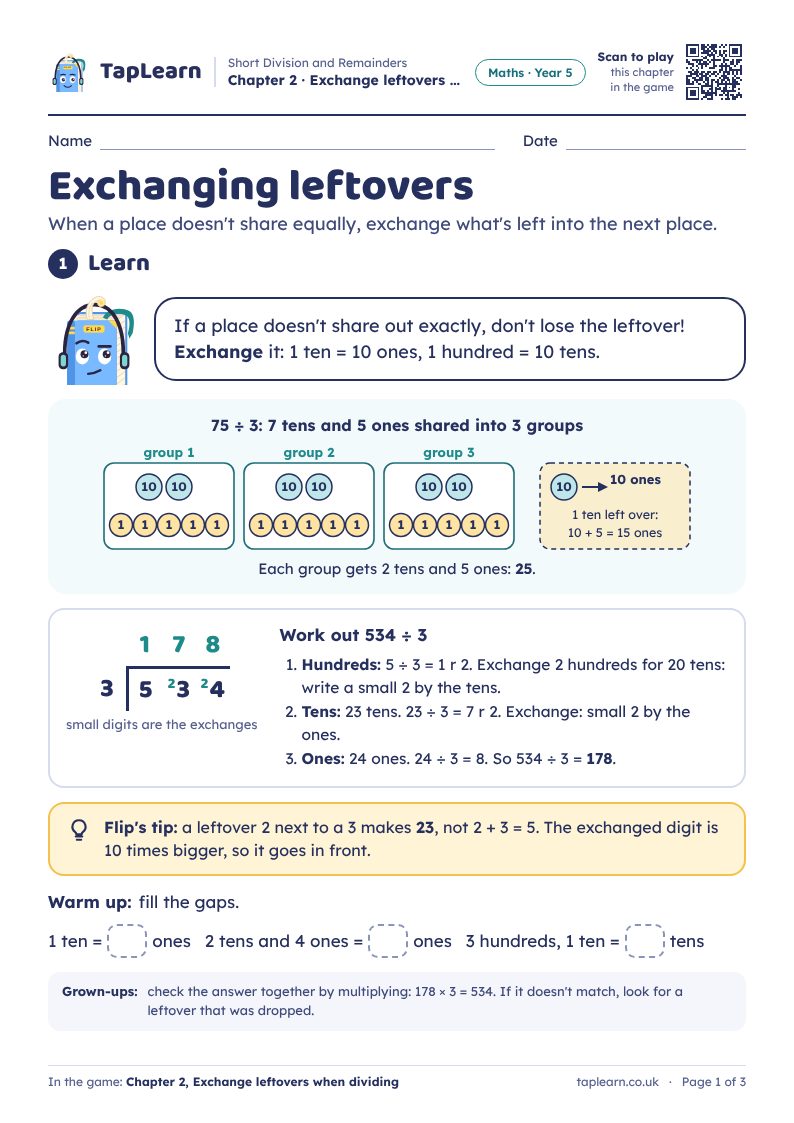
Exchanging Leftovers is a printable short division with exchanging worksheet for Year 5 (ages 9 to 10) that teaches children to turn a leftover into the next place, so 1 ten left over becomes 10 ones. It covers the Year 5 maths statement to divide numbers up to 4 digits by a one-digit number using short division and interpret remainders appropriately for the context.
This worksheet is for members
Membership opens every chapter of every game and every worksheet, for all your children.
See the plansAlready a member? Log in to print it.
Start with the free one: Sharing big numbers (chapter 1).
Print it on A4, in colour or black and white. Do it after the chapter, or before it to see what your child already knows.
What's on the worksheet
Your child exchanges a leftover into the next place value when dividing, like swapping 1 ten for 10 ones, using short division. Includes a swap-and-share coin activity and an answers sheet.
- Page 1 · Learn
- 75 ÷ 3 shown with a leftover ten exchanged for 10 ones, a worked example for 534 ÷ 3 with exchanges as small digits, Flip's tip that a leftover 2 next to a 3 makes 23, and a warm-up.
- Page 2 · Try it together
- Swap and share: make 75p with coins, share the 10p coins between 3 people, swap the leftover 10p for ten 1p coins, share those, then try 92p and 56p between 4.
- Page 3 · Practise
- Use short division showing exchanges, work out what number to divide next after an exchange, solve more divisions, share 651 buns between 3 cafés, and a challenge.
- Answers sheet
- Every answer, mix-ups like adding the leftover, and money-swaps and check-by-multiplying ideas.
3 A4 pages and an answers sheet · about 25 minutes
Using it at home
- Check answers together by multiplying: 178 × 3 = 534. If it doesn't match, look for a leftover that was dropped.
- In swap and share, point out that one 10p and ten 1p coins are worth the same. That's exactly what exchanging means.
- Say 72 ÷ 4 = 18 and let your child check it: 18 × 4 = 72.
Watch out for
- Losing the leftover.
- Ask "What happened to the ten that was left?"
- Adding the leftover, so 1 and 5 make 6.
- The leftover is worth 10 times as much: 1 ten is 10 ones, so 15.
- Writing the exchange in the answer.
- Exchanged digits go underneath, not on top.
Questions from the worksheet
- Use short division. Show your exchanges as small digits: 472 ÷ 4, 684 ÷ 6, 896 ÷ 8.
- After an exchange, what number do you divide next? 2 left over, next digit 3. 1 left over, next digit 0.
- The bakery shares 651 buns equally between 3 cafés. How many buns does each café get?
- Leo worked out 75 ÷ 3. He wrote: "7 ÷ 3 = 2 with 1 left over. 1 + 5 = 6, and 6 ÷ 3 = 2. So the answer is 22." Is Leo right? Explain.
The answers are on the answers sheet, for grown-ups.
National curriculum in England
This worksheet practises this statement from the Year 5 maths programme of study:
- Divide numbers up to 4 digits by a one-digit number using the formal written method of short division and interpret remainders appropriately for the context
Source: National curriculum in England: mathematics programmes of study (DfE)
In the classroom
- Model swap and share with place value counters, then move to the written method.
- Use Leo's 22 as a spot-the-mistake starter.
Questions and answers
What does exchanging mean in short division?
When a place doesn't share out exactly, the leftover moves into the next place. 1 ten left over becomes 10 ones.
Why does a leftover 2 next to a 3 make 23?
The leftover is 2 tens, which is 20 ones. With 3 more ones, that makes 23 ones, not 5.
Where do you write the exchanged digit?
Write it small, in front of the next digit under the line, not in the answer on top.
 TapLearn