Grammar terms worksheet for Year 4: Name that word
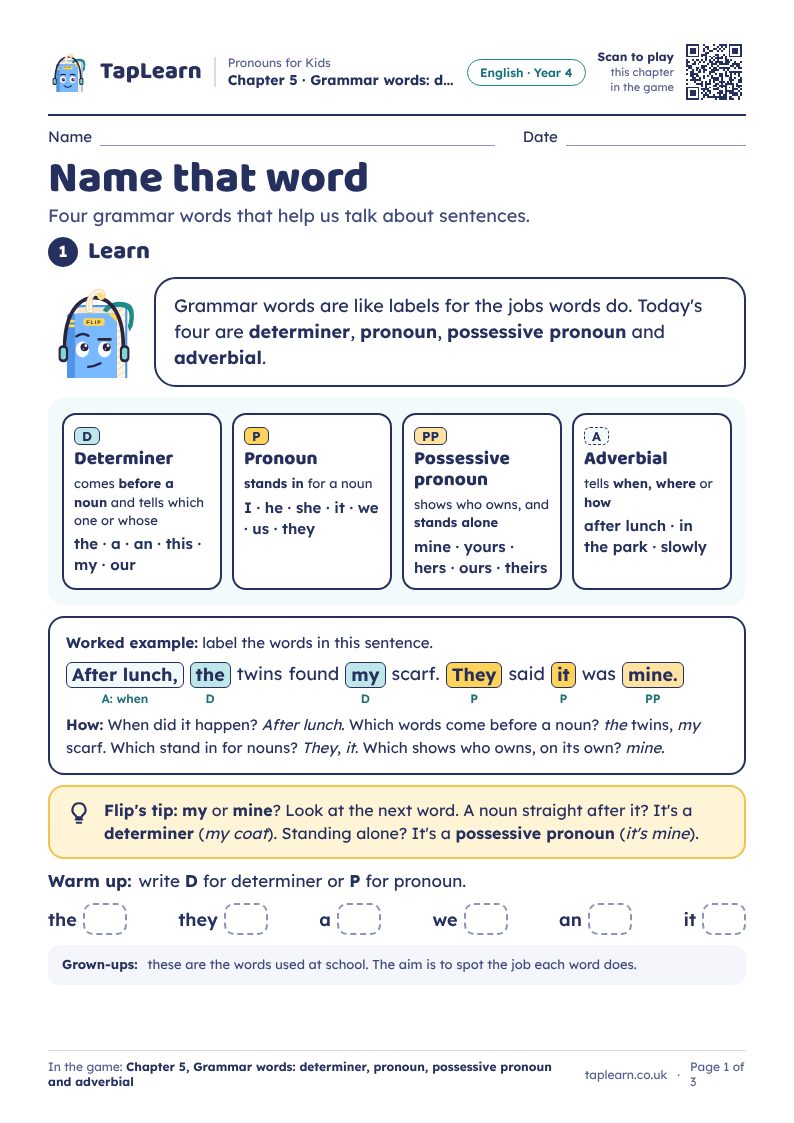
Name That Word is a printable grammar terms worksheet for Year 4 (ages 8 to 9) that teaches children to label the job each word does as a determiner, pronoun, possessive pronoun or adverbial. It covers the Year 4 English terminology statement: determiner, pronoun, possessive pronoun, adverbial.
Free to print, no account needed.
Print it on A4, in colour or black and white. Do it after the chapter, or before it to see what your child already knows.
What's on the worksheet
Your child recognises and names determiners, pronouns, possessive pronouns and adverbials, and tells my (a determiner) from mine (a possessive pronoun). Includes a grammar word hunt on a food packet and an answers sheet.
- Page 1 · Learn
- A chart of the four grammar words with examples, a worked example labelling "After lunch, the twins found my scarf", Flip's tip on my or mine, and a D-or-P warm-up.
- Page 2 · Try it together
- Grammar word hunt: write D, P, PP and A on paper scraps, the grown-up reads a sentence from a food packet or comic and points at a word, and the child holds up the right card.
- Page 3 · Practise
- Choose my or mine and label D or PP, underline adverbials and say when, where or how, sort boxed words into a table, write and label your own sentence, and a challenge.
- Answers sheet
- Every answer, mix-ups like missing longer adverbials, and packet-hunt and when-where-how ideas.
3 A4 pages and an answers sheet · about 25 minutes
In the classroom
- Give groups D, P, PP and A cards and hold them up as you read sentences from a class text.
- Use Practise C as a sorting task on mini-whiteboards.
Questions from the worksheet
- Draw a ring round the right word. Then write D or PP: The noisy dog is our / ours.
- Underline the adverbial. Does it tell when, where or how? Leo hid the present under the stairs.
- Write a sentence with a determiner, a pronoun and an adverbial. Label them D, P and A.
- Mia says: "My and mine are both possessive pronouns." Is she right? Explain how you know.
The answers are on the answers sheet, for grown-ups.
National curriculum in England
This worksheet practises this statement from the Year 4 english programme of study:
- Terminology: determiner, pronoun, possessive pronoun, adverbial
Using it at home
- These are the words used at school. The aim is to spot the job each word does, not to learn definitions by heart.
- In the word hunt, look for adverbials on packets, like "in a cool, dry place" telling where.
- Say "Dad sang" and let your child add an adverbial: "Dad sang loudly."
Watch out for
- Mixing up my and mine, or our and ours.
- Ask "Is there a noun straight after it?" Yes means determiner; no means possessive pronoun.
- Missing adverbials of several words, like under the stairs.
- Ask "When? Where? How?" and underline the whole answer.
- Getting stuck on her and his, which do more than one job.
- Look at what comes after: her bag (D), I saw her (P), it's his (PP).
Questions and answers
What is a determiner?
A determiner comes before a noun and tells which one or whose, like the, a, this, my or our.
What is an adverbial?
An adverbial tells when, where or how something happens. It can be one word, like slowly, or a phrase, like after lunch.
Is my a pronoun or a determiner?
My is a determiner because it comes before a noun, as in my bike. Older books may call it a possessive adjective.
More worksheets from Pronouns for Kids: Clear Writing Adventure in Pronoun Town
- Chapter 1: Pronouns worksheet: Pronoun detectives Free
- Chapter 2: Avoiding repetition worksheet: No more repeats Free
- Chapter 3: Noun or pronoun worksheet: Who do you mean? Free
- Chapter 4: Possessive pronouns worksheet: Mine, yours, theirs Free
- Chapter 6: Editing pronouns worksheet: Pronoun check-up Free
 TapLearn