Avoiding repetition worksheet for Year 4: No more repeats
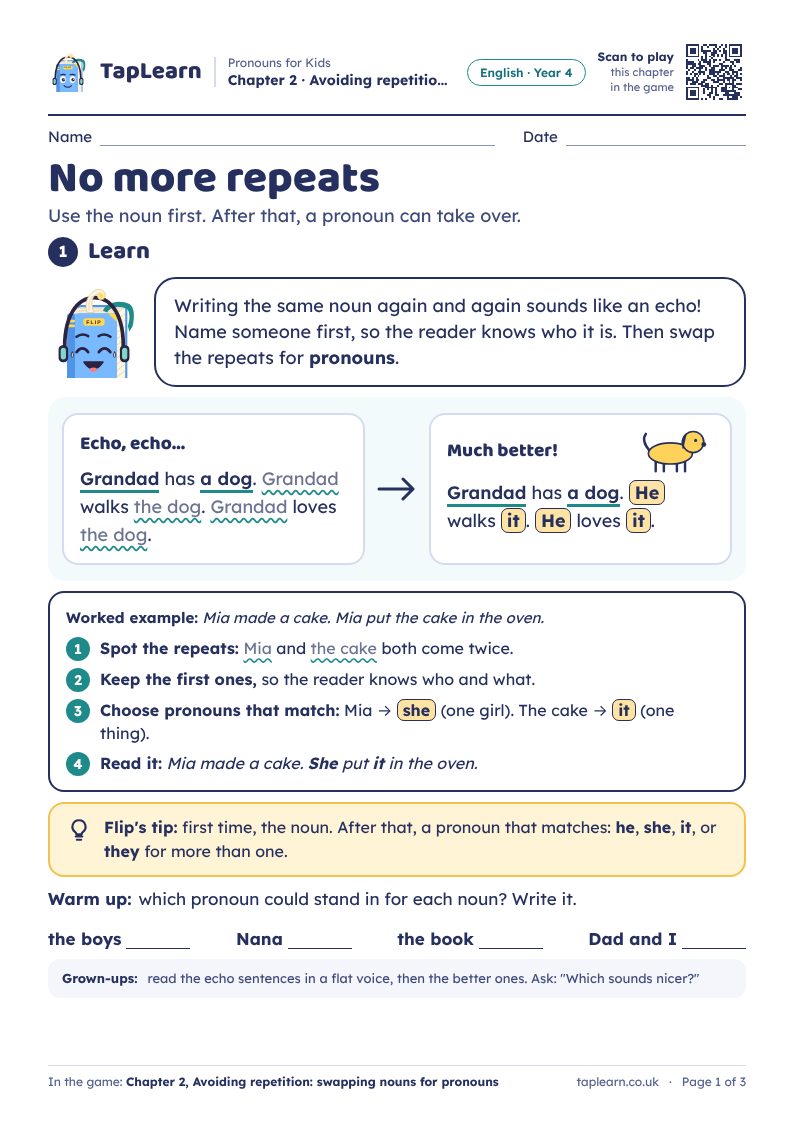
No More Repeats is a printable avoiding repetition worksheet for Year 4 (ages 8 to 9) that teaches children to name someone first, then swap the repeats for a pronoun that matches. It covers the Year 4 English statements on choosing nouns or pronouns for clarity and cohesion and to avoid repetition, within and across sentences.
Free to print, no account needed.
Print it on A4, in colour or black and white. Do it after the chapter, or before it to see what your child already knows.
What's on the worksheet
Your child swaps repeated nouns for pronouns within and across sentences, choosing he, she, it or they to match. Includes an echo game to play together and an answers sheet.
- Page 1 · Learn
- Echo sentences about Grandad and his dog next to the fixed version, a worked example turning "Mia… Mia… the cake" into she and it, Flip's tip on noun first, and a warm-up.
- Page 2 · Try it together
- The echo game: the grown-up says three echo sentences about a toy, the child says them again with pronouns, then you swap, with the grown-up sometimes using the wrong pronoun on purpose.
- Page 3 · Practise
- Ring repeated nouns and write the pronoun, rewrite second sentences with a pronoun, tick whether pronouns match, and a challenge about using she before the name.
- Answers sheet
- Every answer, mix-ups like swapping every noun, and too-repetitive and story-chain ideas.
3 A4 pages and an answers sheet · about 25 minutes
Using it at home
- Read the echo sentences in a flat voice, then the better ones, and ask "Which sounds nicer?"
- In the echo game, a toy can be he, she or it, as long as it stays the same each time.
- Say "Dad made tea and Dad drank the tea" in a silly voice and let your child fix it.
Watch out for
- Using a pronoun the very first time someone appears.
- Ask "Would someone who hasn't met Ava know who she is?"
- Choosing a pronoun that doesn't match, like it for a person.
- Ask "Is it a person or a thing? One, or more than one?"
- Swapping every noun.
- Pronouns are for repeats. It's fine to use a name again later in a story.
Questions from the worksheet
- Draw a ring round the noun that comes back again. Write the pronoun to use the second time: Dad phoned Gran because Dad missed Gran.
- Rewrite the second sentence. Use a pronoun instead of the repeated noun: Mia and Ava went to the park. Mia and Ava played on the swings.
- Does the pronoun match? My cousins live on a farm. She have six goats.
- Ava wrote: "She found a shell on the beach. Ava took it home." What's wrong? Write it the right way.
The answers are on the answers sheet, for grown-ups.
National curriculum in England
This worksheet practises these statements from the Years 3–4 english programme of study:
- Develop their understanding of the concepts set out in English appendix 2 by: choosing nouns or pronouns appropriately for clarity and cohesion and to avoid repetition
- Text: appropriate choice of pronoun or noun within and across sentences to aid cohesion and avoid repetition (Year 4 english)
In the classroom
- Play the echo game as a class: read an echo paragraph aloud and have children call out the fixes.
- Run story chain in groups, with each new sentence using a pronoun for the named pet.
Questions and answers
How do pronouns help avoid repetition?
After naming someone or something once, a pronoun can take over: "Mia made a cake. She put it in the oven."
Why name someone before using a pronoun?
The reader needs to know who the pronoun means. Use the noun first, then a pronoun that matches.
Should every repeated noun become a pronoun?
No. Pronouns are for repeats, but it's fine to use a name again later, especially if a pronoun would be unclear.
 TapLearn