Noun or pronoun worksheet for Year 4: Who do you mean?
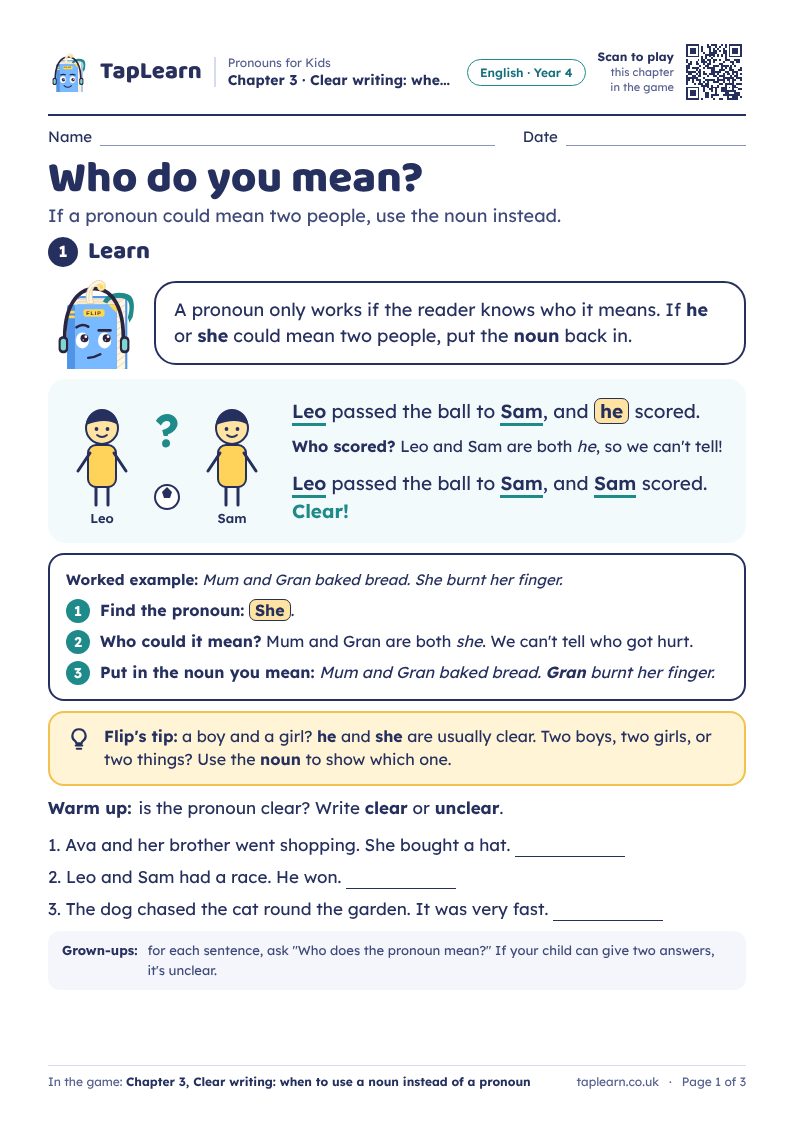
Who Do You Mean? is a printable noun or pronoun worksheet for Year 4 (ages 8 to 9) that teaches children to use the noun when he, she or it could point to two people or things. It covers the Year 4 English statements on choosing nouns or pronouns for clarity and cohesion and to avoid repetition, within and across sentences.
Free to print, no account needed.
Print it on A4, in colour or black and white. Do it after the chapter, or before it to see what your child already knows.
What's on the worksheet
Your child spots when he or she could mean two people and puts the noun back so the reader knows who is meant. Includes a who-did-it game with toys and an answers sheet.
- Page 1 · Learn
- Leo passing the ball to Sam and an unclear he, a worked example fixing "Mum and Gran… She burnt her finger", Flip's tip on two boys or two girls, and a clear-or-unclear warm-up.
- Page 2 · Try it together
- Who did it?: name three toys, two of them both boys or both girls, act out a scene with a pronoun sentence, then the child asks "Who?" and says it again clearly.
- Page 3 · Practise
- Write who a pronoun could mean, rewrite unclear sentences, ring the clear choice between noun and pronoun, write a sentence where a pronoun is clear, and a challenge.
- Answers sheet
- Every answer, mix-ups like changing every pronoun back to a noun, and who-caught-it and story-listening ideas.
3 A4 pages and an answers sheet · about 25 minutes
Using it at home
- For each warm-up sentence, ask "Who does the pronoun mean?" If your child can give two answers, it's unclear.
- In who did it?, try Bella with one of the boys too: then she is clear, and the pronoun is fine.
- When reading aloud, stop at a pronoun and ask "Do we know who this is?"
Watch out for
- Using he or she when two people could be meant.
- It feels clear to the writer. Ask "Could I think it was the other person?"
- Changing every pronoun back to a noun.
- That brings the echo back. Only change the ones that are unclear.
- Missing an unclear it.
- Two things or animals can be just as confusing as two people.
Questions from the worksheet
- Who could the pronoun mean? Write the name, or both: Dad and Uncle Tom washed the car. He got very wet.
- Rewrite the second sentence so it is clear. You choose who did it: Leo and Sam had a race. He won.
- Noun or pronoun? Ring the clear choice: Leo and his sister went to the zoo. Leo / He liked the penguins best.
- Leo says: "Pronouns are always better than nouns, because they stop repeats." Do you agree? Explain why.
The answers are on the answers sheet, for grown-ups.
National curriculum in England
This worksheet practises these statements from the Years 3–4 english programme of study:
- Develop their understanding of the concepts set out in English appendix 2 by: choosing nouns or pronouns appropriately for clarity and cohesion and to avoid repetition
- Text: appropriate choice of pronoun or noun within and across sentences to aid cohesion and avoid repetition (Year 4 english)
In the classroom
- Use who did it? with puppets as a whole-class starter.
- Discuss Leo's challenge as a debate: are pronouns always better?
Questions and answers
When should you use a noun instead of a pronoun?
Use the noun when a pronoun could mean two people or things. "Leo passed to Sam and he scored" is unclear, so write "Sam scored".
What is an unclear pronoun?
It is a pronoun the reader can't link to one noun, like she in "Mum and Gran baked bread. She burnt her finger."
Are he and she clear with a boy and a girl?
Usually yes. With a boy and a girl, he and she each point to one person, so the pronoun is clear.
More worksheets from Pronouns for Kids: Clear Writing Adventure in Pronoun Town
- Chapter 1: Pronouns worksheet: Pronoun detectives Free
- Chapter 2: Avoiding repetition worksheet: No more repeats Free
- Chapter 4: Possessive pronouns worksheet: Mine, yours, theirs Free
- Chapter 5: Grammar terms worksheet: Name that word Free
- Chapter 6: Editing pronouns worksheet: Pronoun check-up Free
 TapLearn