Root words worksheet for Years 5–6: Word detective
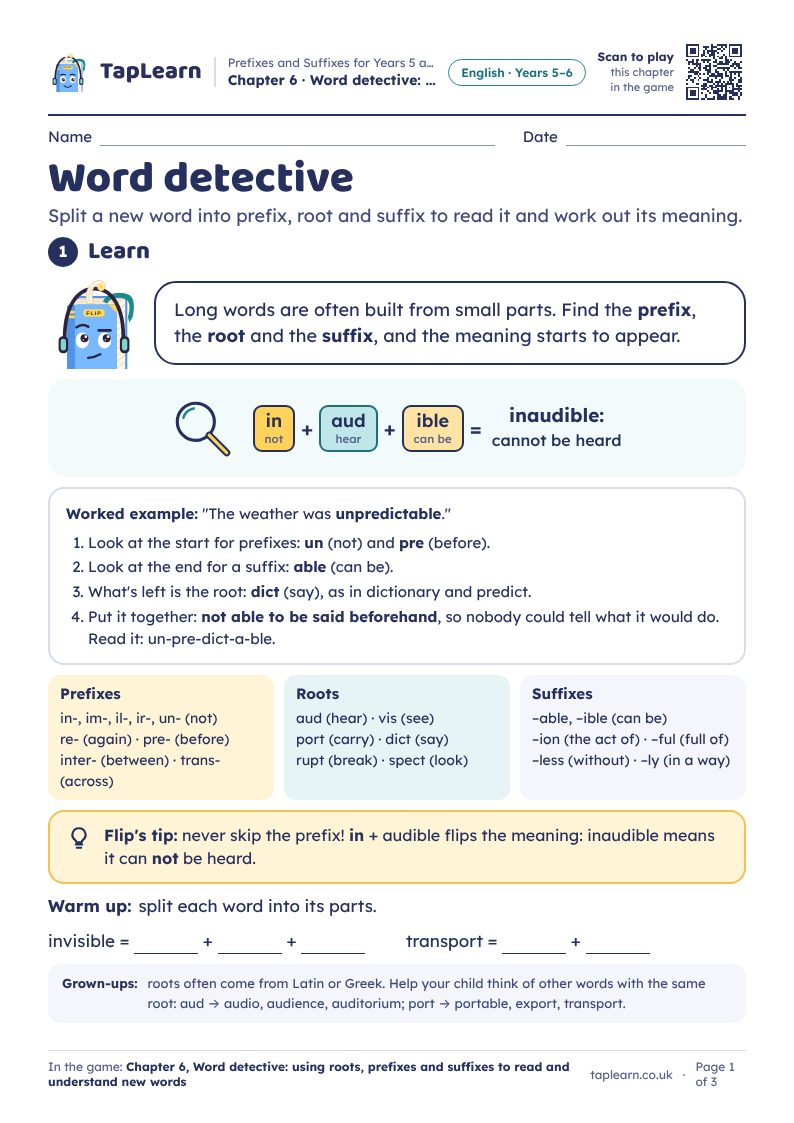
Word Detective is a printable root words worksheet for Years 5 and 6 (ages 9 to 11) that teaches children to find the prefix, root and suffix in a long word, like in + aud + ible, and put their meanings together. It covers the Years 5 to 6 statement on applying knowledge of root words, prefixes and suffixes to read aloud and understand new words.
This worksheet is for members
Membership opens every chapter of every game and every worksheet, for all your children.
See the plansAlready a member? Log in to print it.
Start with the free one: The 'shus' sound (chapter 1).
Print it on A4, in colour or black and white. Do it after the chapter, or before it to see what your child already knows.
What's on the worksheet
Your child splits long words into prefix, root and suffix, like in + aud + ible, to read them aloud and work out what they mean. Includes a book detective activity and an answers sheet.
- Page 1 · Learn
- Inaudible split into in + aud + ible, a worked example reading unpredictable, a bank of prefixes, roots and suffixes with meanings, Flip's tip never to skip the prefix, and a warm-up.
- Page 2 · Try it together
- Book detective: skim a page for long words with a prefix or suffix you know, split each into parts, guess its meaning from the parts and the sentence, then check a dictionary.
- Page 3 · Practise
- Match word parts to meanings, split words and write what they mean, explain words like irreplaceable and impassable, build words from parts, and a challenge about inaudible.
- Answers sheet
- Every answer, mix-ups like splitting in the wrong place, and a root-families idea.
3 A4 pages and an answers sheet · about 30 minutes
Using it at home
- Help your child spot each root in other words: aud in audio and audience, port in portable and export.
- In book detective, ask "What does the sentence around it tell us?" Parts plus context is what good readers use.
- Pick a root like spect, port or dict and take turns naming words that contain it.
Watch out for
- Forgetting what the prefix adds, like thinking inaudible means "can be heard".
- Always read the prefix's meaning first.
- Not knowing in- has two jobs.
- It can mean "not" (inaudible) or "in, into" (inside, inspect). The sentence tells you which.
- Splitting in the wrong place.
- Check each part is a prefix, root or suffix you know, and that the parts join to make the whole word.
Questions from the worksheet
- Draw a line to match each word part to its meaning: aud, vis, port, rupt, inter, trans.
- Split each word into its parts. Then write what it means: audible, portable, interruption, unbreakable.
- Use the word parts to explain the word: Gran's old ring is irreplaceable. (ir + re + place + able)
- Build a word from the parts to match each meaning: can be seen, not possible, carry across.
- Leo says, "Inaudible means 'can be heard', because it has aud (hear) and ible (can be)." Is he right? What has he missed?
The answers are on the answers sheet, for grown-ups.
National curriculum in England
This worksheet practises this statement from the Years 5–6 english programme of study:
- Apply their growing knowledge of root words, prefixes and suffixes (morphology and etymology), as listed in English appendix 1, both to read aloud and to understand the meaning of new words that they meet
In the classroom
- Display the parts bank and add new words to each root through the week.
- Give pairs a long word to split and explain to the class.
Questions and answers
What is a root word?
A root word is the main part of a word that carries its meaning, like aud (hear) in audible and audience.
How can prefixes and suffixes help children understand new words?
Splitting a word into parts and putting their meanings together, like in (not) + aud (hear) + ible (can be), gives cannot be heard.
What does the root port mean?
Port means carry, as in portable (can be carried) and transport (carry across).
More worksheets from Prefixes and Suffixes for Years 5 and 6: Tink's Word Workshop
- Chapter 1: Cious and tious worksheet: The 'shus' sound Free
- Chapter 2: Ant, ance, ent and ence worksheet: –ant or –ent? Members
- Chapter 3: Able and ible worksheet: –able or –ible? Members
- Chapter 4: Suffix spelling rules worksheet Members
- Chapter 5: Hyphens after prefixes worksheet: Prefix hyphens Members
 TapLearn