Ant, ance, ent and ence worksheet for Years 5–6: –ant or –ent?
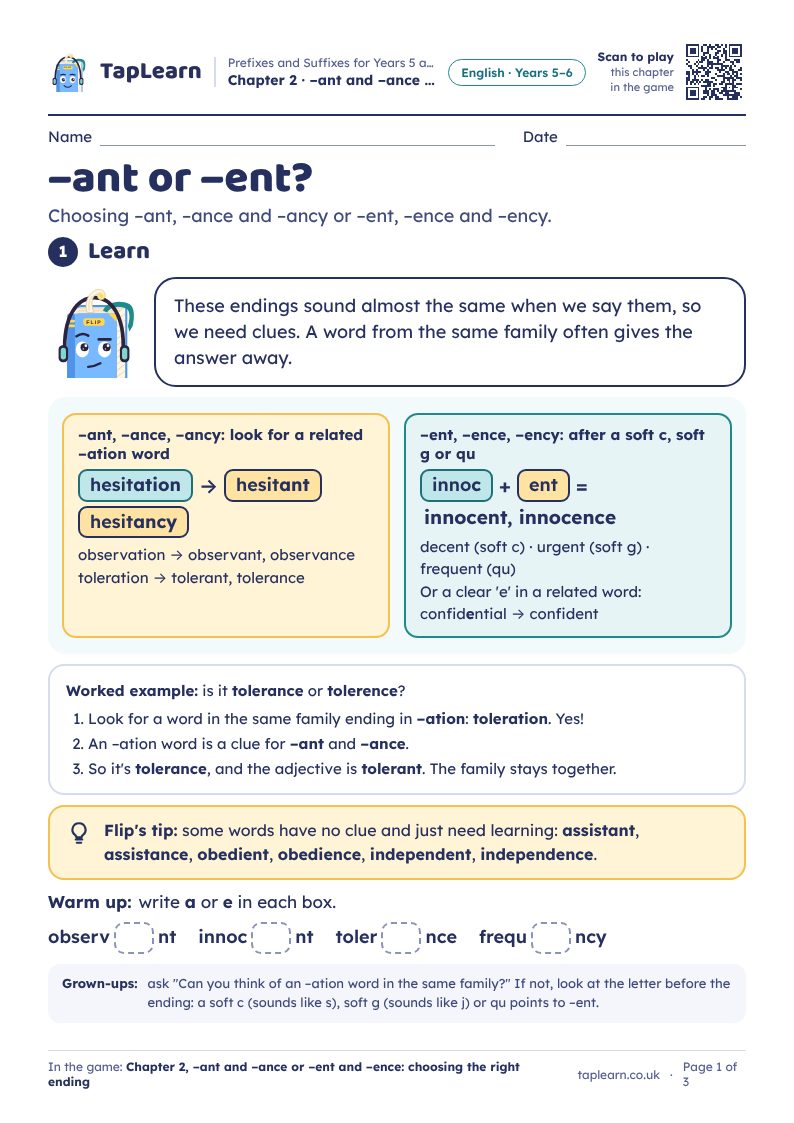
-ant or -ent? is a printable ant, ance, ent and ence worksheet for Years 5 and 6 (ages 9 to 11) that teaches children that a related -ation word points to -ant and -ance, while a soft c, soft g or qu before the ending points to -ent and -ence. It covers the Years 5 to 6 statement on using further prefixes and suffixes and understanding the guidance for adding them.
This worksheet is for members
Membership opens every chapter of every game and every worksheet, for all your children.
See the plansAlready a member? Log in to print it.
Start with the free one: The 'shus' sound (chapter 1).
Print it on A4, in colour or black and white. Do it after the chapter, or before it to see what your child already knows.
What's on the worksheet
Your child chooses -ant, -ance and -ancy or -ent, -ence and -ency using clues: a related -ation word, or a soft c, soft g or qu before the ending. Includes a word family cards game and an answers sheet.
- Page 1 · Learn
- The clues for -ant/-ance and -ent/-ence with example families, a worked example deciding tolerance or tolerence, Flip's tip on words with no clue, and a write-a-or-e warm-up.
- Page 2 · Try it together
- Word family cards: turn over clue words like hesitation and innocent, decide which clue each gives, say the other members of its family, and check they all use the same letter.
- Page 3 · Practise
- Write the noun from the same family, write a or e with the clue used, ring correct spellings, learn three no-clue words, and a challenge about tolerence.
- Answers sheet
- Every answer, mix-ups like changing letter within a family, and family-trees and hard-or-soft ideas.
3 A4 pages and an answers sheet · about 30 minutes
Using it at home
- If your child is unsure, look at the letter before the ending: a soft c (sounds like s), soft g (sounds like j) or qu points to -ent.
- In the card game, say "innocant" aloud to show how wrong it sounds: an a after c or g would make it hard, which is why -ent is used.
- Say an -ation word like expectation and your child says the -ant and -ance or -ancy words.
Watch out for
- Mixing up -ant and -ent, like tolerence or innocance.
- Ask, "Is there an -ation word in the family? What letter comes just before the ending?"
- Changing letter within a family.
- If the adjective is -ant, the noun is -ance or -ancy; if it is -ent, the noun is -ence or -ency.
- Expecting a rule for every word.
- The clues help often but not always. Words like assistant and obedient need to be learnt.
Questions from the worksheet
- Write the noun from the same family. Keep the same letter: tolerant, observant, innocent, frequent, urgent, confident.
- Write a or e, then the clue that helped you: expect_nt, dec_nt, hesit_nt, urg_nt.
- Ring the correct spelling: Our teacher shows great tolerance / tolerence. The judge believed in his innocance / innocence.
- Sam wrote tolerence. He says, "I used -ence because that's how it sounds." Is he right? What clue could he use?
The answers are on the answers sheet, for grown-ups.
National curriculum in England
This worksheet practises this statement from the Years 5–6 english programme of study:
- Use further prefixes and suffixes and understand the guidance for adding them
In the classroom
- Make word family trees on the board from -ation words.
- Use Practise C as a quick-fire spelling check on mini whiteboards.
Questions and answers
How do you know whether to use -ance or -ence?
Look for clues. A related -ation word points to -ance (toleration, tolerance). A soft c, soft g or qu before the ending points to -ence (innocence).
Do word families keep the same ending letter?
Yes. If the adjective ends -ant, the noun ends -ance or -ancy; if it ends -ent, the noun ends -ence or -ency.
Which -ant and -ent words have no clue?
Words like assistant, obedient and independent have no clue and need learning by heart.
 TapLearn