Able and ible worksheet for Years 5–6: –able or –ible?
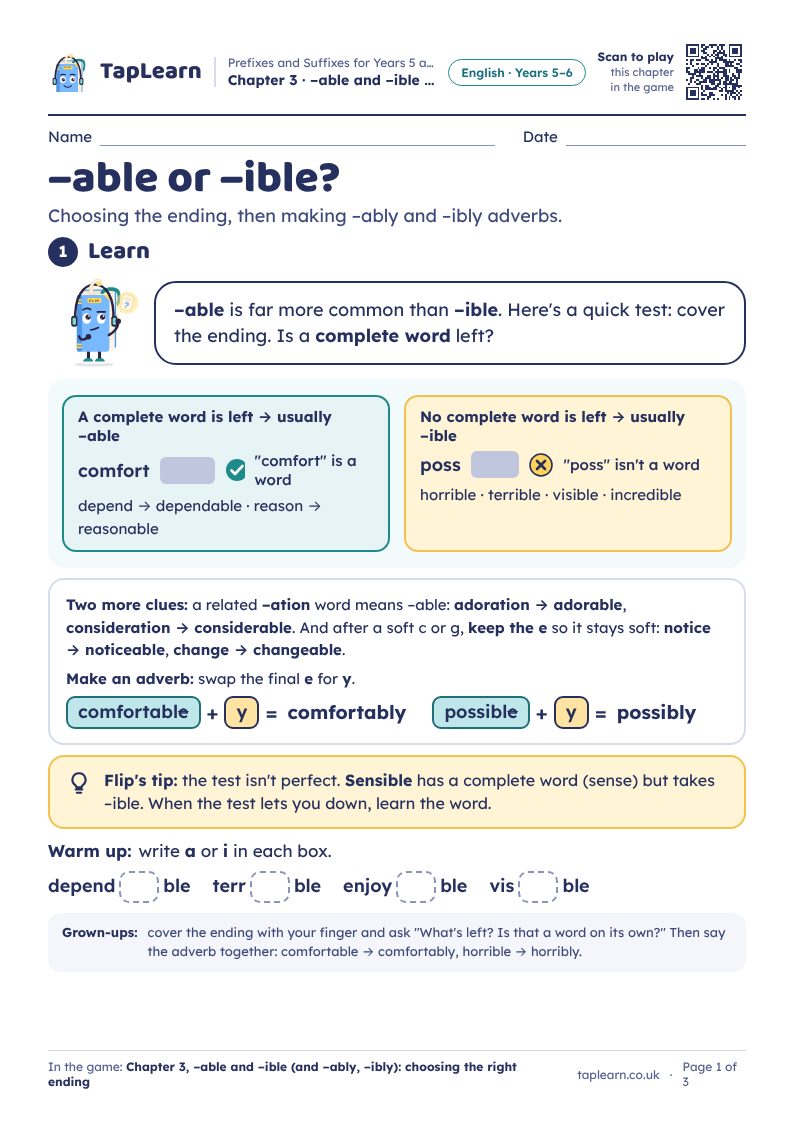
-able or -ible? is a printable able and ible worksheet for Years 5 and 6 (ages 9 to 11) that teaches children to cover the ending: a complete word left usually means -able, no complete word usually means -ible. It covers the Years 5 to 6 statement on using further prefixes and suffixes and understanding the guidance for adding them.
This worksheet is for members
Membership opens every chapter of every game and every worksheet, for all your children.
See the plansAlready a member? Log in to print it.
Start with the free one: The 'shus' sound (chapter 1).
Print it on A4, in colour or black and white. Do it after the chapter, or before it to see what your child already knows.
What's on the worksheet
Your child chooses -able or -ible with the cover-up test and -ation clues, keeps the e in words like noticeable, and turns the words into -ably and -ibly adverbs. Includes a cover-up test book hunt and an answers sheet.
- Page 1 · Learn
- The cover-up test with comfortable and possible, -ation and soft c and g clues, how to make -ably and -ibly adverbs, Flip's tip on sensible, and a write-a-or-i warm-up.
- Page 2 · Try it together
- The cover-up test: skim a book for words ending in -able or -ible, cover the ending to see if a complete word is left, then turn each into an -ably or -ibly adverb.
- Page 3 · Practise
- Add -able or -ible, make adverbs, use -ation clues, ring whether to keep the e, write a sentence with possibly or comfortably, and a challenge about reasonible.
- Answers sheet
- Every answer, mix-ups like comfortablely, and quick-fire test and adverb-story ideas.
3 A4 pages and an answers sheet · about 30 minutes
Using it at home
- Make the adverb together by swapping the final e for y: comfortable to comfortably, horrible to horribly.
- In the book hunt, words where the test doesn't work, like sensible, are worth learning by heart.
- Take turns adding a sentence to a story using an -ably or -ibly word.
Watch out for
- Mixing up -able and -ible, like reasonible.
- Do the cover-up test.
- Dropping the e after a soft c or g, like noticable.
- Without the e, the c or g would sound hard before the a.
- Spelling adverbs like comfortablely.
- Swap the e for y: comfortably.
Questions from the worksheet
- Add -able or -ible and write the whole word: understand, break, reason, horr..., vis..., ed...
- Turn each word into an adverb ending in -ably or -ibly: comfortable, terrible, reasonable, visible.
- Use the -ation clue to write the -able word: adoration, application, consideration, toleration.
- Keep the e or not? Ring the correct spelling: noticable / noticeable, changeable / changable.
- Ava wrote: "That's a reasonible idea." Is her spelling right? Use the cover-up test to explain.
The answers are on the answers sheet, for grown-ups.
National curriculum in England
This worksheet practises this statement from the Years 5–6 english programme of study:
- Use further prefixes and suffixes and understand the guidance for adding them
In the classroom
- Play the quick-fire test: say depend, poss, enjoy, terr and pupils spell the -able or -ible word.
- Hunt for -able and -ible words in a class novel and test each one.
Questions and answers
How do you know whether to use -able or -ible?
Cover the ending. If a complete word is left, it's usually -able (comfortable). If not, it's usually -ible (possible).
Why does noticeable keep the e?
The e keeps the c soft. Without it, the c would sound hard before the a.
How do you make -ably and -ibly adverbs?
Swap the final e for y: comfortable becomes comfortably and possible becomes possibly.
More worksheets from Prefixes and Suffixes for Years 5 and 6: Tink's Word Workshop
- Chapter 1: Cious and tious worksheet: The 'shus' sound Free
- Chapter 2: Ant, ance, ent and ence worksheet: –ant or –ent? Members
- Chapter 4: Suffix spelling rules worksheet Members
- Chapter 5: Hyphens after prefixes worksheet: Prefix hyphens Members
- Chapter 6: Root words worksheet: Word detective Members
 TapLearn