Suffix spelling rules worksheet for Years 5–6
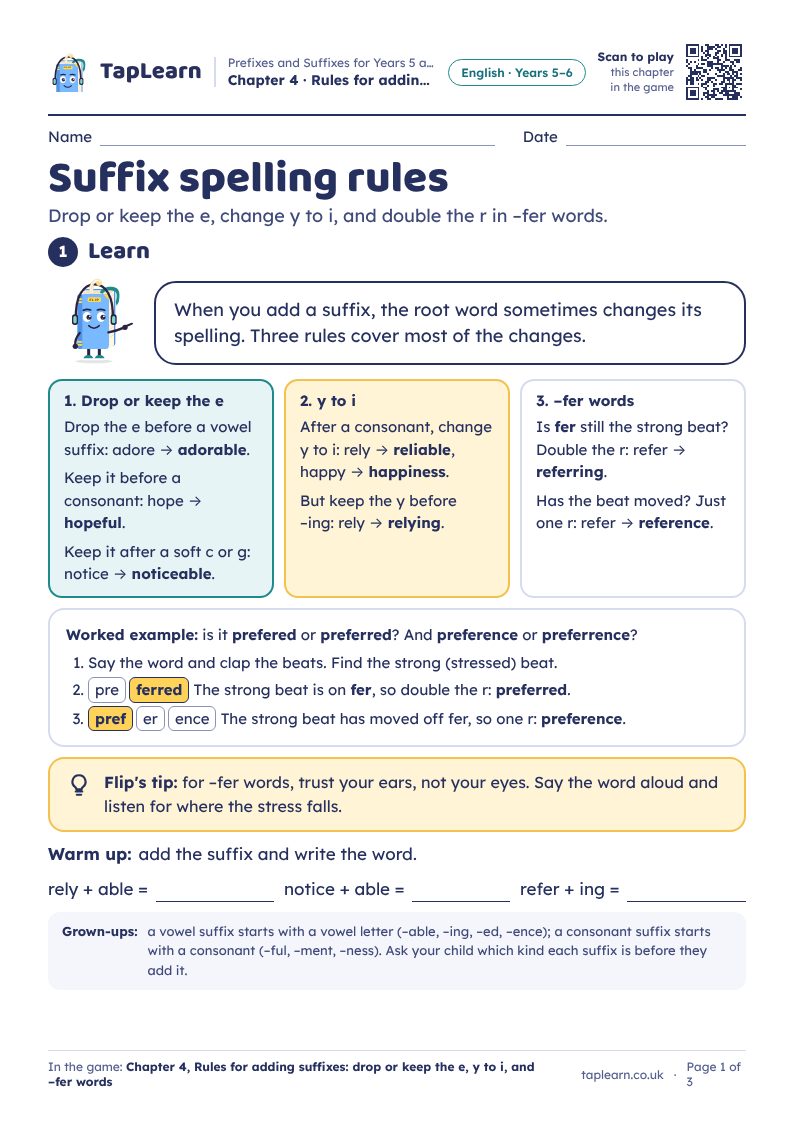
Suffix Spelling Rules is a printable suffix spelling rules worksheet for Years 5 and 6 (ages 9 to 11) that teaches three rules: drop or keep the e, change y to i, and double the r in -fer words when the strong beat stays on fer. It covers the Years 5 to 6 statement on using further prefixes and suffixes and understanding the guidance for adding them.
This worksheet is for members
Membership opens every chapter of every game and every worksheet, for all your children.
See the plansAlready a member? Log in to print it.
Start with the free one: The 'shus' sound (chapter 1).
Print it on A4, in colour or black and white. Do it after the chapter, or before it to see what your child already knows.
What's on the worksheet
Your child practises the rules for adding suffixes: drop or keep the e, change y to i, and double the r in -fer words when the stress stays on fer. Includes a clap-the-beat activity and an answers sheet.
- Page 1 · Learn
- Three suffix rules with examples, a worked example deciding preferred and preference by the strong beat, Flip's tip to trust your ears for -fer words, and an add-the-suffix warm-up.
- Page 2 · Try it together
- Clap the beat: the grown-up reads -fer words aloud, you clap each beat and stamp on the strong one, then decide whether the r doubles and write the spelling.
- Page 3 · Practise
- Drop or keep the e, change y to i or keep it, choose one r or two in -fer words, spot mistakes and name the rule, and a challenge about referring and reference.
- Answers sheet
- Every answer, mix-ups like keeping the y, and a stress-swap idea.
3 A4 pages and an answers sheet · about 30 minutes
Using it at home
- Before adding a suffix, ask whether it starts with a vowel (-able, -ous) or a consonant (-ful, -ment, -ness).
- In clap the beat, transfer + ed has the strong beat on the first syllable, so fer isn't stressed and the r stays single.
- Say pairs like referring and reference, stamping on the strong beat each time.
Watch out for
- Dropping the e after a soft c or g, like noticable.
- The e keeps the c or g soft before -able or -ous.
- Keeping the y, like relyable.
- After a consonant, y changes to i, except before -ing (relying).
- Getting -fer doubling wrong, like prefered.
- Say it aloud: stress on fer means double r; stress moved means one r.
Questions from the worksheet
- Drop the e or keep it? adore + able, hope + ful, change + able, excite + ment, courage + ous.
- y to i, or keep the y? deny + al, happy + ness, rely + ing, rely + ance, carry + ed.
- -fer words: one r or two? Say each word aloud first: refer + ed, refer + ence, prefer + ence, transfer + ing.
- Spot the mistake and write it correctly. Name the rule: noticable, relyable, prefered.
- Sam says, "Referring has a double r, so reference must have one too." Is he right? Explain why.
The answers are on the answers sheet, for grown-ups.
National curriculum in England
This worksheet practises this statement from the Years 5–6 english programme of study:
- Use further prefixes and suffixes and understand the guidance for adding them
In the classroom
- Clap -fer words as a class, stamping on the strong beat.
- Use Practise D as an editing starter: find the mistake and name the rule.
Questions and answers
When do you drop the e before a suffix?
Drop the e before a suffix that starts with a vowel (adore, adorable), but keep it before a consonant (hope, hopeful) and after a soft c or g (noticeable).
When does y change to i?
After a consonant, change y to i before most suffixes (rely, reliable), but keep the y before -ing (relying).
When do you double the r in -fer words?
Double the r if the strong beat stays on fer (referring). If the beat moves, use one r (reference).
More worksheets from Prefixes and Suffixes for Years 5 and 6: Tink's Word Workshop
- Chapter 1: Cious and tious worksheet: The 'shus' sound Free
- Chapter 2: Ant, ance, ent and ence worksheet: –ant or –ent? Members
- Chapter 3: Able and ible worksheet: –able or –ible? Members
- Chapter 5: Hyphens after prefixes worksheet: Prefix hyphens Members
- Chapter 6: Root words worksheet: Word detective Members
 TapLearn