Numbers in words worksheet for Year 5
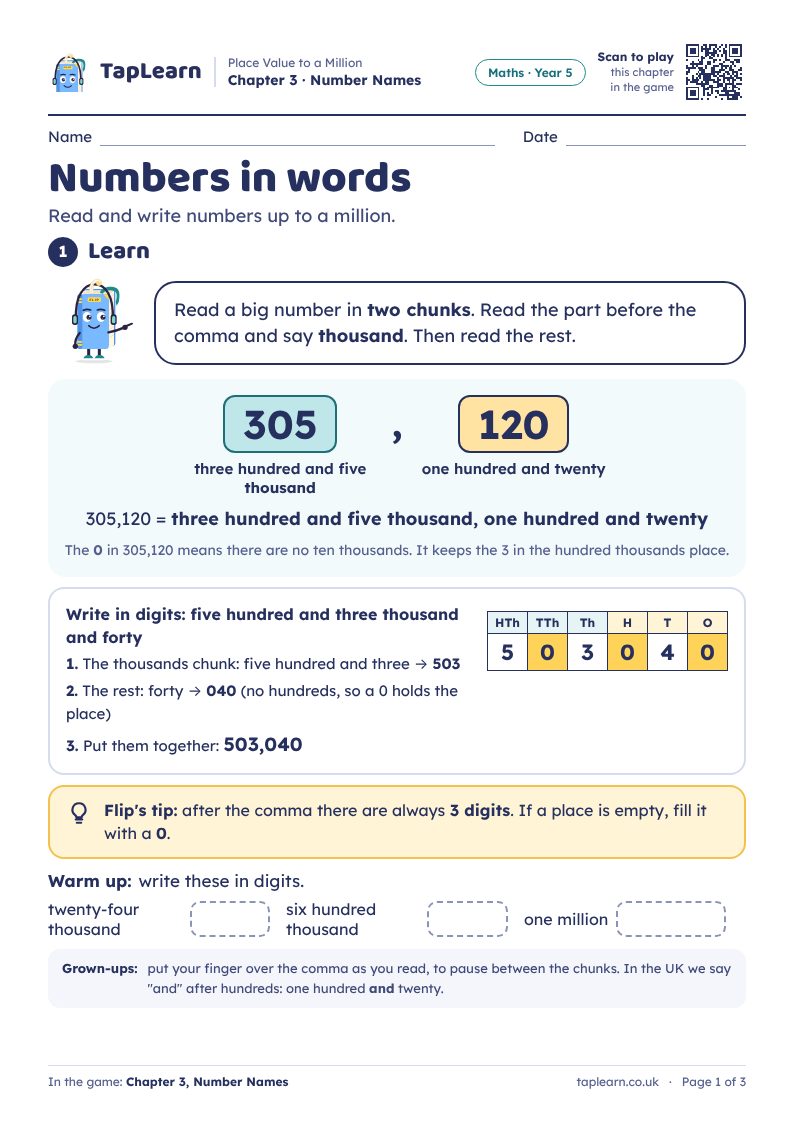
Numbers in Words is a printable numbers in words worksheet for Year 5 (ages 9 to 10) that teaches children to read and write numbers up to a million in words and in digits, using 0 to hold empty places. It covers the Year 5 maths statement to read and write numbers to at least 1,000,000.
Free to print, no account needed.
Print it on A4, in colour or black and white. Do it after the chapter, or before it to see what your child already knows.
What's on the worksheet
Your child reads and writes numbers up to a million in words and in digits, reading them in two chunks and using zeros to hold empty places. Includes a zero traps activity to do together and an answers sheet.
- Page 1 · Learn
- How to read 305,120 in two chunks around the comma, a worked example writing five hundred and three thousand and forty in digits, and a warm-up.
- Page 2 · Try it together
- Zero traps: a grown-up reads numbers like 405,030 aloud for the child to write in digits, then the child writes a number full of zeros for the grown-up to read. Then write numbers in digits.
- Page 3 · Practise
- Write numbers like 104,025 in words, join number names to numbers, ring the right number for a name, and a challenge about writing 706,020.
- Answers sheet
- Every answer with accepted wordings, mix-ups like 530,040 for 503,040, and two reading-big-numbers games.
3 A4 pages and an answers sheet · about 30 minutes
Using it at home
- Put your finger over the comma as you read a number together, to pause between the two chunks.
- In zero traps, say "thousand" a little louder so your child hears where the comma goes.
- If your child writes 7,2600, count the digits after the comma together: there are always exactly 3.
Watch out for
- Putting zeros in the wrong place, like 530,040 for 503,040.
- Write each chunk on its own first: five hundred and three is 503, forty is 040.
- Writing too many digits, like 70,0009 for seventy thousand and nine.
- After the comma there are always exactly 3 digits.
- Reading a big number digit by digit.
- Cover the last 3 digits, read the first chunk, say "thousand", then read the rest.
Questions from the worksheet
- Write these numbers in digits: seventy thousand and nine
- Write these numbers in words: 104,025
- Draw a ring round the right number: one hundred thousand and one
- Join each name to its number: thirty thousand and thirty, three hundred thousand, three hundred, thirty-three thousand.
- Leo writes seven hundred and six thousand and twenty as 760,020. Is he right? What should he write? Explain how you know.
The answers are on the answers sheet, for grown-ups.
National curriculum in England
This worksheet practises these statements from the Year 5 maths programme of study:
- Read, write, order and compare numbers to at least 1,000,000 and determine the value of each digit
- Count forwards or backwards in steps of powers of 10 for any given number up to 1,000,000
- Solve number problems and practical problems that involve all of the above
Source: National curriculum in England: mathematics programmes of study (DfE)
In the classroom
- Run zero traps as a whole-class dictation: read numbers aloud and children write them on mini-whiteboards.
- Use the spot-my-mistake idea as a starter: write a number wrongly on purpose and ask children to fix it.
Questions and answers
How do you read a six-digit number?
Read it in two chunks. Read the part before the comma and say "thousand", then read the rest: 305,120 is three hundred and five thousand, one hundred and twenty.
Why do we use zero as a placeholder?
A zero shows a place is empty and keeps the other digits in the right places. In 305,120 the 0 shows there are no ten thousands.
Do you write 'and' in large numbers?
In the UK we usually say "and" after hundreds, as in one hundred and twenty. Small differences in commas or "and" are fine if the words say the same number.
 TapLearn