Value of each digit worksheet for Year 5: What's it worth?
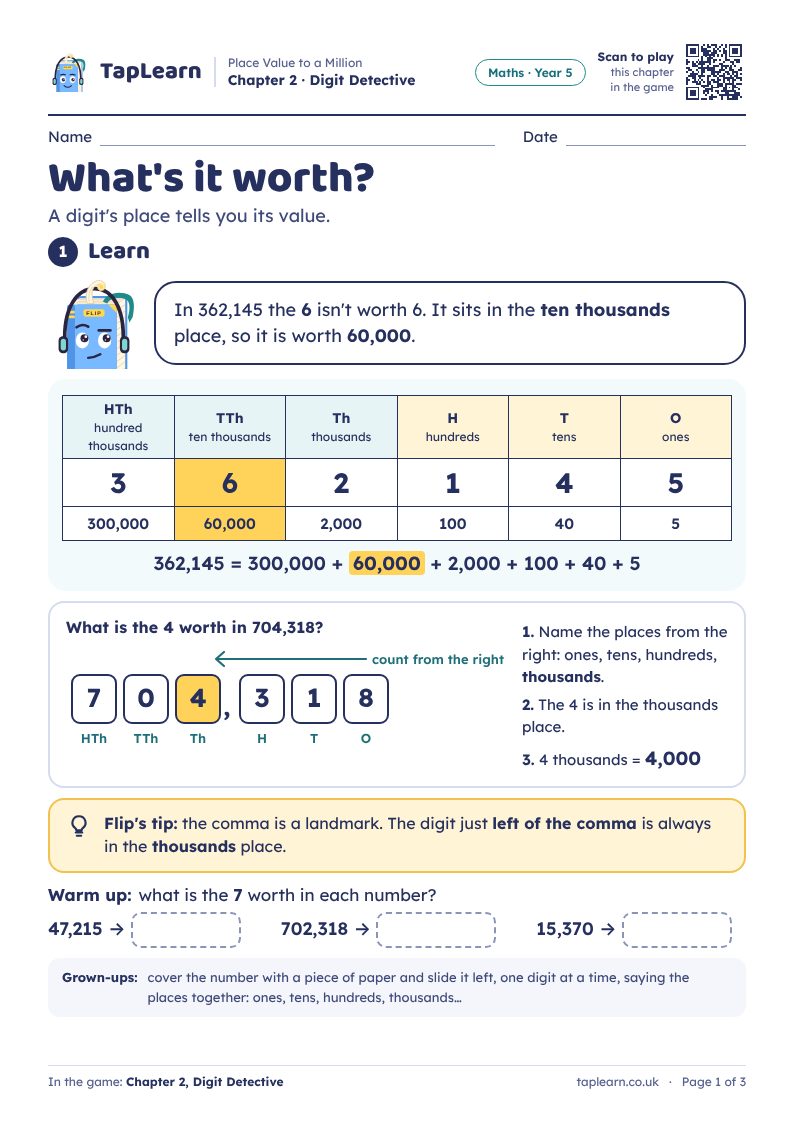
What's It Worth? is a printable value of each digit worksheet for Year 5 (ages 9 to 10) that teaches children to find the value of any digit in a six-digit number and to split numbers into the values of their digits. It covers the Year 5 maths statement to determine the value of each digit in numbers to at least 1,000,000.
Free to print, no account needed.
Print it on A4, in colour or black and white. Do it after the chapter, or before it to see what your child already knows.
What's on the worksheet
Your child finds the value of every digit in a six-digit number, splits numbers into the values of their digits and solves a mystery number from clues. Includes a detective card game with digit cards and an answers sheet.
- Page 1 · Learn
- 362,145 in a place value chart split into the value of each digit, a worked example finding the 4 in 704,318, a tip on using the comma, and a warm-up.
- Page 2 · Try it together
- Detective cards: turn over six digit cards to make a number, then take turns pointing at a digit and saying its place and value. Then find what the 8 is worth in five numbers.
- Page 3 · Practise
- Ring every number where the 3 is worth 30,000, split numbers into the values of their digits and back again, a clue-based mystery number, and a challenge about 247,903.
- Answers sheet
- Every answer, a quick check for the number of zeros in a value, the mix-ups to watch for, and two digit-value games for home.
3 A4 pages and an answers sheet · about 30 minutes
Using it at home
- Cover a number with paper and slide it left one digit at a time, saying the places together: ones, tens, hundreds, thousands.
- If your child says a digit is worth just itself, ask "Which place is it in?" and count the places from the right.
- After a round of detective cards, swap two cards and ask which digits changed value.
Watch out for
- Putting a digit in the wrong place, like reading the 6 in 362,145 as 6,000.
- Name the places from the right, or use the comma: the digit just left of it is the thousands.
- Writing values for zeros when splitting a number.
- In 47,090 there are no hundreds or ones, so they are left out: 40,000 + 7,000 + 90.
- Too many or too few zeros in a value.
- A digit's value has one 0 for each place to its right.
Questions from the worksheet
- What is the 8 worth in each number? 845,120, 58,031, 120,086, 980,000, 3,218
- Draw a ring round every number where the 3 is worth 30,000: 130,452, 435,000, 803,215, 31,600, 300,000, 23,040
- Split each number into the values of its digits: 506,213 = ___
- Mystery number: I have six digits. My hundred thousands digit is 4. I have no ten thousands. My thousands digit is worth 6,000. What am I?
- Sam says, "The 4 in 247,903 is worth 4,000." Is he right? What is it really worth? Explain how you know.
The answers are on the answers sheet, for grown-ups.
National curriculum in England
This worksheet practises these statements from the Year 5 maths programme of study:
- Read, write, order and compare numbers to at least 1,000,000 and determine the value of each digit
- Count forwards or backwards in steps of powers of 10 for any given number up to 1,000,000
- Solve number problems and practical problems that involve all of the above
Source: National curriculum in England: mathematics programmes of study (DfE)
In the classroom
- Play detective cards in pairs, then ask pairs to swap two cards and explain how the value of each digit changed.
- Use Practise B as a mini-whiteboard check: show a number and children write what the 3 is worth.
Questions and answers
How do you find the value of a digit in a large number?
Find which place the digit is in by counting from the right, then give it that place's value. In 362,145 the 6 is in the ten thousands place, so it is worth 60,000.
What does partitioning a six-digit number mean?
It means splitting the number into the values of its digits. For example, 506,213 = 500,000 + 6,000 + 200 + 10 + 3.
How does the comma help with place value?
The digit just left of the comma is always in the thousands place, so it is a quick landmark for finding the other places.
 TapLearn