Comparing large numbers worksheet for Year 5: Which is bigger?
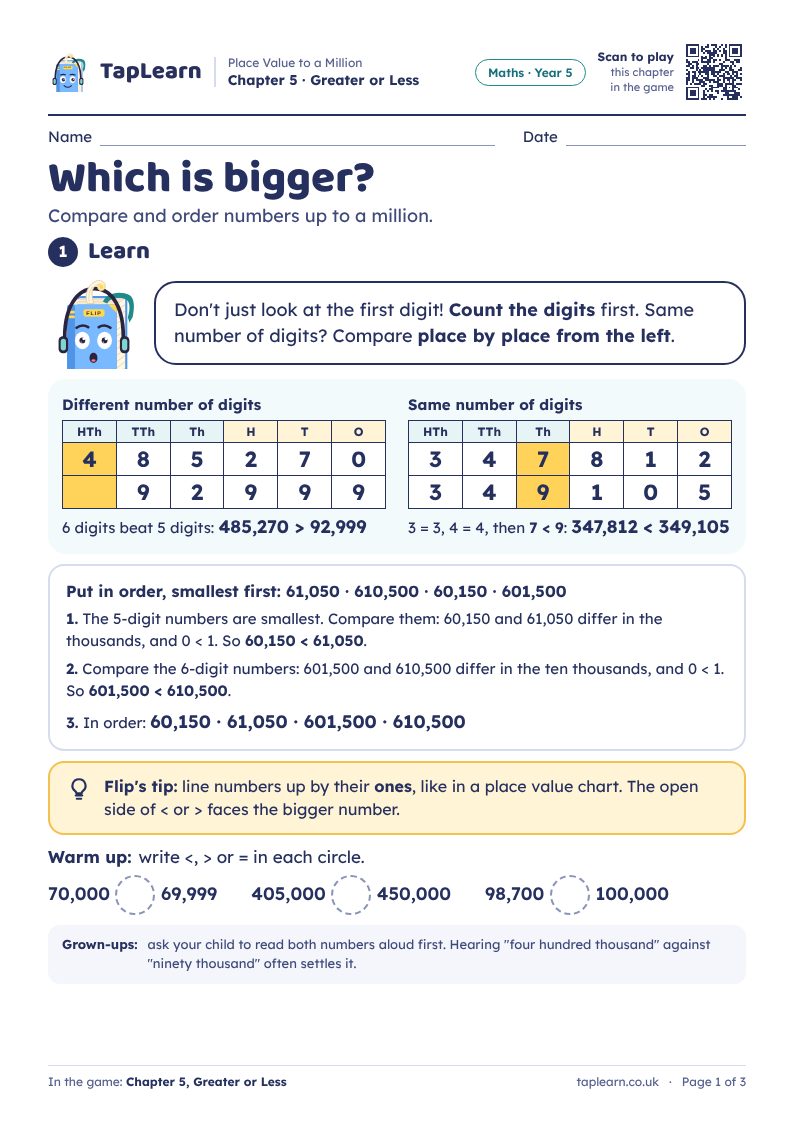
Which Is Bigger? is a printable comparing large numbers worksheet for Year 5 (ages 9 to 10) that teaches children to compare and order numbers up to a million by counting the digits first and then comparing place by place. It covers the Year 5 maths statement to order and compare numbers to at least 1,000,000.
Free to print, no account needed.
Print it on A4, in colour or black and white. Do it after the chapter, or before it to see what your child already knows.
What's on the worksheet
Your child compares numbers up to a million with <, > and = and puts them in order, by counting the digits first and then comparing place by place. Includes a biggest-and-smallest digit card game and an answers sheet.
- Page 1 · Learn
- Place value charts compare numbers with different and equal numbers of digits, a worked example ordering 61,050, 610,500, 60,150 and 601,500, and a <, > or = warm-up.
- Page 2 · Try it together
- Biggest and smallest: turn over six digit cards, the child makes the biggest number and the grown-up the smallest, then compare them and make one in between.
- Page 3 · Practise
- Write <, > or = between pairs, order sets of four numbers, find missing digits, order four rockets by distance, and a challenge about 73,850 and 412,600.
- Answers sheet
- Every answer including all the possible missing digits, mix-ups like comparing first digits only, and higher-or-lower and ordering games.
3 A4 pages and an answers sheet · about 30 minutes
Using it at home
- Ask your child to read both numbers aloud before comparing. Hearing "four hundred thousand" against "ninety thousand" often settles it.
- In biggest and smallest, ask "How did you know where to put the biggest digit?"
- Remind your child that the smallest number can't start with 0 when they make it from the cards.
Watch out for
- Comparing the first digits only, as in thinking 73,850 > 412,600.
- Count the digits first: a 6-digit number is always bigger than a 5-digit one.
- Lining up numbers from the left when they have different lengths.
- Line numbers up by their ones digit, as in a place value chart.
- Mixing up < and >.
- The open side faces the bigger number. Say "is less than" or "is greater than" aloud.
Questions from the worksheet
- Write <, > or = in each circle: 730,100 and 730,010
- Write each set in order, smallest first: 345,600, 354,060, 34,560, 345,060
- Missing digits: 4_2,500 < 432,000. Which digits could go in the box? Find them all.
- Write the rockets in order, the greatest distance first: Comet 506,300 km, Nova 560,030 km, Orbit 56,300 km, Star 506,030 km.
- Mia says, "73,850 is bigger than 412,600, because 7 is bigger than 4." Is she right? Explain how you know.
The answers are on the answers sheet, for grown-ups.
National curriculum in England
This worksheet practises these statements from the Year 5 maths programme of study:
- Read, write, order and compare numbers to at least 1,000,000 and determine the value of each digit
- Count forwards or backwards in steps of powers of 10 for any given number up to 1,000,000
- Solve number problems and practical problems that involve all of the above
Source: National curriculum in England: mathematics programmes of study (DfE)
In the classroom
- Play biggest and smallest in pairs, then line up the class's biggest numbers in order across the room.
- Use Practise A as a show-me check: children write the sign on mini-whiteboards for each pair.
Questions and answers
How do you compare numbers up to a million?
Count the digits first: the number with more digits is bigger. If they have the same number of digits, compare place by place from the left until the digits differ.
How do you order large numbers?
Sort them by how many digits they have, then compare each group place by place from the left. For example, 60,150 < 61,050 < 601,500 < 610,500.
Why is 73,850 smaller than 412,600?
73,850 has 5 digits and 412,600 has 6. The 7 is worth 70,000 but the 4 is worth 400,000.
 TapLearn