Place value problems worksheet for Year 6: Place value puzzles
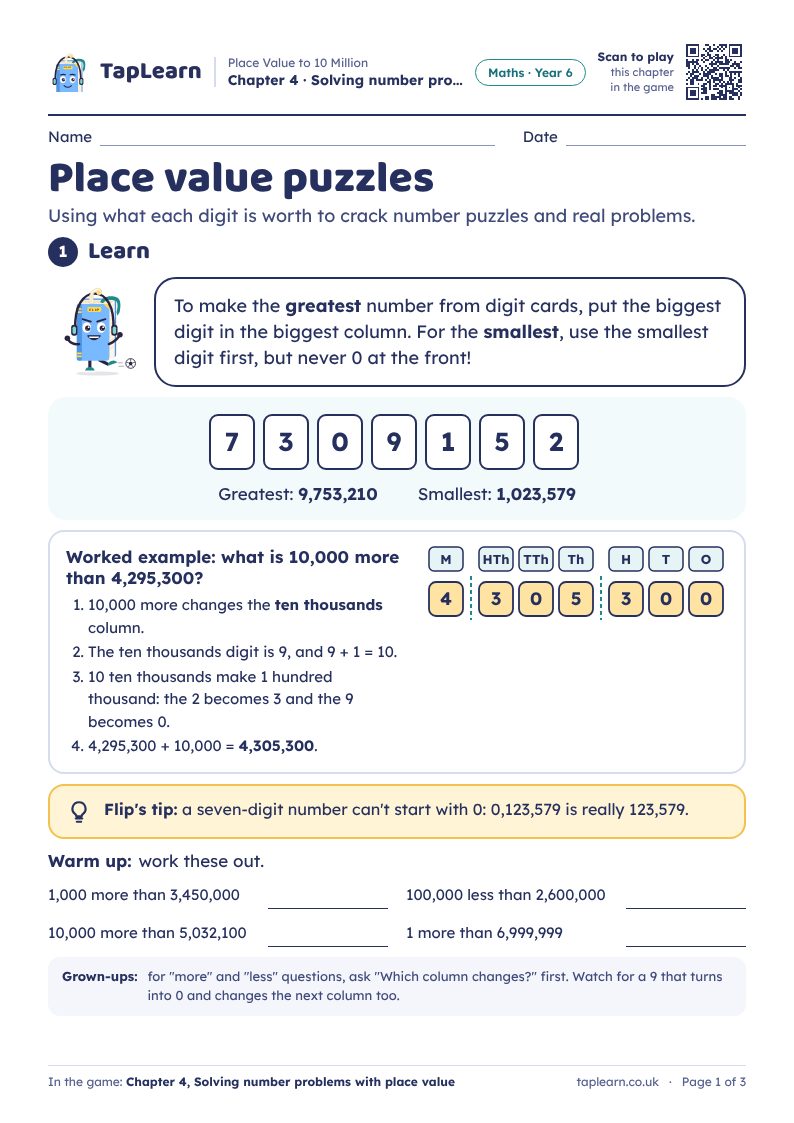
Place Value Puzzles is a printable place value problems worksheet for Year 6 (ages 10 to 11) that teaches children to use what each digit is worth to make numbers from digit cards and solve real problems. It covers the Year 6 maths statement to solve number and practical problems involving reading, writing, ordering and comparing numbers up to 10,000,000.
Free to print, no account needed.
Print it on A4, in colour or black and white. Do it after the chapter, or before it to see what your child already knows.
What's on the worksheet
Your child makes the greatest and smallest numbers from digit cards, finds 10,000 or 100,000 more or less, and solves real-life problems with numbers up to ten million. Includes a digit race game and an answers sheet.
- Page 1 · Learn
- The greatest and smallest numbers from 7 digit cards, a worked example finding 10,000 more than 4,295,300, Flip's tip that a seven-digit number can't start with 0, and a warm-up.
- Page 2 · Try it together
- Digit race: pick 7 digit scraps, both make the greatest seven-digit number you can and compare, then both make the smallest, remembering 0 can't go first.
- Page 3 · Practise
- Find 10,000 more, 100,000 more and 1,000,000 less, make numbers from digit cards, solve city, space probe and mystery number problems, and a challenge.
- Answers sheet
- Every answer, mix-ups like a zero at the front of the smallest number, and card shuffle and ten-thousand-more ideas.
3 A4 pages and an answers sheet · about 25 minutes
In the classroom
- Play digit race in pairs as a starter, then share the greatest numbers made.
- Use the mystery number problem as a model, then have pairs write their own for another pair to solve.
Questions from the worksheet
- A city has 2,456,300 people. 10,000 more move in. How many people live there now?
- I have 7 digits. My millions digit is 3 and my ten thousands digit is 8. All my other digits are 0. What number am I?
- Which is greater, 989,999 or 1,000,000? How much greater?
- Sam used the digits 0, 3, 5, 6, 7, 8 and 9 to make the smallest seven-digit number. He wrote 0,356,789. Is he right? What should it be?
The answers are on the answers sheet, for grown-ups.
National curriculum in England
This worksheet practises this statement from the Year 6 maths programme of study:
- Solve number and practical problems that involve all of the above
Source: National curriculum in England: mathematics programmes of study (DfE)
Using it at home
- For more and less questions, ask "Which column changes?" first, and watch for a 9 that turns into 0.
- In digit race, ask your child to explain their smallest number: "Why does the 0 go second, not first?"
- Say 7 digits aloud and ask your child for the greatest number they make, with no paper.
Watch out for
- Putting a zero at the front of the smallest number.
- Ask "How many digits does it really have?" 0,356,789 is really 356,789.
- Changing the wrong digit for 10,000 or 100,000 more.
- Point to the column first, then change that digit.
- Comparing only the first digit, thinking 989,999 is more than 1,000,000.
- Count the digits: 989,999 has 6 and 1,000,000 has 7.
Questions and answers
How do you make the smallest seven-digit number from digit cards?
Put the smallest digit that isn't 0 first, then the rest in order from smallest. From 0, 3, 5, 6, 7, 8 and 9 it is 3,056,789.
How do you find 10,000 more than a number?
Add 1 to the ten thousands digit. If that digit is 9, it becomes 0 and the hundred thousands digit goes up by 1: 4,295,300 becomes 4,305,300.
Can a seven-digit number start with 0?
No. A number starting with 0 is really shorter: 0,123,579 is 123,579, a six-digit number.
 TapLearn