Comparing and ordering large numbers worksheet for Year 6: Which is greater?
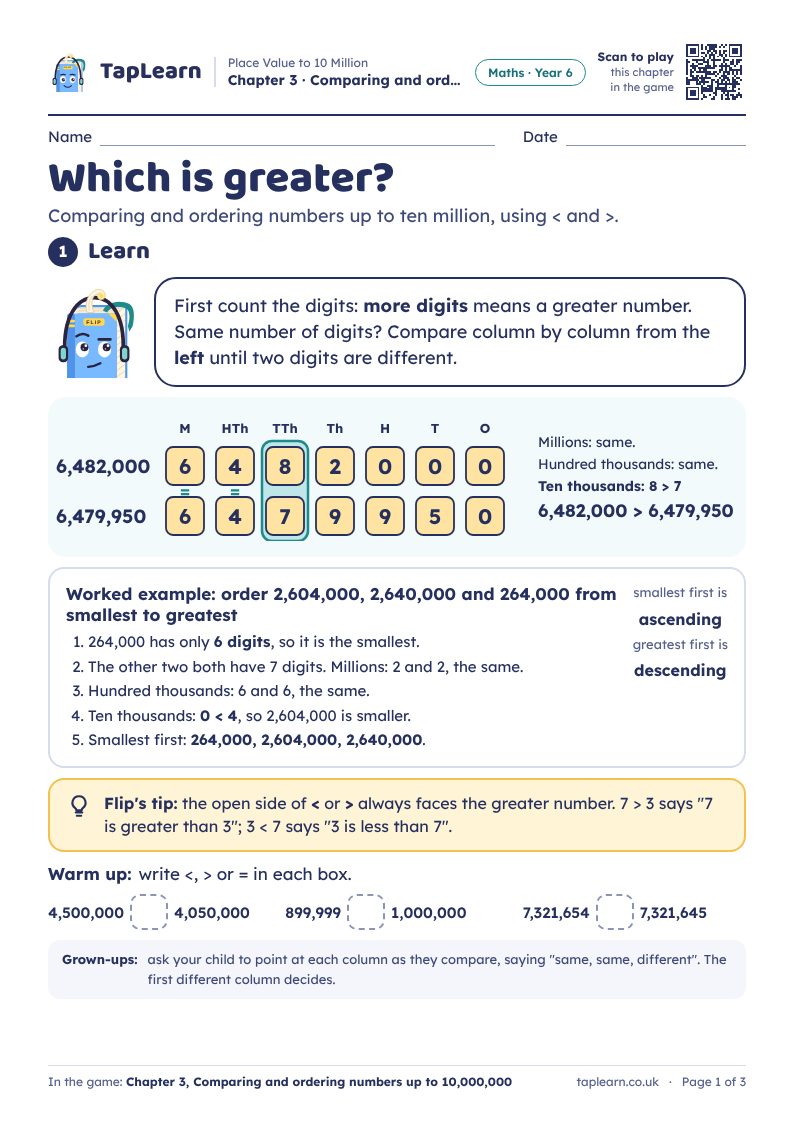
Which Is Greater? is a printable comparing and ordering large numbers worksheet for Year 6 (ages 10 to 11) that teaches children to count the digits first, then compare column by column from the left. It covers the Year 6 maths statement to read, write, order and compare numbers up to 10,000,000 and determine the value of each digit.
Free to print, no account needed.
Print it on A4, in colour or black and white. Do it after the chapter, or before it to see what your child already knows.
What's on the worksheet
Your child compares numbers up to ten million column by column using < and >, and puts them in ascending and descending order. Includes a secret numbers game and an answers sheet.
- Page 1 · Learn
- Comparing 6,482,000 and 6,479,950 on a place value chart, a worked example ordering three numbers, what ascending and descending mean, Flip's tip on the signs, and a warm-up.
- Page 2 · Try it together
- Secret numbers: each write a hidden seven-digit number, reveal them, decide whose is greater and which column decided it, then play again starting with the same two digits.
- Page 3 · Practise
- Write <, > or =, order numbers in ascending and descending order, find numbers that fit between two others, decide true or false, and a challenge about comparing first digits.
- Answers sheet
- Every answer, mix-ups like comparing only the first digit, and higher-or-lower and line-them-up ideas.
3 A4 pages and an answers sheet · about 25 minutes
In the classroom
- Play secret numbers in pairs, recording which column decided each round.
- Use the true or false statements as a mini-whiteboard check at the start of the lesson.
Questions from the worksheet
- Write these in ascending order (smallest first).
- Write a number that fits each gap. There is more than one answer: 4,599,999 < ___ < 4,600,005.
- True or false? 9,876,543 < 987,654. 999,999 + 1 < 1,000,000.
- Ava says 892,450 > 6,482,000 because 8 is bigger than 6. Is she right? Explain.
The answers are on the answers sheet, for grown-ups.
National curriculum in England
This worksheet practises this statement from the Year 6 maths programme of study:
- Read, write, order and compare numbers up to 10,000,000 and determine the value of each digit
Source: National curriculum in England: mathematics programmes of study (DfE)
Using it at home
- Ask your child to point at each column as they compare, saying "same, same, different". The first different column decides.
- In secret numbers, the round where both start with the same two digits is where mistakes happen, so slow down there.
- Play higher or lower: think of a number up to 10,000,000 and say "greater" or "less" after each guess.
Watch out for
- Comparing only the first digit, thinking 892,450 > 6,482,000.
- Count the digits first: more digits means a greater number.
- Mixing up ascending and descending.
- Ascending goes up, like climbing stairs: smallest first.
- Turning < and > the wrong way.
- The open side faces the greater number.
Questions and answers
How do you compare large numbers?
First count the digits: more digits means a greater number. If they have the same number of digits, compare column by column from the left until two digits differ.
What is the difference between ascending and descending order?
Ascending order goes from smallest to greatest. Descending order goes from greatest to smallest.
Which way do the < and > signs go?
The open side always faces the greater number. 7 > 3 says 7 is greater than 3, and 3 < 7 says 3 is less than 7.
 TapLearn