Writing numbers in words worksheet for Year 6: Big numbers in words
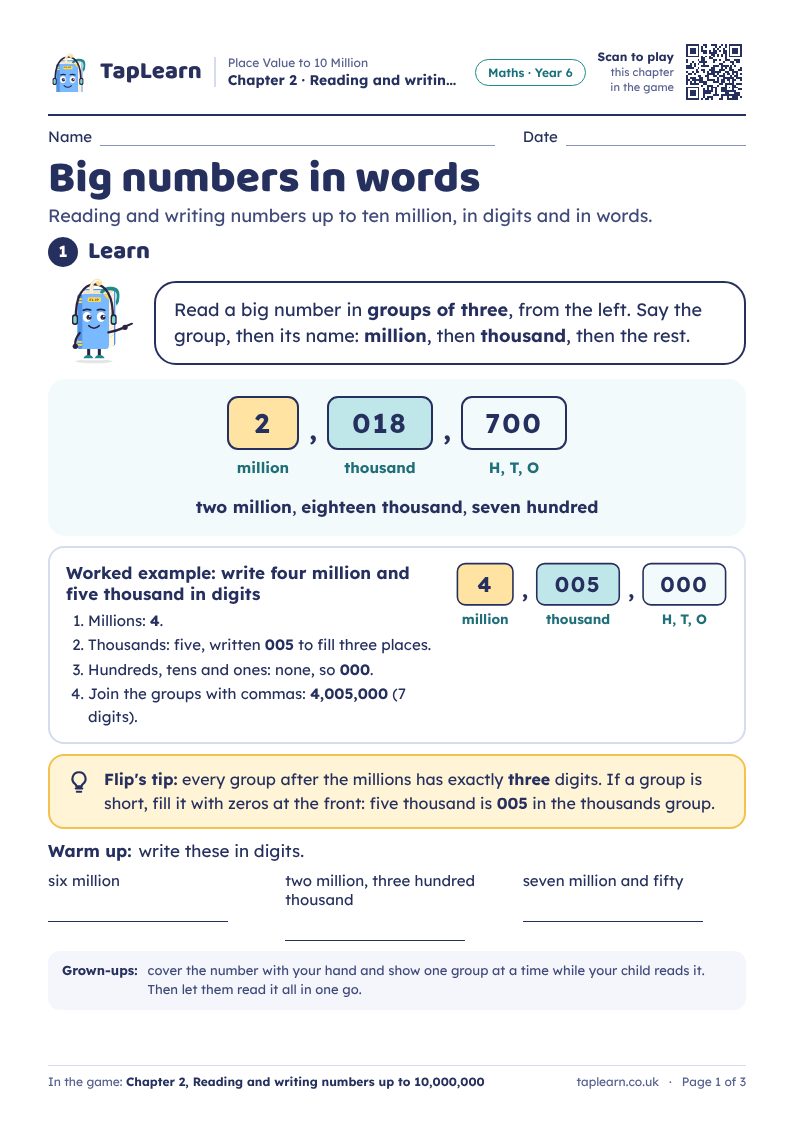
Big Numbers in Words is a printable writing numbers in words worksheet for Year 6 (ages 10 to 11) that teaches children to read seven-digit numbers in groups of three and use placeholder zeros, as in 4,005,000. It covers the Year 6 maths statement to read, write, order and compare numbers up to 10,000,000 and determine the value of each digit.
Free to print, no account needed.
Print it on A4, in colour or black and white. Do it after the chapter, or before it to see what your child already knows.
What's on the worksheet
Your child reads and writes numbers up to ten million in words and digits, using groups of three and placeholder zeros. Includes a say-it, write-it activity and an answers sheet.
- Page 1 · Learn
- How to read big numbers in groups of three, a worked example writing four million and five thousand as 4,005,000, Flip's tip on filling short groups with zeros, and a warm-up.
- Page 2 · Try it together
- Say it, write it: the grown-up reads a big number aloud, perhaps a city population from a map, the child writes it in digits, then you compare each group of three and swap.
- Page 3 · Practise
- Write numbers in digits and in words, match numbers like 7,007,000 and 7,070,000 to their words, find the thousands group, and a challenge about missing and extra zeros.
- Answers sheet
- Every answer, mix-ups like leaving out placeholder zeros, and how-many-digits and zero hunt ideas.
3 A4 pages and an answers sheet · about 25 minutes
Using it at home
- Cover the number with your hand and show one group of three at a time while your child reads it, then let them read it all at once.
- In say it, write it, pause after "million" and "thousand". That pause is where the comma goes.
- Say a number like "six million and sixty" and ask how many zeros it has before your child writes it.
Watch out for
- Leaving out placeholder zeros, writing 4,5000.
- Each group after the millions needs exactly three digits: 4,005,000.
- Writing too many zeros, like 40,005,000.
- Count the digits: numbers in the millions have 7.
- Grouping wrongly, reading 2,018,700 as twenty million.
- Find the commas first, then read each group.
Questions from the worksheet
- Write these numbers in digits: five million, forty thousand and six; nine million, nine hundred and nine.
- Draw a line to match each number to its words: 7,007,000, 7,070,000, 7,700,000, 7,000,700.
- Read each number. How many thousands are in its thousands group? 2,018,700, 5,300,000, 9,045,500.
- Mia writes four million and five thousand as 4,5000. Sam writes 40,005,000. Is either of them right? Write it correctly and explain each mistake.
The answers are on the answers sheet, for grown-ups.
National curriculum in England
This worksheet practises this statement from the Year 6 maths programme of study:
- Read, write, order and compare numbers up to 10,000,000 and determine the value of each digit
Source: National curriculum in England: mathematics programmes of study (DfE)
In the classroom
- Dictate numbers with zeros for children to write on mini-whiteboards, then reveal and check each group.
- Use the Mia and Sam challenge as a paired discussion on placeholder zeros.
Questions and answers
How do you read a seven-digit number?
Read it in groups of three from the left: say the group, then its name. 2,018,700 is two million, eighteen thousand, seven hundred.
What is a placeholder zero?
A zero that fills an empty place so the other digits stay in the right columns. Five thousand in the thousands group is written 005, as in 4,005,000.
How many digits does a number in the millions have?
Numbers from 1,000,000 to 9,999,999 have 7 digits. Ten million, 10,000,000, has 8.
 TapLearn