Place value chart worksheet for Year 6: What digits are worth
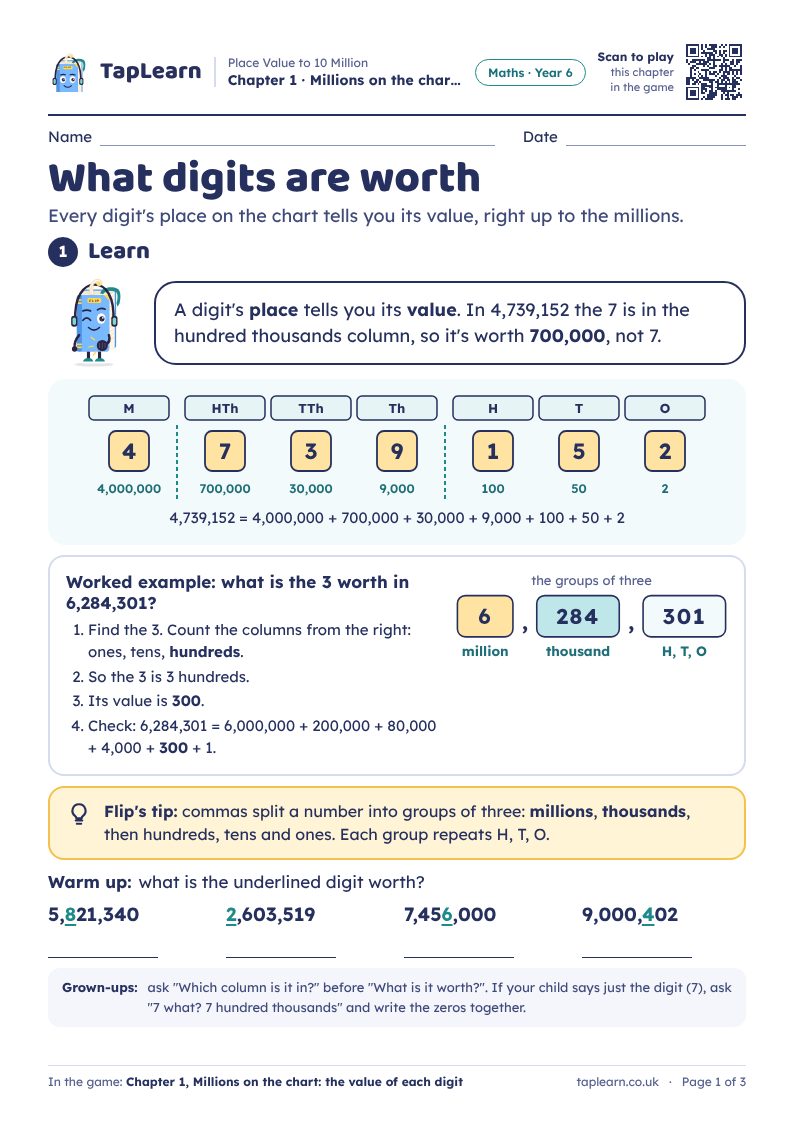
What Digits Are Worth is a printable place value chart worksheet for Year 6 (ages 10 to 11) that teaches children to find which column a digit is in and what it is worth, such as the 7 in 4,739,152 being worth 700,000. It covers the Year 6 maths statement to read, write, order and compare numbers up to 10,000,000 and determine the value of each digit.
Free to print, no account needed.
▶ Play chapter 1 in the game · How the place value chart works
Print it on A4, in colour or black and white. Do it after the chapter, or before it to see what your child already knows.
What's on the worksheet
Your child finds the value of each digit in numbers up to ten million on a place value chart and splits seven-digit numbers into their parts. Includes a digit spotter activity and an answers sheet.
- Page 1 · Learn
- A place value chart from millions to ones, 4,739,152 split into its parts, a worked example finding the value of the 3 in 6,284,301, Flip's tip on groups of three, and a warm-up.
- Page 2 · Try it together
- Digit spotter: draw a 7-column place value chart, pick folded digit scraps to build a seven-digit number, read it aloud, then point to digits and say their column and value.
- Page 3 · Practise
- Write digit values, fill gaps to split numbers into parts, ring numbers where the 6 is worth 60,000, write numbers from columns and parts, and a challenge about the 7.
- Answers sheet
- Every answer, mix-ups like giving the digit instead of its value, and point-and-say and number-spotting ideas.
3 A4 pages and an answers sheet · about 25 minutes
In the classroom
- Run digit spotter in pairs with digit cards and mini place value charts.
- Use Practise C as a quick hinge question: show the numbers and ask children to hold up which ones have a 6 worth 60,000.
Questions from the worksheet
- Fill the gaps to split each number into its parts: 3,506,240 = 3,000,000 + ___ + 6,000 + ___ + 40.
- Write each number in digits: 4 millions, 8 ten thousands, 6 hundreds and 1 one.
- Put the parts together. Write each number in digits: 60,000 + 4,000,000 + 1,000.
- Leo says, "The 7 in 4,739,152 is worth 7." Is he right? Explain what it is really worth and how you know.
The answers are on the answers sheet, for grown-ups.
National curriculum in England
This worksheet practises this statement from the Year 6 maths programme of study:
- Read, write, order and compare numbers up to 10,000,000 and determine the value of each digit
Source: National curriculum in England: mathematics programmes of study (DfE)
Using it at home
- Ask "Which column is it in?" before "What is it worth?" If your child says just 7, ask "7 what?" and write the zeros together.
- Keep the digit scraps from digit spotter: chapter 4's digit race uses them again.
- Look for long numbers on a car's mileage or a box and ask what the first digit is worth.
Watch out for
- Giving the digit, not its value: "the 7 is worth 7".
- Ask "7 what?" and write the zeros: 7 hundred thousands is 700,000.
- Mixing up neighbouring columns, like ten thousands and hundred thousands.
- Read the group names: in the thousands group it goes hundred thousands, ten thousands, thousands.
Questions and answers
What is a place value chart?
A place value chart has a column for each place: millions, hundred thousands, ten thousands, thousands, hundreds, tens and ones. A digit's column tells you its value.
What is the value of a digit?
It is how much the digit is worth in its column. In 4,739,152 the 7 is in the hundred thousands column, so its value is 700,000.
Why are big numbers split with commas?
Commas split a number into groups of three: millions, thousands, then hundreds, tens and ones. Each group repeats hundreds, tens and ones.
 TapLearn