Perfect tense time and cause worksheet for Years 5–6: Time and cause
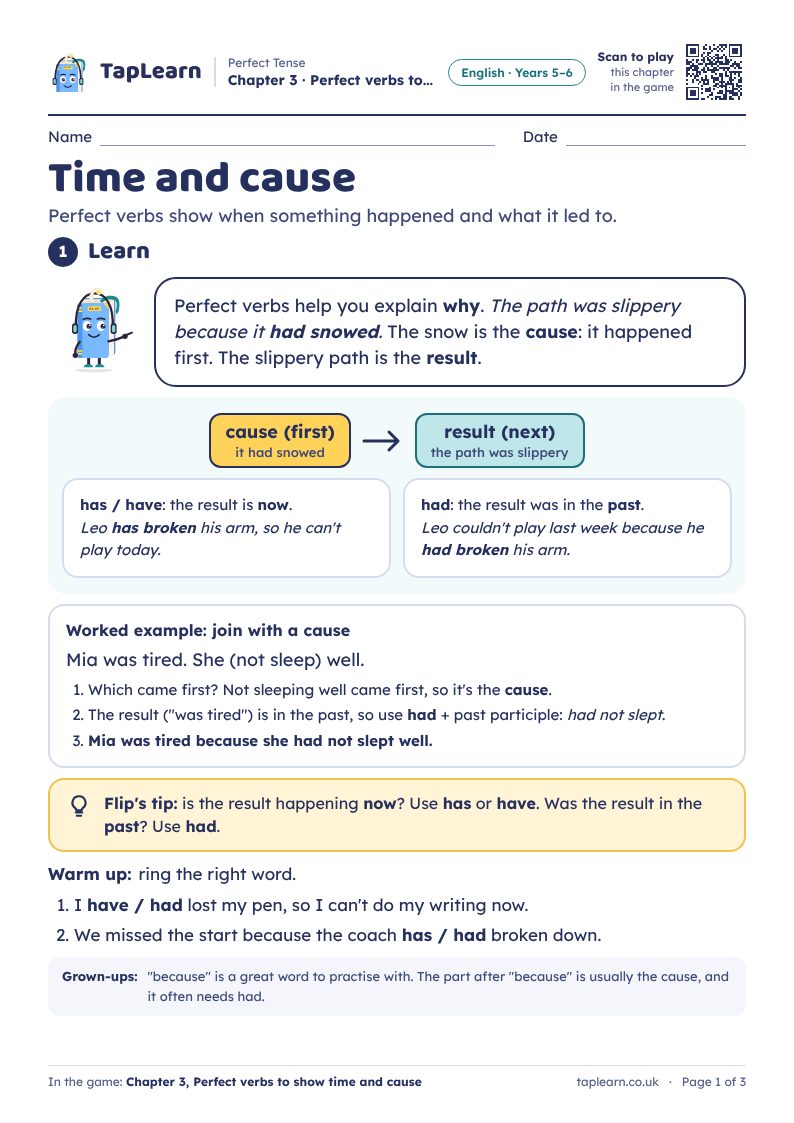
Time and Cause is a printable perfect tense time and cause worksheet for Years 5 and 6 (ages 9 to 11) that teaches children that the cause happened first, often with had after because, and to use has or have when the result is now. It covers the Years 5 to 6 statement on using the perfect form of verbs to mark relationships of time and cause.
This worksheet is for members
Membership opens every chapter of every game and every worksheet, for all your children.
See the plansAlready a member? Log in to print it.
Start with the free one: Has and have (chapter 1).
Print it on A4, in colour or black and white. Do it after the chapter, or before it to see what your child already knows.
What's on the worksheet
Your child chooses has, have or had to show when something happened and what it led to, and spots the cause and the result. Includes a spoken because game and an answers sheet.
- Page 1 · Learn
- Cause and result explained with "it had snowed", has and had compared with Leo's broken arm, a worked example joining two sentences, Flip's now-or-past tip, and a warm-up.
- Page 2 · Try it together
- The because game: one person says what happened ("I was soaked"), the other gives a reason with had ("because I had forgotten my coat"), then swap and write three.
- Page 3 · Practise
- Underline the cause, write has, have or had, finish sentences with a cause, correct past participles, write sentences with has and had, and a challenge about cause.
- Answers sheet
- Every answer, mix-ups like had ran, and a now-or-then idea.
3 A4 pages and an answers sheet · about 25 minutes
Using it at home
- Because is a good word to practise with: the part after because is usually the cause, and it often needs had.
- In the because game, check the had part happened first, and say "had run" or "had gone" back if needed.
- Say "I have lost my glasses" and "I had lost my glasses". Which one means they're still lost?
Watch out for
- Swapping has and had.
- Ask, "Is the result happening now, or was it in the past?" Now: has or have. Past: had.
- Mixing up cause and result.
- Ask, "Which happened first?" The first event is the cause.
- Writing had ran or had gave.
- After had, use the past participle: run, given, swum.
Questions from the worksheet
- Underline the cause (the event that happened first): The plants died because no one had watered them. Because the river had flooded, the road was closed.
- Write has, have or had in each gap: Look! The postman ___ just been. By the time help came, the little boat ___ sunk.
- Finish each sentence with a cause. Use had + a past participle: The classroom was a mess because…
- Write the correct past participle in each box: He had ran. She had gave. They had swam.
- Sam says, "In I was soaked because I had forgotten my coat, being soaked is the cause." Is he right? Explain how you know.
The answers are on the answers sheet, for grown-ups.
National curriculum in England
This worksheet practises this statement from the Years 5–6 english programme of study:
- Develop their understanding of the concepts set out in English appendix 2 by: using the perfect form of verbs to mark relationships of time and cause
In the classroom
- Play the because game round the class.
- Use Practise B as a mini-whiteboard has-have-had check.
Questions and answers
How does the perfect tense show cause?
The cause happened first and often uses had: "The path was slippery because it had snowed."
When do you use has or had?
Use has or have when the result is now ("I have lost my pen, so I can't write"). Use had when the result was in the past.
How can children find the cause in a sentence?
Ask which event happened first. The part after because is usually the cause.
 TapLearn