Linking paragraphs with adverbials worksheet for Years 5–6: Linking paragraphs
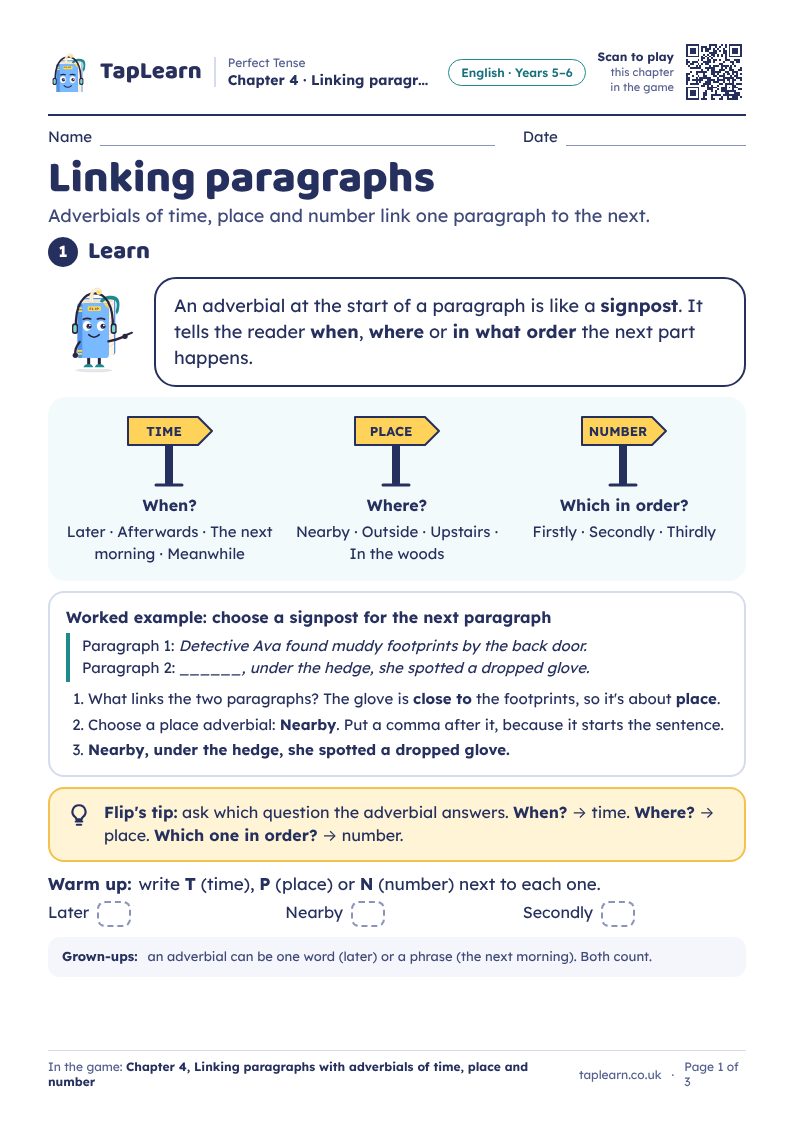
Linking Paragraphs is a printable linking paragraphs with adverbials worksheet for Years 5 and 6 (ages 9 to 11) that teaches children to start a paragraph with a signpost that says when (later), where (nearby) or in what order (secondly). It covers the Year 5 statement on linking ideas across paragraphs using adverbials of time, place and number.
This worksheet is for members
Membership opens every chapter of every game and every worksheet, for all your children.
See the plansAlready a member? Log in to print it.
Start with the free one: Has and have (chapter 1).
Print it on A4, in colour or black and white. Do it after the chapter, or before it to see what your child already knows.
What's on the worksheet
Your child links paragraphs with adverbials of time, place and number, like later, nearby and secondly, and sorts them by type. Includes a day-out-in-three-parts retelling activity and an answers sheet.
- Page 1 · Learn
- Time, place and number adverbials with examples, a worked example choosing Nearby to link two detective paragraphs, Flip's which-question tip, and a T, P or N warm-up.
- Page 2 · Try it together
- A day out in three parts: choose a day out you both remember, retell it in three parts, each starting with a different signpost like Later, Nearby or Secondly, and record them.
- Page 3 · Practise
- Sort adverbials into time, place and number, fill gaps in a detective story with signposts, label adverbials T, P or N, write paragraph openers, and a challenge about nearby.
- Answers sheet
- Every answer, mix-ups like calling nearby a time word, and a signpost-snap idea.
3 A4 pages and an answers sheet · about 25 minutes
Using it at home
- An adverbial can be one word (later) or a phrase (the next morning). Both count.
- In the day-out retelling, try a different type of signpost for each part, so all three kinds get a turn.
- Play signpost snap: one person says an adverbial; the other says time, place or number.
Watch out for
- Mixing up the three types.
- Ask the question: when? where? which one in order? The answer gives the type.
- Using only then or next.
- Encourage a mix: place and number signposts make writing clearer and more varied.
- Forgetting the comma after an adverbial at the start of a sentence.
- Add a comma after it: "Later that evening, …"
Questions from the worksheet
- Sort these adverbials into time, place and number: The next day, In the garden, Thirdly, Meanwhile, Under the bridge, Secondly.
- Fill each gap with a signpost from the box (Firstly, Secondly, Nearby, Later that evening) so the paragraphs about the dog and the cake link.
- Underline the adverbial. Write T, P or N: Upstairs, the twins were still asleep. After lunch, we packed up the tent.
- Write the first sentence of a new paragraph: one starting with a time adverbial, one with a place adverbial.
- Leo says, "Nearby is an adverbial of time, because it tells you what happens next." Is he right? Explain.
The answers are on the answers sheet, for grown-ups.
National curriculum in England
This worksheet practises this statement from the Year 5 english programme of study:
- Text: linking ideas across paragraphs using adverbials of time, place and number or tense choices
In the classroom
- Display signposts sorted into time, place and number for writing lessons.
- Use Practise B as a paragraph-linking task in pairs.
Questions and answers
What is a linking adverbial?
A linking adverbial starts a paragraph and tells the reader when (later), where (nearby) or in what order (secondly) the next part happens.
What are examples of adverbials of place?
Nearby, outside, upstairs and in the woods are adverbials of place: they answer "where?".
Do you need a comma after a linking adverbial?
Yes, when it starts the sentence: "Nearby, under the hedge, she spotted a glove."
 TapLearn