Linking paragraphs with tense worksheet for Years 5–6: Linking back with had
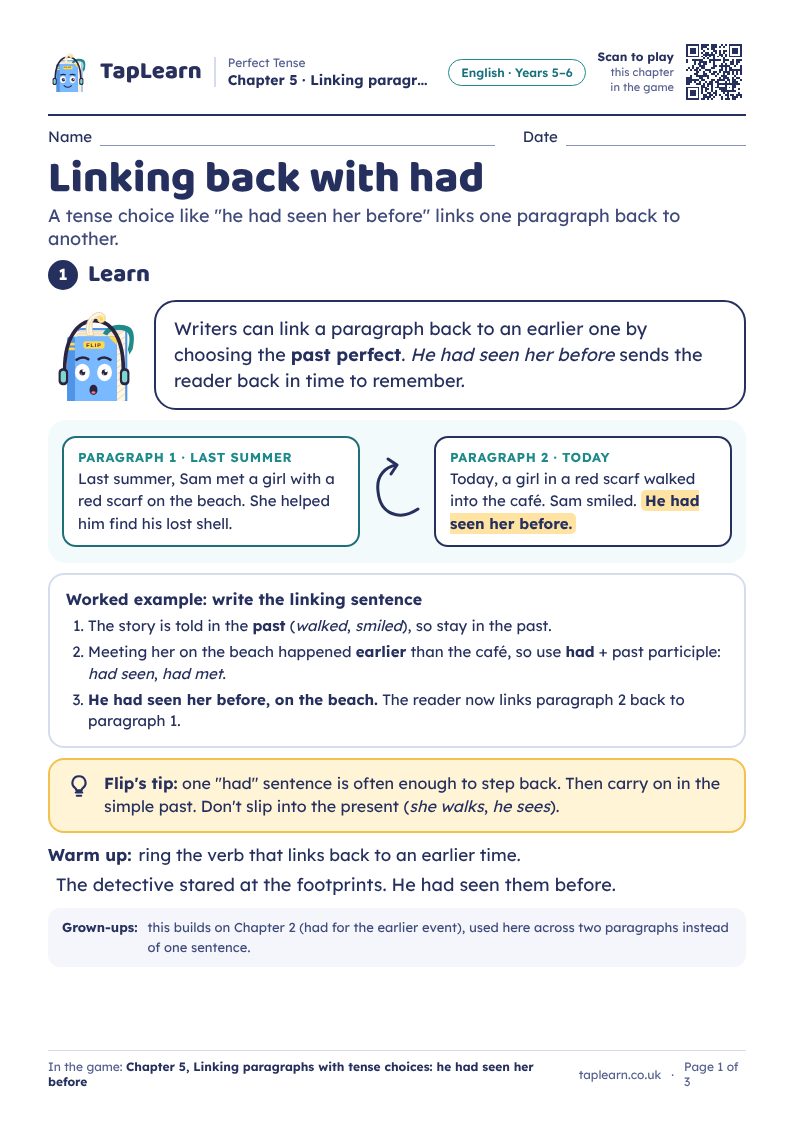
Linking Back with Had is a printable linking paragraphs with tense worksheet for Years 5 and 6 (ages 9 to 11) that teaches children to use the past perfect, like "He had seen her before", to send the reader back to an earlier paragraph. It covers the Years 5 to 6 statements on using perfect verbs for time and cause and linking paragraphs through tense choices.
This worksheet is for members
Membership opens every chapter of every game and every worksheet, for all your children.
See the plansAlready a member? Log in to print it.
Start with the free one: Has and have (chapter 1).
Print it on A4, in colour or black and white. Do it after the chapter, or before it to see what your child already knows.
What's on the worksheet
Your child links a paragraph back to an earlier one with a tense choice like he had seen her before, and keeps a past-tense story in the past. Includes a meeting-again two-paragraph writing activity and an answers sheet.
- Page 1 · Learn
- Two paragraphs about Sam and a girl in a red scarf linked by "He had seen her before", a worked example writing the linking sentence, Flip's stay-in-the-past tip, and a warm-up.
- Page 2 · Try it together
- Meeting again: think of a time you met someone or a pet, write it as paragraph 1, imagine meeting them again in paragraph 2, and add a linking sentence with had.
- Page 3 · Practise
- Choose the sentence that links back to a puppy rescue, rewrite pairs with verb mistakes, write a linking sentence about a lost cap, compare two versions, and a challenge.
- Answers sheet
- Every answer, mix-ups like had stole, and a story-callbacks idea.
3 A4 pages and an answers sheet · about 25 minutes
Using it at home
- This builds on using had for the earlier event, now across two paragraphs instead of one sentence.
- In meeting again, check paragraph 2 stays in the past tense and the had sentence points back to paragraph 1.
- When reading together, spot a had sentence that reminds you of an earlier part of the book.
Watch out for
- Telling a flashback in the simple past, like "He hid it there".
- Ask, "Did this happen before the rest of the story?" If so, add had.
- Slipping into the present, like "She sees…", in a past-tense story.
- Read it aloud: the change usually sounds odd.
- Writing had stole or had took.
- Use the past participle: stolen, taken, written, gone.
Questions from the worksheet
- Paragraph 1: On Monday, Ava rescued a muddy puppy from the pond. Which sentence links paragraph 2 back to it? a) She sees the puppy again. b) She had rescued it from the pond. c) She will rescue it.
- Each pair has a verb mistake. Rewrite it in the past, using had to link back: Leo walked into the hall. He sees the trophy he wins last year.
- Read both paragraphs. Write a linking sentence with had: At the start of the holiday, Sam lost his blue cap on the bus. A week later, Sam spotted a blue cap on a bench.
- Which version makes the order clearer? "He hid it there last year." or "He had hidden it there last year." Explain why.
- Mia wrote: The thief crept back to the house. He had stole the necklace from there. Is it right? Explain and fix it.
The answers are on the answers sheet, for grown-ups.
National curriculum in England
This worksheet practises these statements from the Years 5–6 english programme of study:
- Develop their understanding of the concepts set out in English appendix 2 by: using the perfect form of verbs to mark relationships of time and cause
- Text: linking ideas across paragraphs using adverbials of time, place and number or tense choices (Year 5 english)
In the classroom
- Model a two-paragraph story on the board and add the had link together.
- Use Practise D for a short talk task about which version is clearer.
Questions and answers
How can tense choice link paragraphs?
A past perfect sentence like "He had seen her before" sends the reader back to an earlier paragraph, linking the two.
Why use had in a flashback?
Had shows the event happened before the rest of the story, so the order is clear.
Should a story stay in the same tense?
A past-tense story should stay in the past. Use one had sentence to step back, then carry on in the simple past.
 TapLearn