Missing number problems worksheet for Year 5: Work it backwards
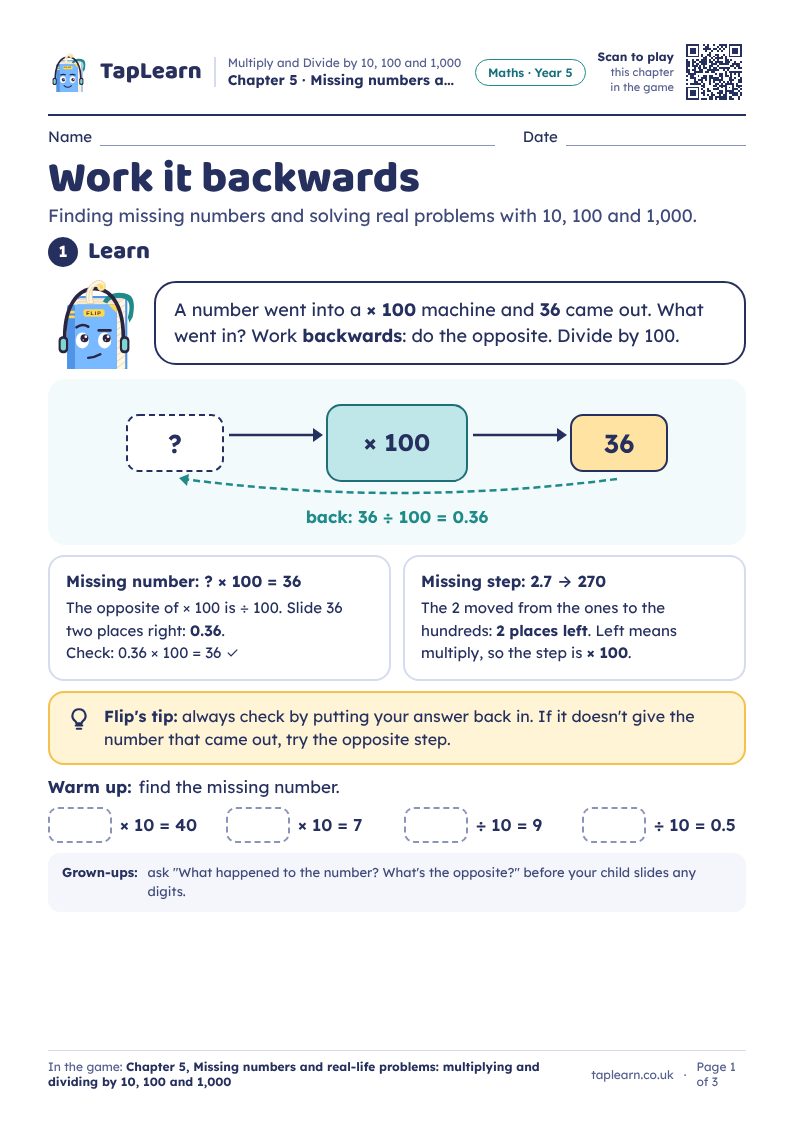
Work It Backwards is a printable missing number problems worksheet for Year 5 (ages 9 to 10) that teaches children to find missing numbers and missing steps by doing the opposite, and to solve real problems with 10, 100 and 1,000. It covers the Year 5 maths statement to multiply and divide whole numbers and those involving decimals by 10, 100 and 1,000.
This worksheet is for members
Membership opens every chapter of every game and every worksheet, for all your children.
See the plansAlready a member? Log in to print it.
Start with the free one: Digits slide left (chapter 1).
Print it on A4, in colour or black and white. Do it after the chapter, or before it to see what your child already knows.
What's on the worksheet
Your child finds missing numbers and missing steps by working backwards, like ? × 100 = 36, and solves real problems with 10, 100 and 1,000. Includes a mystery machine game and an answers sheet.
- Page 1 · Learn
- A × 100 machine shows how to work backwards from 36 to 0.36, a missing-step example from 2.7 to 270, Flip's put-it-back-in tip, and a warm-up.
- Page 2 · Try it together
- Mystery machine: one player secretly multiplies or divides a number by 10, 100 or 1,000 and says the start and end, and the other works out the secret step.
- Page 3 · Practise
- Find missing numbers and check them, find missing steps, solve pencil, step, rope and card problems, and a challenge about ? × 100 = 36.
- Answers sheet
- Every answer, mix-ups like doing the same step instead of the opposite, and mystery machine aloud and real-life ideas.
3 A4 pages and an answers sheet · about 30 minutes
In the classroom
- Play mystery machine as a whole class: say "3 went in, 3,000 came out" and children name the step.
- Give pairs Practise C to solve, then compare methods for the rope and card questions.
Questions from the worksheet
- Find the missing number. Check it by putting it back in: ___ × 100 = 36
- Find the missing step: × or ÷, and 10, 100 or 1,000. 5.2 → ___ → 0.52
- A 25 m rope is cut into 100 equal pieces. How long is each piece?
- Leo says, "? × 100 = 36, so the missing number is 3,600." Is he right? Explain what he did and find the real answer.
The answers are on the answers sheet, for grown-ups.
National curriculum in England
This worksheet practises this statement from the Year 5 maths programme of study:
- Multiply and divide whole numbers and those involving decimals by 10, 100 and 1,000
Source: National curriculum in England: mathematics programmes of study (DfE)
Using it at home
- Before sliding any digits, ask "What happened to the number? What's the opposite?"
- If a mystery machine guess is wrong, put both numbers in a place value chart and follow one digit: "Where is it now?"
- When shopping, spot packs of 10 or 100 and work out the cost of one.
Watch out for
- Doing the same step instead of the opposite, so ? × 100 = 36 becomes 3,600.
- Always check by putting the answer back in.
- Picking the wrong one of 10, 100 or 1,000.
- Follow one digit and count how many places it moved.
- Leaving out zeros in answers like 0.25 m.
- Ask which column each digit is in.
Questions and answers
How do you find a missing number in ? × 100 = 36?
Do the opposite: 36 ÷ 100 = 0.36. Check by putting it back in: 0.36 × 100 = 36.
How can you tell which step changed a number?
Follow one digit: count how many places it moved and which way. Left means multiply; right means divide.
What is the inverse of multiplying by 100?
Dividing by 100 undoes multiplying by 100, so it is the step to use when working backwards.
 TapLearn