Multiplying by 10, 100 and 1,000 worksheet for Year 5: Digits slide left
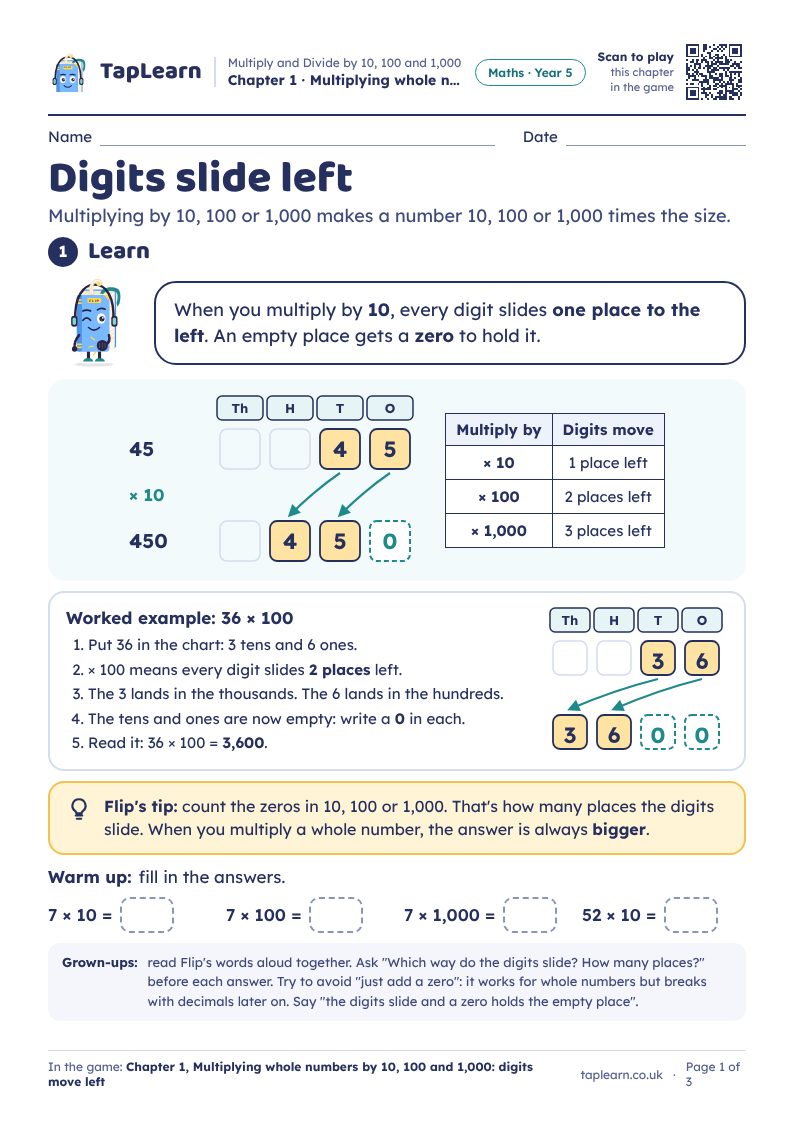
Digits Slide Left is a printable multiplying by 10, 100 and 1,000 worksheet for Year 5 (ages 9 to 10) that teaches children to slide every digit 1, 2 or 3 places left and use zeros to hold empty places. It covers the Year 5 maths statement to multiply and divide whole numbers and those involving decimals by 10, 100 and 1,000.
Free to print, no account needed.
Print it on A4, in colour or black and white. Do it after the chapter, or before it to see what your child already knows.
What's on the worksheet
Your child multiplies whole numbers by 10, 100 and 1,000 by sliding every digit left on a place value chart, with zeros holding empty places. Includes a slide strip activity with paper squares and an answers sheet.
- Page 1 · Learn
- A place value chart shows 45 × 10, a table of how many places the digits move, a worked example of 36 × 100, Flip's count-the-zeros tip, and a warm-up.
- Page 2 · Try it together
- Slide strip: draw place value columns on a paper strip, put digit squares in, pick × 10, × 100 or × 1,000 from folded scraps and slide every square left, filling gaps with zeros.
- Page 3 · Practise
- Multiply whole numbers, find what a number was multiplied by, write answers in a place value chart, ring the right answer, and a challenge about 45 × 10 = 4.5.
- Answers sheet
- Every answer, mix-ups like sliding the wrong way or missing a zero, and times-table echo and big-or-small games.
3 A4 pages and an answers sheet · about 25 minutes
In the classroom
- Use a large place value chart with digit cards and have children physically slide the cards for each question.
- Play big or small as a starter: "Which is bigger: 6 × 1,000 or 60 × 10?"
Questions from the worksheet
- Multiply: 64 × 100, 125 × 10, 8 × 1,000
- What was it multiplied by? Write 10, 100 or 1,000: 52 × ___ = 5,200
- Draw a ring round the right answer: 16 × 1,000 = 1,600 / 16,000 / 160,000
- Sam worked out 45 × 10 = 4.5. Is he right? What did he do, and what should the answer be?
The answers are on the answers sheet, for grown-ups.
National curriculum in England
This worksheet practises this statement from the Year 5 maths programme of study:
- Multiply and divide whole numbers and those involving decimals by 10, 100 and 1,000
Source: National curriculum in England: mathematics programmes of study (DfE)
Using it at home
- Try to avoid saying "just add a zero": it breaks with decimals later. Say "the digits slide and a zero holds the empty place".
- In the slide strip, ask "Is the new number bigger or smaller? How many times bigger?"
- Play times-table echo: say a number and your child says it × 10, then × 100, then × 1,000.
Watch out for
- Sliding the wrong way, so 45 × 10 becomes 4.5.
- Ask "Should the answer be bigger or smaller?" before sliding.
- Mixing up × 100 and × 1,000.
- Count the zeros in 100 or 1,000 together, then count the slides.
- Leaving out a zero, as in 409 × 10 = 4,90.
- Every place to the right of the digits, up to the ones, needs a digit.
Questions and answers
What happens when you multiply by 10, 100 or 1,000?
Every digit slides left: 1 place for × 10, 2 places for × 100 and 3 places for × 1,000. Zeros hold any empty places.
Why not just add a zero to multiply by 10?
It works for whole numbers but not for decimals: 3.5 with a zero added is 3.50, which is the same number. Sliding the digits always works.
What is 36 × 100?
36 × 100 = 3,600. The 3 and the 6 slide two places left, and zeros fill the tens and ones.
 TapLearn