Dividing decimals worksheet for Year 5: Zeros hold the place
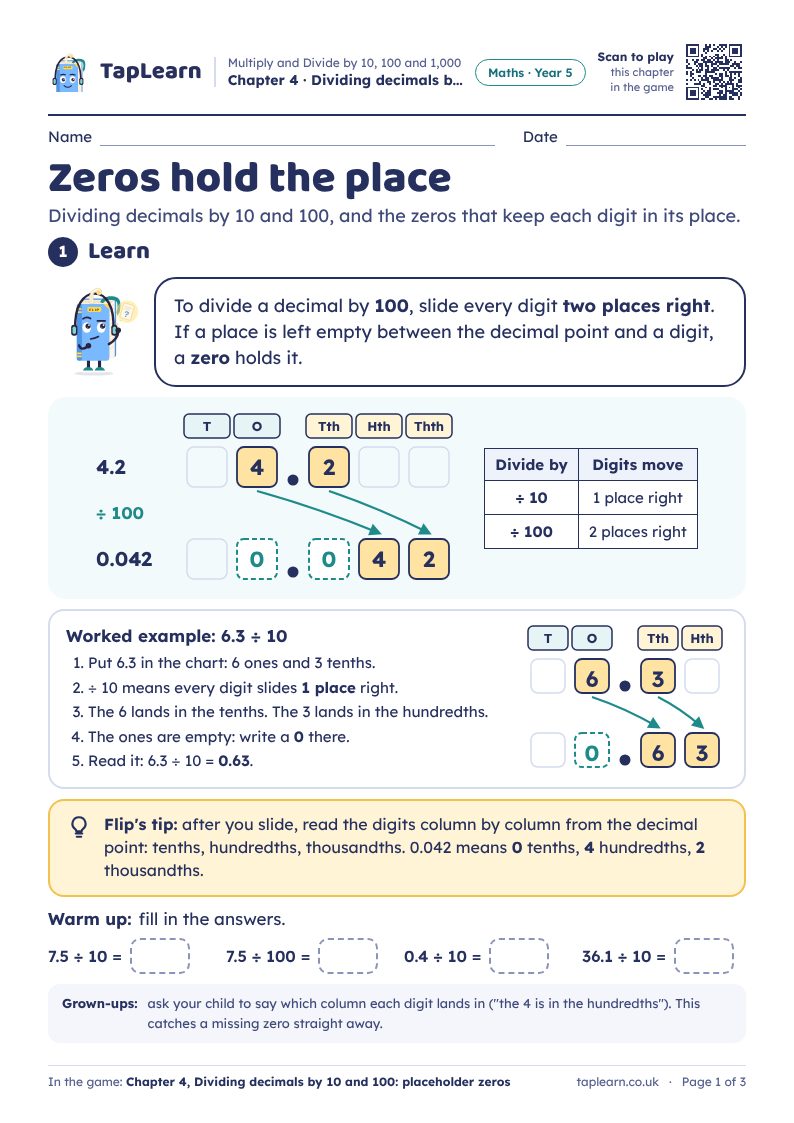
Zeros Hold the Place is a printable dividing decimals worksheet for Year 5 (ages 9 to 10) that teaches children to slide decimal digits right and use zeros to hold empty places. It covers the Year 5 maths statement to multiply and divide whole numbers and those involving decimals by 10, 100 and 1,000.
This worksheet is for members
Membership opens every chapter of every game and every worksheet, for all your children.
See the plansAlready a member? Log in to print it.
Start with the free one: Digits slide left (chapter 1).
Print it on A4, in colour or black and white. Do it after the chapter, or before it to see what your child already knows.
What's on the worksheet
Your child divides decimals by 10 and 100, using zeros to hold empty places, as in 4.2 ÷ 100 = 0.042. Includes a measuring activity with a ruler and an answers sheet.
- Page 1 · Learn
- 4.2 ÷ 100 = 0.042 on a place value chart with thousandths, a worked example of 6.3 ÷ 10, Flip's read-column-by-column tip, and a warm-up.
- Page 2 · Try it together
- A tenth of it: measure four things in centimetres with a ruler, then find a tenth and a hundredth of each length by dividing by 10 and 100.
- Page 3 · Practise
- Divide decimals, ring the right answer, write answers in a chart to thousandths, a jug sharing problem, and a challenge about 6.3 ÷ 100 = 0.63.
- Answers sheet
- Every answer, mix-ups like a missing placeholder zero, and smaller-and-smaller and measure talk ideas.
3 A4 pages and an answers sheet · about 25 minutes
Using it at home
- Ask your child to say which column each digit lands in ("the 4 is in the hundredths"). This catches a missing zero straight away.
- A hundredth of something small is tiny. Say each answer aloud, like "nought point one two five".
- Start at 50 and keep dividing by 10 aloud: 5, 0.5, 0.05, 0.005.
Watch out for
- Missing a placeholder zero, writing 6.3 ÷ 100 as 0.63.
- Ask "Which column is the 6 in now?"
- Sliding the wrong number of places with decimals.
- Count the slides aloud: "one, two".
- Sliding the wrong way, so 4.2 ÷ 10 becomes 42.
- Dividing makes the number smaller.
Questions from the worksheet
- Divide. Remember the zeros that hold places: 0.3 ÷ 100, 3.08 ÷ 10, 0.6 ÷ 100
- Draw a ring round the right answer: 25.1 ÷ 100 = 2.51 / 0.251 / 0.0251
- A jug holds 2.5 litres. It is shared equally between 10 cups. How much is in each cup? What if it was shared between 100 cups?
- Sam wrote 6.3 ÷ 100 = 0.63. Is he right? Explain where the 6 should go.
The answers are on the answers sheet, for grown-ups.
National curriculum in England
This worksheet practises this statement from the Year 5 maths programme of study:
- Multiply and divide whole numbers and those involving decimals by 10, 100 and 1,000
Source: National curriculum in England: mathematics programmes of study (DfE)
In the classroom
- Run a tenth of it in groups with classroom objects and compare answers.
- Use Practise B as a mini-whiteboard check, asking children to name the column of each digit.
Questions and answers
How do you divide a decimal by 100?
Slide every digit two places right; the decimal point stays still. Zeros hold any empty places: 4.2 ÷ 100 = 0.042.
What is a placeholder zero?
A placeholder zero fills an empty place so the other digits stay in the right columns, like the 0 in the tenths of 0.042.
What is 6.3 ÷ 100?
6.3 ÷ 100 = 0.063. The 6 moves to the hundredths and the 3 to the thousandths.
 TapLearn