Multiplying decimals worksheet for Year 5: Decimals slide left
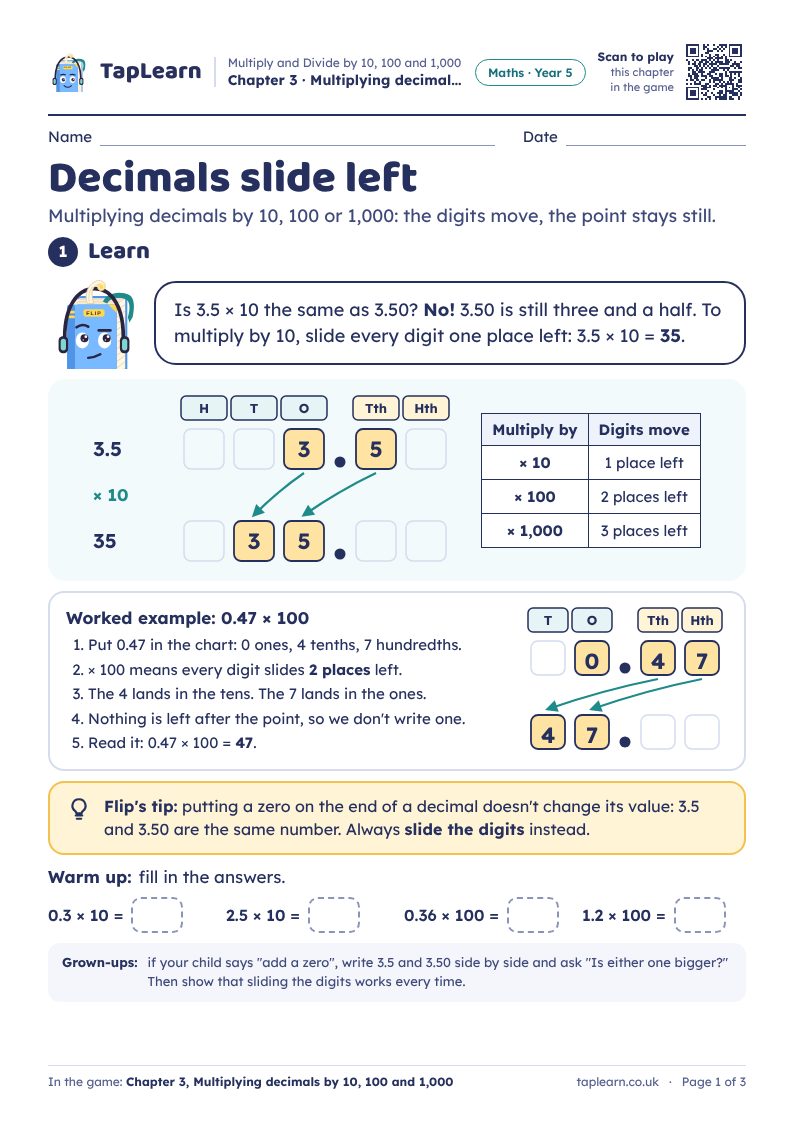
Decimals Slide Left is a printable multiplying decimals worksheet for Year 5 (ages 9 to 10) that teaches children to multiply decimals by 10, 100 and 1,000 by sliding the digits while the decimal point stays still. It covers the Year 5 maths statement to multiply and divide whole numbers and those involving decimals by 10, 100 and 1,000.
This worksheet is for members
Membership opens every chapter of every game and every worksheet, for all your children.
See the plansAlready a member? Log in to print it.
Start with the free one: Digits slide left (chapter 1).
Print it on A4, in colour or black and white. Do it after the chapter, or before it to see what your child already knows.
What's on the worksheet
Your child multiplies decimals by 10, 100 and 1,000 by sliding the digits, not adding a zero, so 3.5 × 10 = 35. Includes a ten-of-the-same shopping activity and an answers sheet.
- Page 1 · Learn
- Why 3.5 × 10 is 35, not 3.50, on a place value chart, a worked example of 0.47 × 100 = 47, Flip's tip on zeros at the end of decimals, and a warm-up.
- Page 2 · Try it together
- Ten of the same: choose things costing under one pound from shop labels or a receipt, then work out the cost of 10 and 100 of each by sliding the digits.
- Page 3 · Practise
- Multiply decimals, tick or correct four answers including 3.5 × 10 = 3.50, write answers in a chart, a ribbon length problem, and a challenge about Leo's add-a-zero rule.
- Answers sheet
- Every answer, mix-ups like adding a zero to a decimal, and shop talk and multiply ladder ideas.
3 A4 pages and an answers sheet · about 25 minutes
In the classroom
- Display Leo's rule and ask groups to test it on whole numbers and decimals before agreeing a better rule.
- Use Practise B as a right-or-wrong vote with thumbs up and down.
Questions from the worksheet
- Multiply. Slide the digits; the decimal point stays still: 0.75 × 100, 1.3 × 1,000, 0.05 × 1,000
- Right or wrong? 2.6 × 1,000 = 260
- A ribbon is 1.25 m long. How long are 10 of them end to end? 100 of them?
- Leo says, "To multiply by 10, just put a 0 on the end." Try his rule on 3.5 × 10. Does it work? Write a rule that always works.
The answers are on the answers sheet, for grown-ups.
National curriculum in England
This worksheet practises this statement from the Year 5 maths programme of study:
- Multiply and divide whole numbers and those involving decimals by 10, 100 and 1,000
Source: National curriculum in England: mathematics programmes of study (DfE)
Using it at home
- If your child says "add a zero", write 3.5 and 3.50 side by side and ask "Is either one bigger?"
- Money is always written with two digits after the point, which can look like adding a zero. Show that the digits really slide one place left.
- Start at 0.007 and keep multiplying by 10 aloud: 0.07, 0.7, 7, 70.
Watch out for
- Adding a zero to a decimal, so 3.5 × 10 becomes 3.50.
- Ask "Is 3.50 ten times bigger than 3.5?"
- Sliding the wrong number of places, so 2.6 × 1,000 becomes 260.
- Count three slides for × 1,000.
- Sliding the wrong way, so 0.08 × 10 becomes 0.008.
- Multiplying by 10 makes the number bigger.
Questions and answers
How do you multiply a decimal by 10?
Slide every digit one place left; the decimal point stays still. 3.5 × 10 = 35.
Why is 3.5 × 10 not 3.50?
Adding a zero to the end of a decimal doesn't change its value: 3.5 and 3.50 are the same number. Sliding the digits gives 35.
What is 0.47 × 100?
0.47 × 100 = 47. The 4 slides into the tens and the 7 into the ones.
 TapLearn