Sharing equally worksheet for Year 2
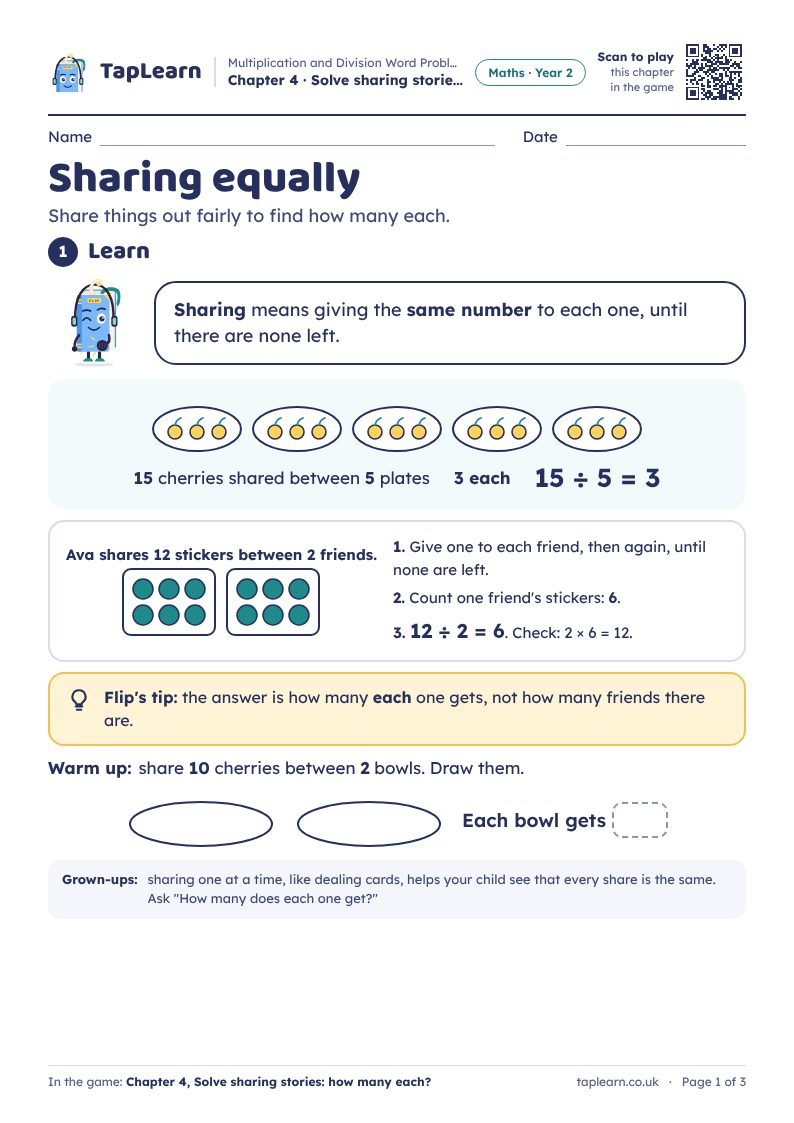
Sharing Equally is a printable sharing equally worksheet for Year 2 (ages 6 to 7) that teaches children to share things one at a time until none are left, and that the answer is how many each one gets. It covers the Year 2 maths statement to solve problems involving multiplication and division using materials, arrays, repeated addition and known facts, including problems in contexts.
This worksheet is for members
Membership opens every chapter of every game and every worksheet, for all your children.
See the plansAlready a member? Log in to print it.
Start with the free one: Equal groups (chapter 1).
Print it on A4, in colour or black and white. Do it after the chapter, or before it to see what your child already knows.
What's on the worksheet
Your child solves sharing stories by sharing equally to find how many each, writing them with ÷ and checking with a times fact. Includes a paper plates activity and an answers sheet.
- Page 1 · Learn
- 15 cherries shared between 5 plates as 15 ÷ 5 = 3, a worked example sharing 12 stickers between 2 friends, Flip's tip on what the answer means, and a sharing warm-up.
- Page 2 · Try it together
- Paper plates: share 10 pasta pieces between 2 paper plates, then 20 between 5 and between 10, writing each division and checking it with a times fact.
- Page 3 · Practise
- Share apples and cakes on plates, ring the right answer, solve pencil, sticker, grape and toy car stories with ÷, check with times facts, draw strawberries in bowls, and a challenge.
- Answers sheet
- Every answer, mix-ups like giving the number of plates, and teddy-shares and card-deal ideas.
3 A4 pages and an answers sheet · about 20 minutes
Using it at home
- Share one at a time, like dealing cards, so your child sees every share is the same.
- In paper plates, ask "What happens to each share when there are more plates?"
- Deal 20 playing cards between 2 players, then 5. How many each?
Watch out for
- Giving the number of groups instead of how many each gets.
- Ask "How many are on one plate?"
- Multiplying when the story asks to share.
- The total is already in the story, so share it out.
- Adding the two numbers, so 15 and 5 makes 20.
- Share real things to see what happens.
Questions from the worksheet
- Share 10 cakes between 5 plates. Draw them. Write how many each.
- 30 stickers are shared between 10 children. How many each? Write the division sentence.
- Check with a times fact: 35 ÷ 5 = ___ because ___ × 5 = 35.
- Mia shares 15 grapes between 5 plates. She says the answer is 5. Is she right? What did she do?
The answers are on the answers sheet, for grown-ups.
National curriculum in England
This worksheet practises this statement from the Year 2 maths programme of study:
- Solve problems involving multiplication and division, using materials, arrays, repeated addition, mental methods, and multiplication and division facts, including problems in contexts
Source: National curriculum in England: mathematics programmes of study (DfE)
In the classroom
- Run paper plates in small groups with counters, recording each division and times check.
- Use Mia's challenge to discuss what the answer to a sharing story means.
Questions and answers
What does sharing equally mean?
Sharing equally means giving the same number to each one until there are none left. 15 cherries between 5 plates is 3 each.
What is the answer to a sharing story?
The answer is how many each one gets, not how many people or plates there are.
How do you check a sharing answer?
Use a times fact: if 15 ÷ 5 = 3, then 5 × 3 should make 15.
 TapLearn