Repeated addition worksheet for Year 2: Adding equal jumps
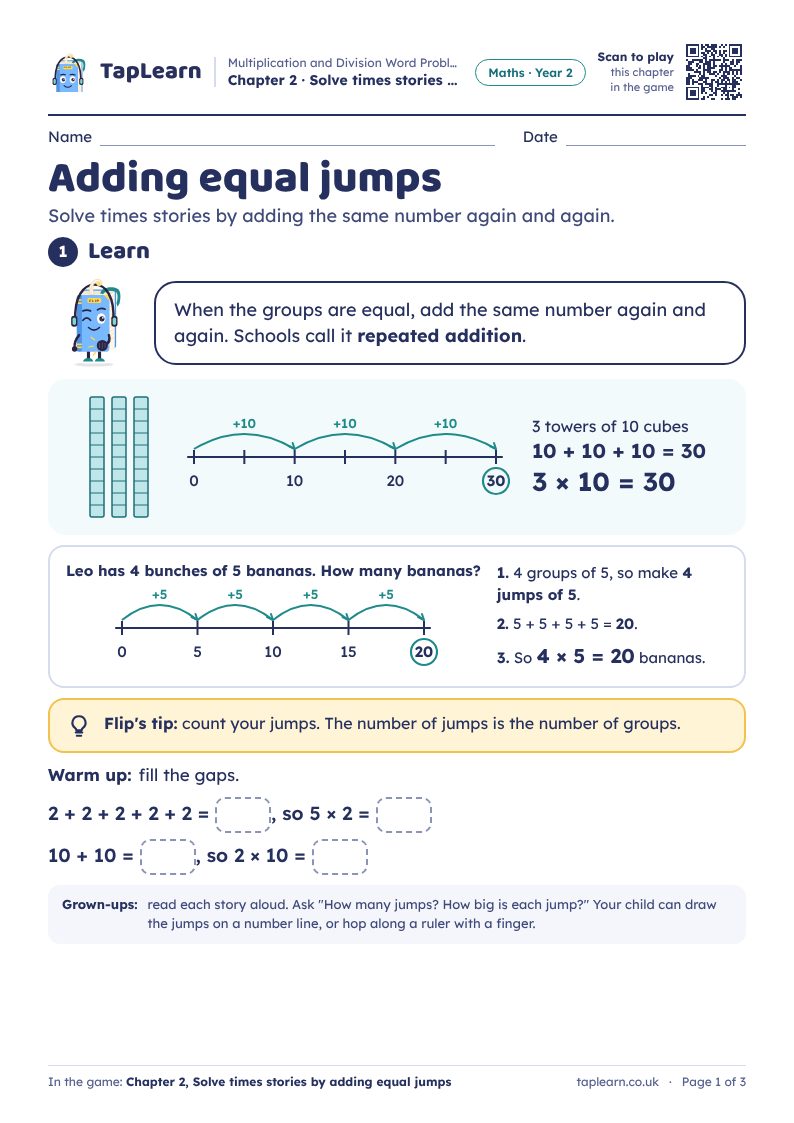
Adding Equal Jumps is a printable repeated addition worksheet for Year 2 (ages 6 to 7) that teaches children to add the same number again and again, or jump along a number line, to find a total. It covers the Year 2 maths statement to solve problems involving multiplication and division using materials, arrays, repeated addition and known facts, including problems in contexts.
This worksheet is for members
Membership opens every chapter of every game and every worksheet, for all your children.
See the plansAlready a member? Log in to print it.
Start with the free one: Equal groups (chapter 1).
▶ Play chapter 2 in the game · How the repeated addition works
Print it on A4, in colour or black and white. Do it after the chapter, or before it to see what your child already knows.
What's on the worksheet
Your child solves how-many-altogether stories by adding equal jumps (repeated addition) in 2s, 5s and 10s on a number line. Includes a story hops activity and an answers sheet.
- Page 1 · Learn
- 3 towers of 10 as 10 + 10 + 10 = 30 on a number line, a worked example for 4 bunches of 5 bananas, Flip's tip that the number of jumps is the number of groups, and a warm-up.
- Page 2 · Try it together
- Story hops: lay out scraps numbered 0 to 50 in fives, hop a toy one jump for each group as the grown-up reads a story like 6 hands with 5 fingers, then write the adding and times sentence.
- Page 3 · Practise
- Write the adding and times sentence for jumps, draw jumps for 6 pairs of socks, fill gaps, solve pen and duck-leg stories, and a challenge about 3 packs of 10.
- Answers sheet
- Every answer, mix-ups like losing count of jumps, and snack-rows and clap-jumps ideas.
3 A4 pages and an answers sheet · about 20 minutes
In the classroom
- Make a floor number line in fives and have children hop out story problems.
- Use Practise C as a mini-whiteboard check linking adding and times sentences.
Questions from the worksheet
- Draw the jumps to solve: 6 pairs of socks. How many socks?
- Fill the gaps: 10 + 10 + 10 + 10 + 10 = ___ × 10 = ___.
- Mia buys 7 packs of pens. There are 10 pens in each pack. How many pens?
- Sam says 3 packs of 10 pens make 13 pens. Is he right? Show the jumps.
The answers are on the answers sheet, for grown-ups.
National curriculum in England
This worksheet practises this statement from the Year 2 maths programme of study:
- Solve problems involving multiplication and division, using materials, arrays, repeated addition, mental methods, and multiplication and division facts, including problems in contexts
Source: National curriculum in England: mathematics programmes of study (DfE)
Using it at home
- Read each story aloud and ask "How many jumps? How big is each jump?"
- In story hops, for jumps of 10 the toy skips a scrap each time. Ask "How many jumps did it make? Where did it land?"
- Clap once for each group as you count: "5 (clap), 10 (clap), 15 (clap)".
Watch out for
- Adding the two numbers, so 3 packs of 10 makes 13.
- Ask "How many jumps? How big is each jump?"
- Losing count when counting in 2s, 5s or 10s.
- Put up a finger for each jump.
- Making one jump too many or too few.
- Start at 0 and count the jumps, not the marks.
Questions and answers
What is repeated addition?
Repeated addition means adding the same number again and again, like 5 + 5 + 5 + 5 = 20. It's another way of writing 4 × 5.
How does a number line help with times stories?
Make one jump for each group, each the same size. Where you land is the total.
Why is 3 packs of 10 not 13?
3 packs of 10 is 10 + 10 + 10, which is 30. Adding 3 and 10 gives 13, which is a different sum.
 TapLearn