Arrays worksheet for Year 2
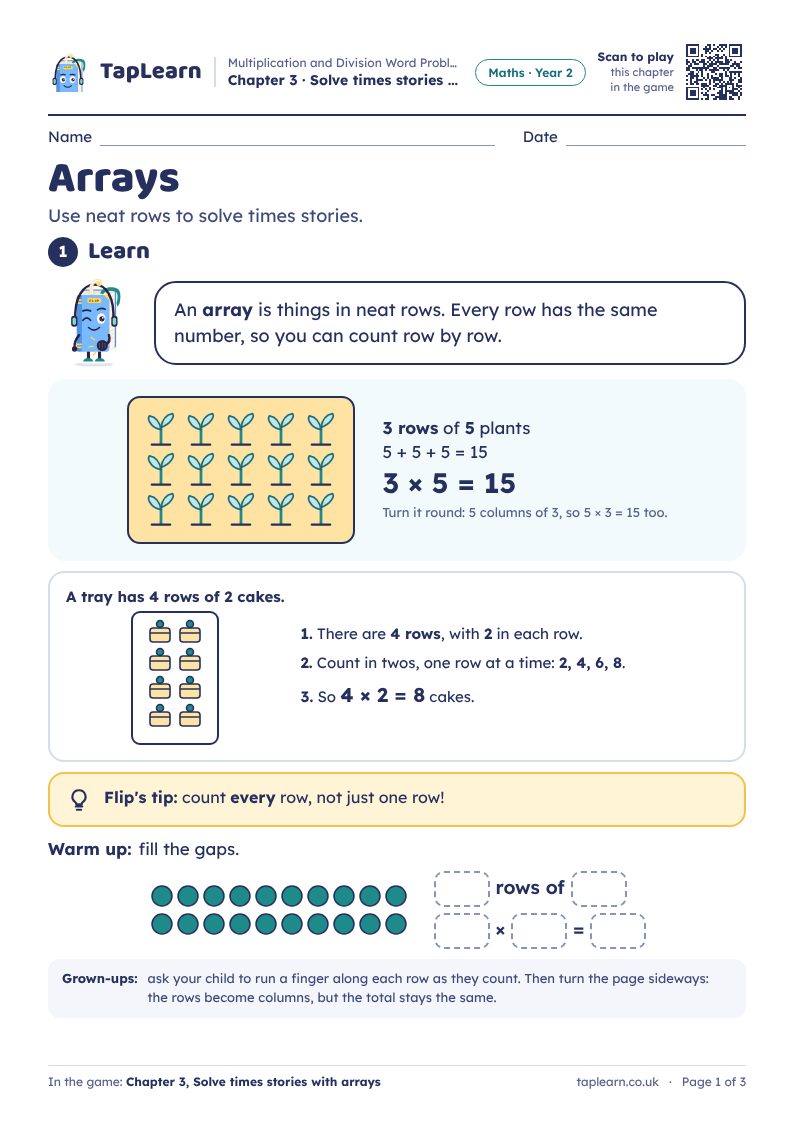
Arrays is a printable arrays worksheet for Year 2 (ages 6 to 7) that teaches children to count neat rows one at a time and see that turning an array round keeps the same total. It covers the Year 2 maths statement to solve problems involving multiplication and division using materials, arrays, repeated addition and known facts, including problems in contexts.
This worksheet is for members
Membership opens every chapter of every game and every worksheet, for all your children.
See the plansAlready a member? Log in to print it.
Start with the free one: Equal groups (chapter 1).
Print it on A4, in colour or black and white. Do it after the chapter, or before it to see what your child already knows.
What's on the worksheet
Your child solves how-many-altogether stories with arrays, counting row by row in 2s, 5s and 10s and writing times sentences. Includes a pasta arrays activity and an answers sheet.
- Page 1 · Learn
- 3 rows of 5 plants as 3 × 5 = 15 and turned round as 5 × 3, a worked example for a tray of 4 rows of 2 cakes, Flip's tip to count every row, and a warm-up.
- Page 2 · Try it together
- Pasta arrays: make 2 rows of 5 pasta pieces and count in fives, turn the plate to make 5 rows of 2, make 3 rows of 10, then make your own array and record each one.
- Page 3 · Practise
- Write times sentences for arrays, draw 5 rows of 2 chairs, solve bun, carrot and window stories, ring sentences that match an array, and a challenge about counting one row.
- Answers sheet
- Every answer, mix-ups like counting just one row, and spot-arrays and turn-it-round ideas.
3 A4 pages and an answers sheet · about 20 minutes
Using it at home
- Ask your child to run a finger along each row as they count, then turn the page sideways to show the total stays the same.
- In pasta arrays, ask "How many rows? How many in each row?" Turning the plate shows 2 × 5 and 5 × 2 make the same.
- Spot arrays at home: egg boxes, window panes and muffin trays.
Watch out for
- Counting just one row.
- Run a finger along each row and count in steps.
- Adding the two numbers, so 2 rows of 5 makes 7.
- Count the things in the array to check.
- Losing count when counting in 2s, 5s or 10s.
- Tick each row as you count it.
Questions from the worksheet
- There are 5 rows of chairs, with 2 chairs in each row. Draw the array. How many chairs?
- A garden has 2 rows of 10 carrots. How many carrots?
- Draw a ring round every number sentence that matches this array: 2 × 5, 5 × 2, 2 + 5, 5 + 5, 2 + 2 + 2 + 2 + 2.
- Leo looks at a tray with 2 rows of 5 cakes. He counts one row and says there are 5 cakes. Is he right?
The answers are on the answers sheet, for grown-ups.
National curriculum in England
This worksheet practises this statement from the Year 2 maths programme of study:
- Solve problems involving multiplication and division, using materials, arrays, repeated addition, mental methods, and multiplication and division facts, including problems in contexts
Source: National curriculum in England: mathematics programmes of study (DfE)
In the classroom
- Make arrays with cubes in pairs, then rotate them to show the matching times sentence.
- Use Practise D as a hinge question on which sentences match an array.
Questions and answers
What is an array in maths?
An array is things set out in neat rows, with the same number in every row, like 3 rows of 5.
How do arrays help with multiplication?
You can count row by row in 2s, 5s or 10s. 4 rows of 2 is 2, 4, 6, 8, so 4 × 2 = 8.
Why is 2 × 5 the same as 5 × 2?
Turn the array round: 2 rows of 5 becomes 5 rows of 2, but the total stays 10.
 TapLearn