Equal groups worksheet for Year 2
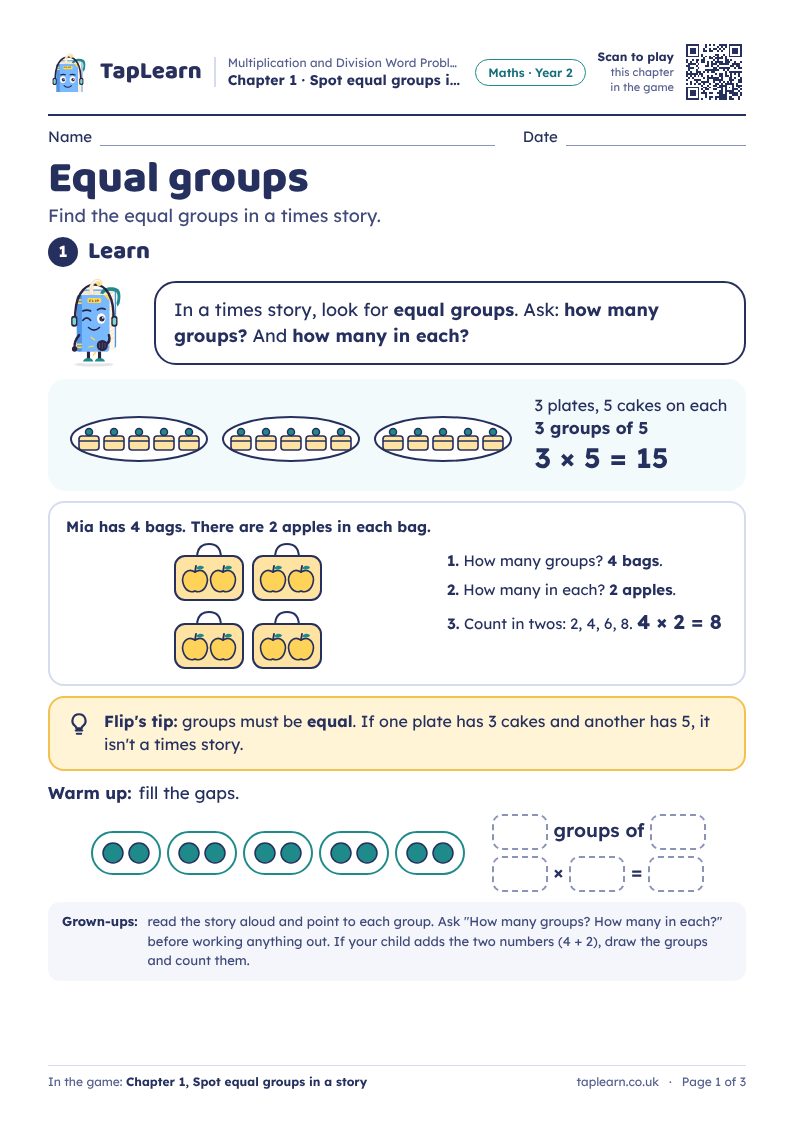
Equal Groups is a printable equal groups worksheet for Year 2 (ages 6 to 7) that teaches children to ask "How many groups?" and "How many in each?" before writing a times sentence like 4 × 2 = 8. It covers the Year 2 maths statement to solve problems involving multiplication and division using materials, arrays, repeated addition and known facts, including problems in contexts.
Free to print, no account needed.
Print it on A4, in colour or black and white. Do it after the chapter, or before it to see what your child already knows.
What's on the worksheet
Your child spots equal groups in times stories, finds how many groups and how many in each, and writes a times sentence. Includes a teddy picnic activity and an answers sheet.
- Page 1 · Learn
- 3 plates of 5 cakes as 3 × 5 = 15, a worked example for Mia's 4 bags of 2 apples, Flip's tip that groups must be equal, and a fill-the-gaps warm-up.
- Page 2 · Try it together
- Teddy picnic: sit 2 to 5 toys in a row, give each the same number of pasta pieces, say it as "4 groups of 5", count to find the total, then give one toy an extra piece.
- Page 3 · Practise
- Ring equal or not equal groups, write times sentences for pictures, fill gaps for sticker and orange stories, draw 2 plates of 5 grapes, and a challenge about adding instead.
- Answers sheet
- Every answer, mix-ups like swapping groups and how many in each, and spoons-in-cups and spot-groups ideas.
3 A4 pages and an answers sheet · about 20 minutes
Using it at home
- Read the story aloud and point to each group. If your child adds the two numbers, draw the groups and count them.
- In the teddy picnic, ask "Which number tells us the groups? Which tells us how many in each?"
- On a walk, look for equal groups: wheels on bikes, legs on dogs, windows in rows.
Watch out for
- Mixing up the groups and how many in each.
- In "4 bags of 2", the 4 is the bags (groups) and the 2 is what's in each one.
- Adding the two numbers, so 4 bags of 2 makes 6.
- Draw the bags and count in twos.
- Writing a times sentence for unequal groups.
- A times sentence only works when every group has the same number.
Questions from the worksheet
- Sam has 5 packs of stickers. There are 10 stickers in each pack. ___ groups of ___. Write the times sentence.
- Ava has 3 bowls. There are 2 oranges in each bowl. Write the times sentence.
- Draw 2 plates with 5 grapes on each. Write the times sentence.
- Ava says 4 bags of 2 apples make 6 apples. Is she right? How many apples are there?
The answers are on the answers sheet, for grown-ups.
National curriculum in England
This worksheet practises this statement from the Year 2 maths programme of study:
- Solve problems involving multiplication and division, using materials, arrays, repeated addition, mental methods, and multiplication and division facts, including problems in contexts
Source: National curriculum in England: mathematics programmes of study (DfE)
In the classroom
- Run the teddy picnic in small groups with counters and paper plates.
- Use Practise A as a quick show-me: thumbs up for equal groups, thumbs down for not equal.
Questions and answers
What are equal groups in maths?
Equal groups have the same number of things in each one, like 3 plates with 5 cakes on each. They can be written as a times sentence: 3 × 5 = 15.
How do you write a times sentence from a story?
Find how many groups and how many in each. 4 bags with 2 apples in each is 4 × 2 = 8.
Can unequal groups be written as multiplication?
No. A times sentence only works when every group has the same number.
 TapLearn