Degrees of possibility worksheet for Year 5: How sure are you?
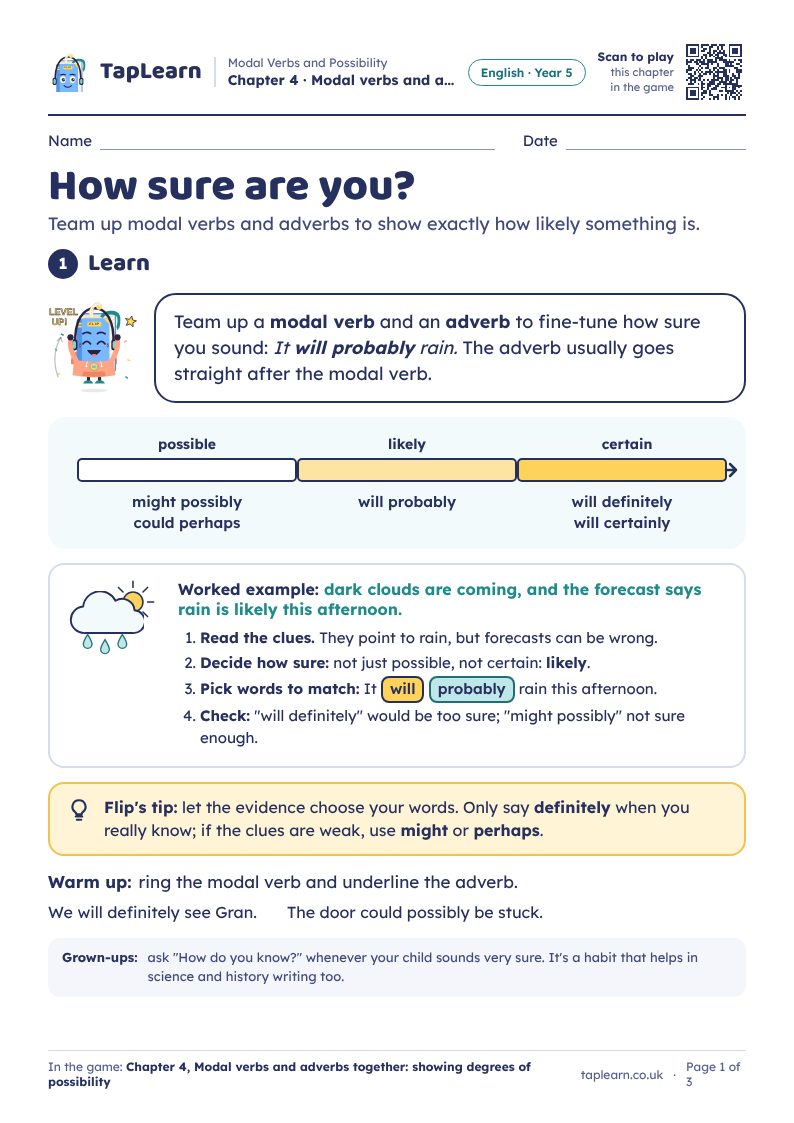
How Sure Are You? is a printable degrees of possibility worksheet for Year 5 (ages 9 to 10) that teaches children to team a modal verb with an adverb, like will probably or might possibly, so their words are exactly as sure as the evidence. It covers the Year 5 statement on indicating degrees of possibility using adverbs or modal verbs.
This worksheet is for members
Membership opens every chapter of every game and every worksheet, for all your children.
See the plansAlready a member? Log in to print it.
Start with the free one: Spot the modal verb (chapter 1).
Print it on A4, in colour or black and white. Do it after the chapter, or before it to see what your child already knows.
What's on the worksheet
Your child combines modal verbs and adverbs, like will probably, to show exactly how likely something is, and matches the words to the evidence. Includes a be-the-forecaster writing activity and an answers sheet.
- Page 1 · Learn
- A scale from might possibly to will definitely, a worked example choosing "will probably" for likely rain, Flip's let-the-evidence-choose tip, and a warm-up.
- Page 2 · Try it together
- Be the forecaster: read tomorrow's weather forecast, write a sentence for rain, sun and wind using a modal verb and an adverb, check they're as sure as the forecast, then check tomorrow.
- Page 3 · Practise
- Tick the sentence that matches each clue, judge whether sentences are too sure, not sure enough or just right, write sentences for two clues, and a challenge about a football cup.
- Answers sheet
- Every answer, mix-ups like sounding too sure, and how-do-you-know and story-detective ideas.
3 A4 pages and an answers sheet · about 25 minutes
Using it at home
- Ask "How do you know?" whenever your child sounds very sure. It's a habit that helps in science and history writing too.
- In be the forecaster, a low chance of rain suits "might possibly" and a high chance suits "will probably". Hardly any weather is "definitely"!
- While reading, guess what will happen next with "will probably" or "might possibly".
Watch out for
- Sounding too sure, using definitely or must when the clues are weak.
- Ask, "How do you know for certain?"
- Not sounding sure enough, using might possibly when the clues are strong.
- Ask, "What do the clues tell you?"
- Putting the adverb in an odd place.
- The adverb usually goes straight after the modal verb: "will probably rain".
Questions from the worksheet
- Read the clue. Which sentence matches it? Clue: Leo has practised every day, and he won the last race. Leo might possibly win. Leo will probably win. Leo will definitely win.
- Is the sentence too sure, not sure enough or just right? Clue: the cake went in 2 minutes ago; the recipe says 30 minutes. "The cake will definitely be ready now."
- Write a sentence for the clue, using a modal verb and an adverb: the bus is nearly always on time, and the app says it's 2 minutes away.
- Before the football season started, Sam wrote: "Our team will definitely win the cup this year." Is definitely a good choice? What would you write instead, and why?
The answers are on the answers sheet, for grown-ups.
National curriculum in England
This worksheet practises these statements from the Year 5 english programme of study:
- Sentence: indicating degrees of possibility using adverbs or modal verbs
- Develop their understanding of the concepts set out in English appendix 2 by: using modal verbs or adverbs to indicate degrees of possibility (Years 5–6 english)
In the classroom
- Write a class weather forecast using modal verbs and adverbs.
- Use Practise B as a too-sure, not-sure-enough, just-right discussion in pairs.
Questions and answers
What are degrees of possibility?
Degrees of possibility are how likely something is, from possible to likely to certain, shown with modal verbs and adverbs.
Can you use a modal verb and an adverb together?
Yes. Teaming them up fine-tunes how sure you sound: "It will probably rain." The adverb usually goes after the modal verb.
How do children choose the right words for possibility?
Let the evidence decide: only say definitely when you really know; if the clues are weak, use might or perhaps.
 TapLearn